In today’s fast-paced digital landscape, system integration is a critical component of any successful project. However, integrating multiple systems can be a daunting task, fraught with security challenges and complexities. A recent meeting delved into the intricacies of system integration, revealing valuable insights and recommendations for navigating these challenges.
One of the primary hurdles faced by the team was the conflicting file formats required by different systems. The RAG system, a critical component of the project, requires unencrypted files, while the current system stores PDFs in an encrypted format. This disparity poses a significant obstacle to seamless integration, highlighting the need for a holistic approach to system integration.
The integration of Neo4j, a system used for storing knowledge graphs, further emphasized the importance of balancing security and functionality. The team recognized the need for data encryption or restricted access to ensure the integrity of the stored information, which directly impacts the overall security posture of the system.
Effective project management and proactive planning were also identified as crucial elements in preventing project delays and blockages. The timely setup of GitLab, a critical tool for the project, ensured that the team could continue working on the project without any interruptions, underscoring the importance of administrative updates.
The meeting’s key takeaways revolved around the need to reconcile conflicting file formats, the requirement for data encryption or restricted access in Neo4j, and the importance of proactive planning and coordination. The team’s strategic direction is focused on addressing these challenges, with team members working on researching encryption storage solutions in Neo4j and integrating with the RAG system, as well as restoring GitLab functionality and secure system integration.
The meeting’s insights and recommendations serve as a valuable reminder of the importance of system integration. Conducting a thorough risk assessment to identify potential security vulnerabilities, developing a comprehensive plan for encryption solutions in Neo4j, and establishing a clear communication plan are all critical components of successful project management.
By acknowledging the complexities of system integration and adopting a holistic approach, project teams can navigate the challenges of security and functionality, ensuring the success of their projects.
In a recent meeting, project leads gathered to discuss the direction and progress of a cutting-edge project aimed at revolutionizing industries. The meeting covered a range of crucial topics, from market strategy and algorithm developments to data management and opportunities. Here’s a glimpse into the key takeaways and strategic direction that emerged from this meeting.
**Listening to the Market**
The project team recognizes that understanding market needs is crucial to success. Feedback from participants will play a vital role in shaping the direction of the academy, which will, in turn, drive innovation in the industries.
**The Power of Algorithms**
Discussions highlighted the critical importance of data algorithms in processing performance metrics. This emphasis on algorithmic advancements will enable the platform to make data-driven decisions and stay ahead of the curve.
**Real-Time Data: The Key to Success**
The meeting underscored the need for real-time data collection and analysis to ensure the platform’s success. By leveraging real-time data, the project can create a robust and responsive system that meets the evolving needs of its users.
**Forging Partnerships**
The meeting evaluated various partnership strategies, recognizing that collaborations with experts will drive innovation and growth. By forming strategic alliances, the project can tap into the expertise and resources needed to stay ahead in the industries.
**A Clear Strategic Direction**
The project is positioning itself as a matchmaker for the industries, aiming to create network effects and build an installed base. By leveraging cutting-edge technology and integrating external data sources, the platform will drive insights and innovation, ultimately transforming the industries.
**The Road Ahead**
To achieve its objectives, the project team has outlined several key action items. These include organizing a workshop, developing a migration plan for the platform, and implementing learning approaches to process user feedback. The team will also work together to establish collaborations and improve data visualization on the platform.
As the project moves forward, it’s clear that a commitment to evidence-based decision making and innovative partnerships will be crucial to its success. By staying focused on its strategic objectives, the team can drive innovation and create a transformative impact on the industries.
As we continue to drive innovation in the platform’s development, our recent Strategic Planning Meeting brought together key stakeholders to assess progress, discuss challenges, and chart a course for future success. This meeting was all about aligning our project’s various components to ensure a cohesive approach to platform development.
**Understanding Market Needs: A Key Focus Area**
We kicked off the meeting by delving into the world of market strategy and feedback. Analyzing participant feedback, particularly from the Asia Pacific markets, highlighted the importance of understanding market needs and adapting our platform to cater to diverse regions and user requirements. This insight will be crucial in shaping our platform’s development and ensuring we meet the needs of our users.
**Algorithmic Advancements: The Power of Data Processing**
Our discussion on algorithmic advancements in data processing was particularly enlightening. The integration of hardware and software is critical to enhancing user interaction and experience. Moreover, our platform’s capabilities as a “matchmaker” for sports medicine and logistics were underscored, emphasizing the importance of real-time data analysis.
**Federated Learning: Building a Network Effect**
We introduced the concept of federated approach to improve user feedback processing through collaborations with experts in machine learning, sports medicine, and healthcare providers. This approach aims to create a network effect, building an installed base, and fostering partnerships with experts and inclusive teams. This collaboration will be pivotal in driving our platform’s success.
**Platform Development: A Focus on Visualization and User Interface**
The meeting concluded with plans for the platform’s development, emphasizing migration strategies and innovative practices for better data visualization and user interface. Action items were assigned to ensure progress, including organizing a workshop for data visualization improvements and evaluating how to visualize data on the platform.
**Key Insights and Recommendations**
Our meeting demonstrated a strong focus on understanding market needs and adapting our platform to cater to diverse regions and user requirements. The importance of algorithmic advancements, data processing, and real-time data analysis was emphasized. We highlighted the platform’s capabilities as a “matchmaker” for sports medicine and logistics. The federated learning approach and partnerships with experts will play a crucial role in the platform’s success. Finally, our platform’s development and growth will rely on innovative practices for better data visualization and user interface.
As we move forward, our priority should be to develop a tailored approach for users, focusing on creating a network effect and building an installed base. The integration of wearables, research databases, and external data sources will be crucial in enhancing our platform’s success and growth in the market. By continuing to explore innovative practices for better data visualization and user interface, we can ensure our platform remains on track for success.
In a recent meeting, our team tackled a critical authentication issue that prevented access to our system. The problem was rooted in an incorrect setup of two-factor authentication, which sparked a thorough investigation and brainstorming session. Despite exploring various methods to bypass the authentication requirement, the team was unable to access the account without the authentication code.
The meeting highlighted the importance of correct setup and management of two-factor authentication. A simple mistake can have far-reaching consequences, disrupting team workflows and impacting business continuity. Our team’s diligence in identifying the root cause of the issue demonstrates a commitment to resolving critical issues promptly.
The collaborative approach to resolving the issue was impressive. The meeting showed that effective communication and teamwork are essential in overcoming technical challenges. By involving IoT interns in the resolution process, our team is taking a proactive stance to addressing the problem. This collaborative approach will help minimize disruption to the system and ensure business continuity.
One of the key takeaways from the meeting is the need for proactive issue resolution. By focusing on resolving the issue promptly, we can prevent similar problems from arising in the future. The meeting’s strategic direction is focused on quick recovery of the existing account, while also considering the creation of a new account to ensure business continuity.
In conclusion, the meeting demonstrated the importance of correct setup and management of two-factor authentication, collaborative problem-solving, and proactive issue resolution. By working together and prioritizing critical issues, our team can ensure the smooth operation of our system, even in the face of technical challenges.
In today’s fast-paced development landscape, it’s easy to get caught up in the excitement of new features and integrations. However, it’s equally important to take a step back, assess the bigger picture, and prioritize a strategic approach to integration. This is precisely what our team did during a recent daily stand-up meeting, and the results were truly insightful.
**Breaking Down Complex Integrations**
One of the key discussion points centered around the integration of a popular fitness tracking platform. Rather than diving headfirst into a complex API integration, our Integration Lead proposed an iframe option to test the waters, so to speak. This thoughtful approach allows us to incrementally integrate new features, ensuring a smoother user experience and minimizing potential bugs.
**The Importance of Adaptability**
Our team also explored an alternative development tool, which has been successfully used locally for reasoning and code snippets. Rather than sticking to the status quo, we decided to contact the support team of our development tool and explore the alternative option. This willingness to adapt and explore innovative solutions may lead to more efficient development workflow and better issue resolution.**
**Prioritizing Quality Assurance**
During the meeting, we reviewed a pull request related to fixing a camera bug in the health form and its connection to the chatbot. Rather than rushing to move it to staging, we emphasized the need for thorough testing to ensure a high-quality user experience. This attention to detail is crucial in minimizing potential bugs and ensuring our users have a seamless experience.
**Collaboration and Accountability**
One of the standout aspects of the meeting was the clear division of tasks and responsibilities. Our Integration Lead will contact the support team, our QA Lead will review the pull request, our Development Lead will merge it, and the team will collectively push changes to the main branch at the next meeting. This clear accountability ensures progress towards resolving issues and integrating new features.
**Takeaways**
This meeting highlighted our team’s commitment to:
* Breaking down complex integrations into manageable, incremental steps
* Exploring alternative tools and strategies to overcome challenges
* Ensuring thorough testing for a high-quality user experience
* Collaborating with clear division of tasks and responsibilities
By prioritizing strategic planning, adaptability, and collaboration, we’re confident that we’ll continue to enhance the user experience and exceed expectations.
In today’s fast-paced world, staying ahead of the curve requires collaboration, innovation, and a commitment to progress. Our recent standup meeting served as a testament to the power of teamwork, showcasing individual and project team updates that demonstrated our strategic direction.
**Individual Brilliance, Collective Excellence**
Our team members took center stage, sharing updates on their projects that highlighted their unique skill sets and expertise. From resolving implementation issues to optimizing chatbot responses, each team member demonstrated their dedication to precision, attention to detail, and adaptability. The meeting underscored our team’s diverse capabilities, emphasizing our ability to tackle complex projects.
**Project Updates: The Heart of Our Operations**
Project team updates provided a deeper understanding of our projects’ progress. Our Content Creator advanced a blog post, showcasing our content creation capabilities, while our UI/UX Team debugged designs, demonstrating our focus on user experience and interface excellence.
**The Future of Innovation: Leveraging High Compute Resources**
Our Infrastructure Specialist encouraged the team to think outside the box, proposing innovative ideas for leveraging high compute resources. This initiative exemplifies our commitment to cutting-edge technologies and their potential uses. We believe that exploring new possibilities will drive our success and propel us forward.
**Our Strategic Direction: The Path to Success
Our meeting revealed our strategic direction, focusing on:
* Developing innovative solutions
* Enhancing infrastructure and technology capabilities
* Improving user experience and interface design
* Exploring new integration opportunities
* Fostering collaboration and knowledge sharing among team members
**Action Items and Accountability: The Keys to Progress**
The meeting concluded with clear action items assigned to specific team members, ensuring accountability and responsibility within the team. This approach enables us to track progress, address potential roadblocks, and achieve our objectives.
In conclusion, our standup meeting was a testament to the power of collaboration, innovation, and progress. By leveraging high compute resources, enhancing infrastructure and technology capabilities, and improving user experience and interface design, we are poised to unlock success and drive innovation forward.
The technological approach to a more sustainable future will most likely lie in harmonizing BACnet and IoT underneath a BACnet umbrella, utilizing Haystack and the likes to get things to talk together in a better way and to make it easier to apply analytics as well. Part 1 of 2
Part 2 of 2
Enabling an open innovation platform for the Real Estate sector
The thing is, we just want to make people healthier, to help reduce global heating faster than ever before, as well as democratizing smart city innovation for the greater good on a global scale of course. Luckily, we think we’ve found the recipe!
The technological aspects were the focus in my last post, and this time I’ll elucidate more on the business side of things. I copied a couple of questions below from my previous post, which hopefully will get you up to speed faster.
What if Real Estate owners could get their buildings connected, up to a point. And then let others innovate with their assets in a standardized way?
And what if end users could come up with the solutions themselves? We are already providing open modular hardware towards system integrators and the maker space, but what about the tenants? Is there a way to get them involved them in this space as well?
This will be the focus of this article; Enabling an open innovation platform for the real estate sector.
The current state of things
Death by 1000 cuts is not only about the technological integrations that need to happen in order to squeeze out value from existing buildings. It is also about the business models that exist today and where data resides.
The lay of the land today is that system integrators are locked into global giants who want them to use their products exclusively. Which in turn locks in system integrators into their respective solutions and their customers into whatever brand, make, their maintenance guys are comfortable with, which leads to little or no room for innovation, except limited to the hands of the global giants.
BASs that use interoperating controllers from multiple manufacturers (except within the Tridium platform, but that’s a unique case) continues to be an (unfortunate?) rarity.
Tridium and the Niagara framework have fantastic solutions, no doubt. And wherever we go, people are using it. But even though they do the harmonization, everything is tied to their proprietary system underneath. And what this does, is that locks in everyone to their platform making it difficult for others to innovate on, and with, buildings today.
One of the major reasons why the industry has been slow to change is that the traditional business models are mostly about fixing stuff that has broken down. Or visits to sites, not based on real data, but of scheduled maintenance visits. Money gets paid by the time you take to fix stuff, and not so much the value of the service.
And on the other side, we see cool sensor solutions which fix a certain need. But this business model is not sustainable either, and there will be certain death by 1000 cuts, that’s guaranteed.
Real estate owners, consultants, service providers, IoT companies, Energy Management providers, system integrators and tenants have everything to gain by engaging in a more open, and platform-oriented business model. Companies have to disrupt themselves, but that in itself is a hard nut to crack for any industry. Surveying the landscape of companies out there, the only must-haves are the ones owning real estate themselves.
But therein lies the largest challenge, in that they don’t really want to digitize with their assets, because most of them don’t see any reason to do so. This is certainly not their fault, but rather other companies, not being able to show where the value actually is, and why digitalization is a must. And that is the key to the future. To be able to show how the platform economy will spark an era of collaboration, desperately needed to get faster to innovation when working with buildings.
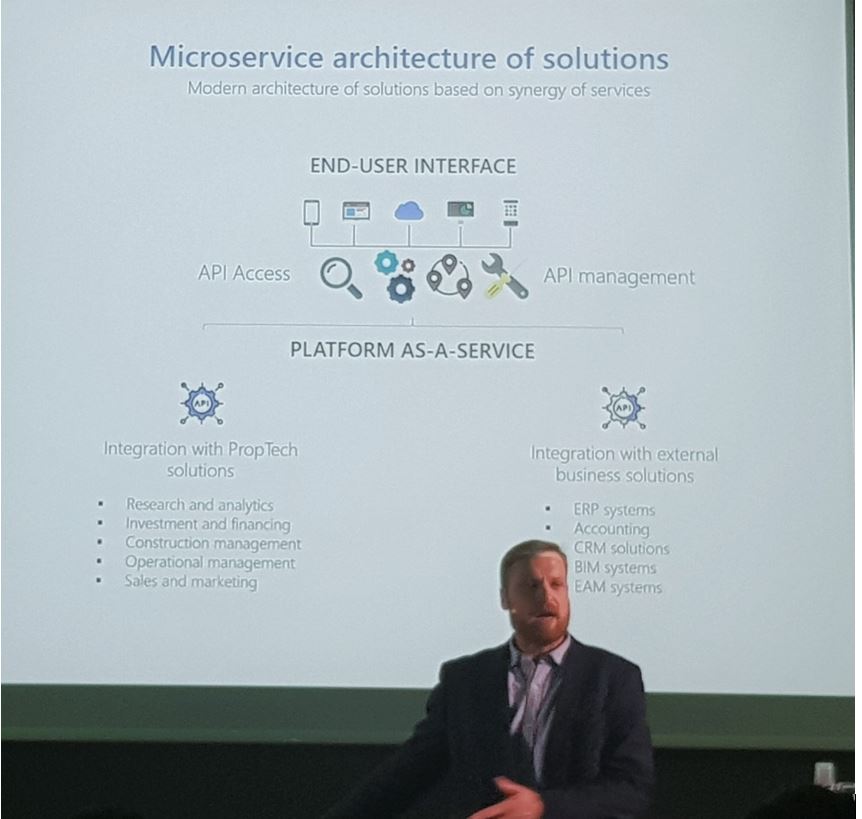
Recently, while attending an event focusing on Real Estate, Architecture and Construction, at Recotech at Slush in Finland, the platform economy was the talk of the town.
Figure 1. Detailing the platform-as-a-service concept – Ivan Nokhrin
Black boxing buildings in terms of technology and opening one API to everything is indeed vital in order to create a standardized path towards the future. This opens buildings for the world of not only analytics but also services to be created in a standardized way on top.
But what does it really mean? And who should be in charge?
An open innovation platform for… everyone?
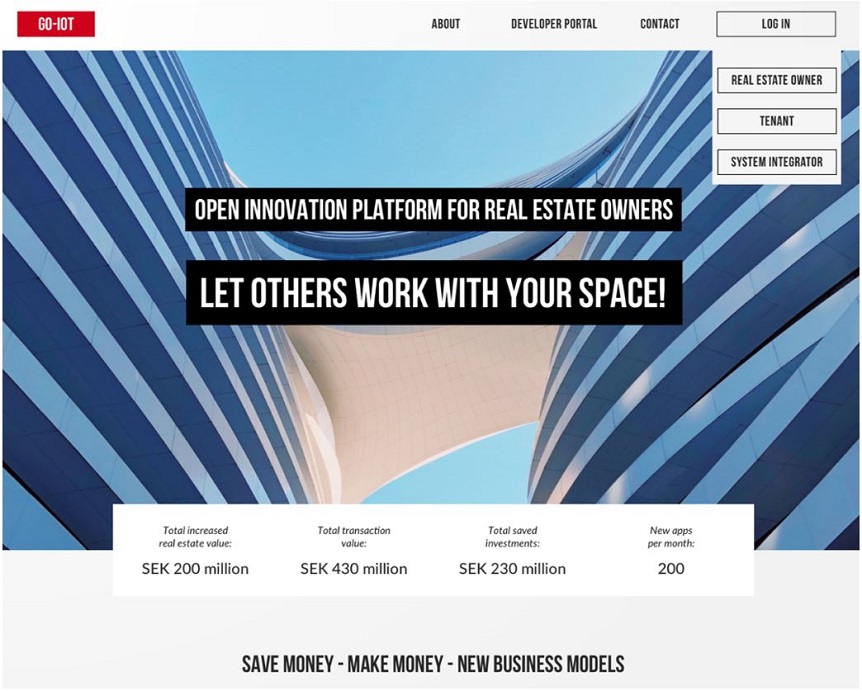
Having seen the separate worlds and need for harmonization between new technology and existing technology in buildings during the last year, we felt that something needed to be done. We got a very progressive real estate owner onboard, Uppsala Kommuns Fastighetsbolag, who wanted to digitize their assets with Manne Johansson in the lead. In this process, we also managed to get a development firm, Devies, to understand the potential of the platform economy quickly, and an app store for buildings approach. They were quick to develop the onsets of an MVP of the platform to be.
Figure 2. An open innovation platform for real estate owners
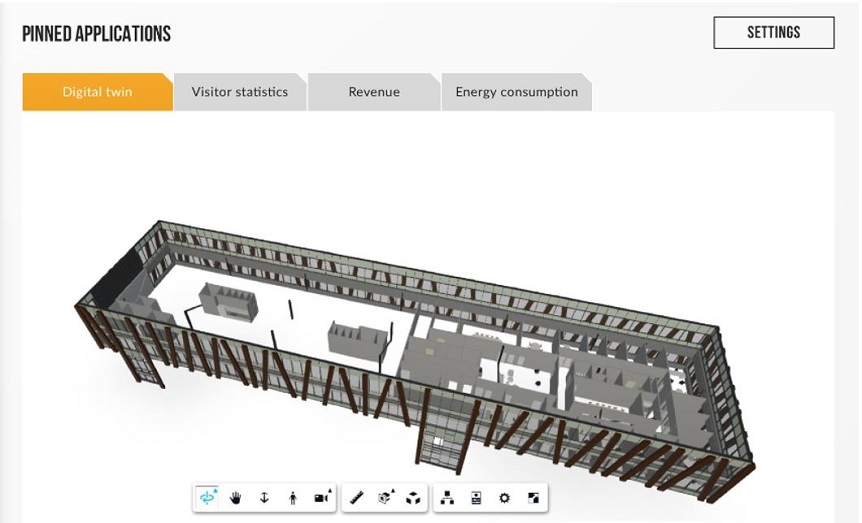
The real estate owner’s idea, which we have the technology for, is to combine the digital world with the physical. The digital twin concept is in focus, and we have partners signed up to convert any physical space into the digital realm. And during our initial discussions, we could see a need for transparent and aligned business processes from a vertical and horizontal perspective, inside and outside of the company — increased efficiency, platform-based automation and integration of solutions as well as more modern applications for any user.
“The focus should be on a fluid interaction between the digital and the physical, viewing technology as an enabler for an improved quality of life and a more vibrant city.” – The building whisperer
They have also seen the need of collaborating amongst different stakeholders with their buildings in focus. But instead of just tying documents to certain assets, they want to leverage the digital twin concept and pool all work around the real/digital assets. And this is exactly why we are utilizing a part of the world’s leading automation protocol as “an adapter” to get data in and out of buildings in a standardized way.
Tying ERP Systems, CRM Systems, Accounting, BIM, EAM systems, together with the existing portfolio has never been easier, and this is exactly what their intent is. And, obviously, we are finding this really exciting, because this is exactly what BACnet Web Services is made to do! (NB. The article is from the legend Steve Tom, Ph.D., P.E, and was written in 2004!)
Figure 3. Digital twin of one of the areas of a Mall in Sweden
One of the first things we are in talks of doing next year is to bring all their buildings into the cloud, reaching a normalization of digital maturity. We have already done this for over 500 buildings in Norway, working closely with system integrators.
The benefits of the platform economy are to easily attach any services outside the traditional BAS-world into the world of BAS, thus making any building Cloud-, and Go-IoT – ready.
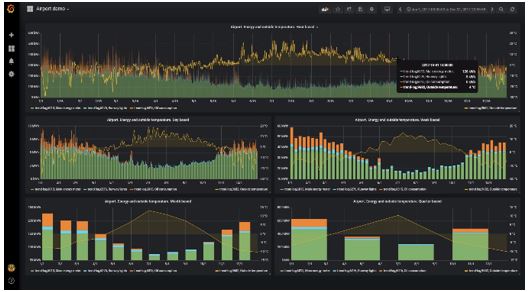
We enable this with our software stack attaching sensor data from anywhere, and black boxing it together with existing data, thus allowing for split-second visualization and analytics. Below is a screenshot from our video enabling Grafana reading data from BACnet objects, in this instance, BACnet trend logs.
Figure 4. Grafana visualization from 8 years of Airport data
We have also done this with Node-Red, DGLux, and we are partnering up with dozens of companies right now in order to get the best package solution for our customers. Because that is what is the logical solution to the 1000 cuts problem: a platform for everyone, democratizing smart building, and city innovation.
But who should be in control?
Is there such a thing as controlling the platform economy?
Talking to especially real estate owners, we see that the “you can do everything approach” doesn’t work. And the “death by 1000” cuts approach doesn’t cut it anymore either. Well, that’s not true. It does, and that is the problem. New entrants might not have felt it yet, but the ones with some foresight will see that there will be integrations challenges down the line.
By enabling an open innovation platform on top of buildings, we can easily see a lot of interesting benefits. At first glance, it might be for real estate owners primarily, but I would argue that there’s more to meet the eye.
System integrators, FM companies, as well as any “IoT – Proptech” company are facing integration challenges everywhere. Bringing up older buildings to make them wise, is everything but easy. Therefore, a platform economy means that there will be a standardized way of integrating to all buildings. And what this does is that it opens tremendous opportunities for everyone that has an interest in the future of buildings and services, not only real estate owners.
Benefits with the platform economy
Real estate owners will be in control of their past, present and future data and applications
They can invite others to their API instead of falling into the API-Hell as discussed before
Access all buildings data from the cloud, the edge, wherever, in a secure way
In addition to inviting others to innovate with their buildings, they can also now invite dev companies and write applications for themselves in whatever language they want
Real estate owners will get the power away from proprietary solutions and path dependency, not having to ask others to do things with their own data, moving towards path creation.
Applying Machine learning and AI much faster both in the Cloud and at the edge, incurring energy savings faster than ever before, as well as speeding up the time for new insights.
There’s no end to the possibilities, and the best part is that it speeds up the time for value creation when innovating with buildings.
Tenants themselves might also get invited to an API for their building, developing an interface to control lighting, room temperature, you name it, for themselves, and other tenants. Talk about Edge-ification!
Real estate owners can focus on what they do best, and any solution provider will be able to do what they do best, not having to worry about messy integrations. FM companies and technical managers will have a field trip integrating newer technology with existing building automation systems in a standardized way.
And everything will be open, transparent and utilizing the digital twin concept. Definitely a New Deal 4 Buildings, and people!
Innovation for the Nation(s)
The potential to include other metrics such as weather data, accounting, energy, etc., becomes a breeze. Managers will get answers to questions such as;
“How often does someone use our conference rooms when the temperature outside is above 25 degrees Celsius”?
“How much space utilization do we have today in buildings worth more than $10Million, and where the sun is shining?”
“How much money could we make if we increase space utilization by 10% and extend usable hours by 20%, in all of our___*insert type room*?”
These are questions that not only will be answered easily across the portfolio, but they will also be tied to digital twins, enabled by the platform economy.
Let’s say we have 100 buildings; all commercial buildings, with some level of digital maturity. And we buy into the “Smart Building as a Service” – approach. What’s next? We get the platform in place, and it comes with 6 services from different vendors. One could be energy analytics provided by company A. The next lighting control by company B. Strategic consultancy around anything related to their buildings in an agnostic way, company C. BIM/Digital twin creation through company D. And classic Energy Management system as company E. And traditional system integration from a Mass System integrator, company F.
Everything tied to one platform from the top, and with data streaming from all buildings from the edge. Since it is a seamless experience from the edge to the cloud, and with traditional BAS and IoT-> services, sensors, there’s logic to be made to the portfolio, instead of just buildings. And companies are not tied to proprietary solutions anymore, and they can mix and match completely because all the technical stuff will be taken care of.
New ways of making money
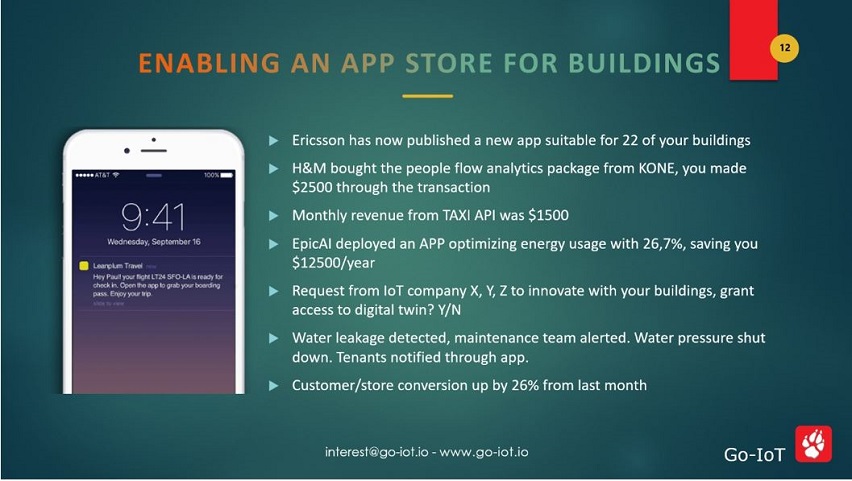
Digitizing real estate utilizing the platform economy opens up new ways of not only saving money by making processes more efficient; one of the most exciting prospects of having an App-Store for buildings is that it opens up dramatic ways of making money as well. Offering new solutions through partners to tenants or any customers in the portfolio will incur new ways of looking at building innovation.
Tenants will get a better experience and be more likely to stay
Future tenants wanting to hire will have better tools, applications at their disposal and would favour a “smarter” building more than a traditional one
Solutions will go through the platform, instead of directly to customers which allows for new ways of making money through revenue sharing
By getting access to more data from real estate assets, insights can be made, as well as the opportunity to sell data. Banks, insurance companies, estimators, and anyone else that could utilize real estate data in order to make their life easier.
Figure 5. Making money on buildings while sleeping
Making money while sleeping will be the new norm for buildings and we’ll see a shift in real estate value increasing innovation and data generation. This will create a win win win for companies, people, climate and everyone living in cities today. I am sure of it!
Final words
What would you do if you could wish for applications to utilize at work, at home, at the hotel? I for one would love to have personalized lighting and indoor climate settings that I could control at the office, through voice commands of course, if need be.
The solution to the Death by 1000 cuts problem is that companies need to define their box, and if not willing to step out of it, damn sure find someone to partner up with that does. Being close-minded won’t last for long, and there’s so much value to be created on top of buildings that it blows my mind. Just imagine the economic benefits we’ve seen with the platform economy for phones, cars, hotels, etc. Imagine what people could do with a building if it was easy enough to innovate on it.
The technology is here to do all that is required, but the solutions need to be closely tied to that of a business case, and people need to collaborate more. One big question that will come up more and more is
-“How much data per square feet/meter are you utilizing and what’s the cash to data ratio per square meter”?
That’s a question I don’t think many companies can answer today. And the way we’ll be able to answer it will be through collaboration. Getting people in the same room from different disciplines is the key. And hopefully, that room is perfectly ventilated, with outstanding CO2 levels. And if not, let’s pray we have the possibilities to change it fast.
As always, don’t just sit around talking, and reading. Go out there and do something! That’s the only way to learn, and magic happens when collaborating with others.