Aiming For Faster Time to Value Creation

Sinclair:   Hi Mr. Building Whisperer, how are things over in Sweden? I see you everywhere these days. Podcasts, speaking engagements, new companies and of course articles for Automatedbuildings.com. How do you find the time?

Waern:  Hi Ken! Things are great. Just enjoyed a couple of days of warm weather here which is partly why I’m again late with the submissions. In regard to the podcasts and whatnot, I just try to give back to the community when I can and hopefully it can lead to faster time to value creation for some.

I’ve worked hard again this summer with only a couple of days of vacation, which is everything but sustainable. Entrepreneurship has its ups and downs for sure with extreme highs, and unfortunately also extreme lows. What keeps me going is the vision that I want to give back to the community who’s been extremely open to share their views with me. And it’s important to find time for my family because that’s what matters. We are also moving to a new place this week, it’s my eldest five-year birthday tomorrow and I’m in the middle of the start of a new company, plus some initiatives so… yeah. I don’t actually know how I find the time!

Sinclair:   Work-life balance. Aren’t you supposed to be the best country in the world for that?

Waern:  That seems to be true, but there’s an exception for every rule right? We have it great here of course, but it’s also why I want to give something back and work hard because I can. Not everyone is as lucky as I am, so I owe it to them to make the most of it.

Sinclair:  Fair enough! So, what’s going on with everything? You still haven’t answered my questions in my other emails? Do you want to do that now?

Waern:  Sure, why not! It resonates a bit with the BB-cycle from last months column as well. So, what have we got – By the looks of it, we have:

  • 5G
  • LoRa
  • Cloud
  • OPC UA
  • MQTT and….
  • Quantum Computing

Okay, I’ll try to keep this short.

5G in buildings- no. 4G and others seem to be better still, and there’s much to do with resiliency in the whole scheme of things. Outside buildings, acting as the gateway of sorts between the building and something else, yes, in some places why not. Some great comments here from a post shared by Richard Dempers at Rheinberry Ltd.

LoRa and LoRaWAN is something I’ve been discussing before. I believe it will have some benefits for slow-moving data where it’s not critical and possibly also one-directional with low packet sizes. LPWAN, in general, is great for some things, but not all, and IMHO not especially for smarter buildings.

I believe much more in high-through-put sensings, such as BACnet/Mesh which handles massive data loads without missing a beat and is also interoperable with anything IP out of the box (Modbus, BACnet etc).

Here is a good discussion and figures from Conectric and Phillip Kopp regarding the vast difference between slow-moving technologies and their stuff.

Cloud – OPC UA- MQTT. Well, the cloud is something I think that everyone will be using more and more, even for OT applications. However, more and more stuff will stay at the edge as well as previously discussed. A data strategy is my answer to cloud. What goes where, how often, who will access it, where will the analytics and fault detection take place and so on.

OPC UA is for me, similar to BACnet, in the sense that it’s a protocol that takes data out from Industrial PLCs and gets it to wherever it needs to go. It’s legacy, and it works. But, here’s the cool thing that I’m doing with my new initiative.

We have managed to remove the OPC layer completely and send and receive up to millions of messages per second via Kafka streams instead of using the old horse and carriage to get data through. MQTT is a publish-subscribe protocol that, in my mind sits at the top of the IP layer getting messages in and out in a fast way. Traditionally, BAS/BMS and buildings haven’t had the need for high throughput data to go in and out. But now, when we see that more things are getting connected, and more data is needed to get more accurate predictions, I see that BACnet and the likes will have its place. But it will be augmented by more modern technologies, making it easier to come in, get data to a streaming platform and write applications on top.

Sinclair:   Very interesting, indeed. These “Kafka Streams” are new to me, can you explain a bit more?

Waern:  Well, Apache Kafka is an open-source streaming platform that is used to manage the exchange of data between systems and to process data in real-time. It is event-driven and can handle enormous data-transactions. We are using it today to get data out of basically any data source, and we have a library/catalogue of connectors for Oracle databases, A wide variety of industry-leading vendor PLCs, SCADA systems, OPC UA, Modbus, and a whole lot of other sources as well via partner companies. Kafka is the straw which you put into the data source, getting data in and out, and it leads to a streaming platform.

There were some bullet points on the www.zaniio.com website, but I managed to delete the content today when I was merging some additional domains into the backend. Luckily for our customers, I’m not the one in charge of development work…

Sinclair:   Okay, so it’s being used to normalize data from wherever it is coming from? And how do you manage all of these data streams? It sounds like a daunting task!

Waern:  Yes, that’s exactly what Kafka is. Just something to get data out of something else, get it to a real-time streaming platform where you can add schemas, tagging and build applications on top.

Managing all of the data streams is indeed challenging, but we have partnered up with the best companies in the business that will help manage all of these streams, make queries, and act as the lense into everything that goes on.

Sinclair:   And this Kafka business, does it have to have anything to do with Quantum Computing?

Waern:  Right now, nothing as far as I know. But ask me again soon, and we’ll see…

In all honesty, the reason why I included Quantum Computing was that one of my idols at Contemporary Controls mentioned it in one of the emails that got sent around for the (not so) young guns preparing for the next AHR Expo. Zach Netsov might be the only young gun on that panel, and I’ve been super impressed by him and his work at CC since I met him the first time in Chicago 1,5 years ago.

I’m not going to steal his thunder, but quantum computing is pretty cool stuff in that it can have true or false states going on at the same time, allowing it to crunch numbers and solutions in ways that we can’t even begin to understand. At least I can’t!

I’ll have to wait until Zach decides to connect QC with BAS to see where his thoughts lie.

Sinclair:   From pneumatic to Quantum Computing… yeah, let’s see when he can connect those two! Any last words?

Waern:  It’s really a stretch I think from where we are today to what will happen in the next 10 years. We’ll see how far IT can go into the OT layers and what will happen with this paradigm shift and convergence that is happening today.

Last words.. hmm. What will happen next month is that I’m a speaker at the De-Days conference in Mallorca on the 24th-25th of September. I will either talk about the Digital Mall concept, which I’ve discussed before or some of the stuff I’ll be doing with the streaming platform tech. Or something totally different. And I’m going to help some companies with ecosystems-strategies, IoT Platform strategies, and also have headed up this new initiative and… also find time to move into a new house!

That said, thanks for all your wisdom, Ken, you are the best. And to your readers, just let me know if you need any help with anything. And whatever you do, just do it – there’s no time like the present!

Sincerely,

/The Building Whisperer –
Nicolas Waern

From iPhone to iBuilding

– Smartphone Journey = Smart Buildings Journey?


How do we change this world for the better through the power of smarter buildings? How do we do it faster than ever before? What tools are necessary to speed up the rate of how we transform buildings, and who should be the intended user of said tools?

I love technology. For the ones that have read my previous articles, I think that’s quite evident. Building automation, as we know it, is becoming more and more digitized. IT/OT and soon IoT convergence where Facility IT and security is high on the agenda. I see real-life use cases with edge applications from Siemens, and well thought out articles from the likes of Zach Netsov at CC. Smarter technology and Open APIs are becoming the norm, and there is the trickle up-economy that is slowly taking place. Business2Business is the norm. But all of this is happening behind the scenes, unbeknownst to most people.

But I also know that technology in the whole scheme of things is a mere 1% of the solutions needed to create a sustainable future. And I don’t think solutions and products are hitting the market fast enough to provide the change we need. So, what do we have to do?

Is a Netflix Experience needed?

Or something else entirely?

Learning from history

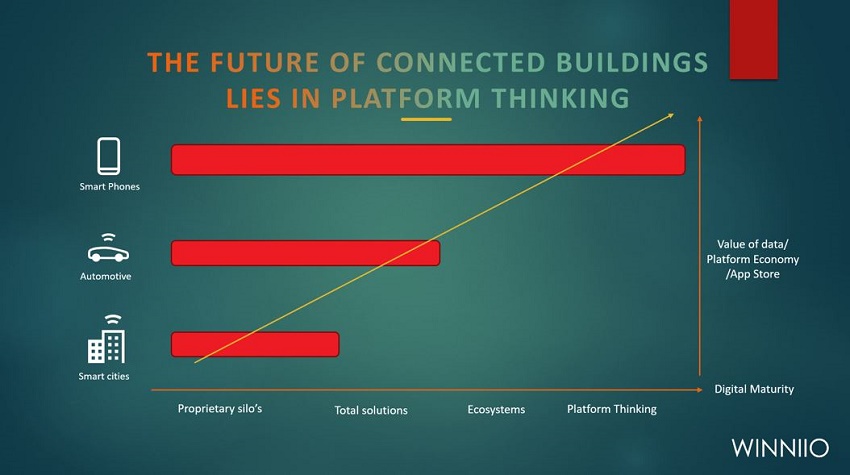
The big question that I’ve been thinking about is if the real estate industry following the same path as the phone industry during the last 20 years?
If that’s the case, which companies will dominate the scene? Do we know about them, or are they still in a garage somewhere preparing to disrupt the industry as we know it? Will it be the big dragons that will turn existing buildings into smarter buildings, or will it be the “IT-companies” that will come in and raise the digital maturity faster than ever? 

Industry transitions and the possible future of Real Estate

Figure 1. Industry transitions and the possible future of Real Estate

Lowering the threshold of adoption through better design

The first iPhone was not ground-breaking in its technology. Far from it. The people at the R&D divisions at Ericsson as well at Nokia laughed at the technology, and the dozens of people I’ve talked to said it was nothing but crap in comparison to the technology inside the Ericsson phones and the Nokias at the time.
But that’s the thing. It’s not technology that will win this battle but instead something that is robust, useful and perhaps most of all, attractive. And it will most likely come from companies that have speed and urgency in their DNA with an organization that is flexible enough to be able to move with the times. Will it be an ecosystem play that will increase speed of adoption, or will it be ONE company that can take these myriads of technologies and solutions and create ONE bundle to rule them all?

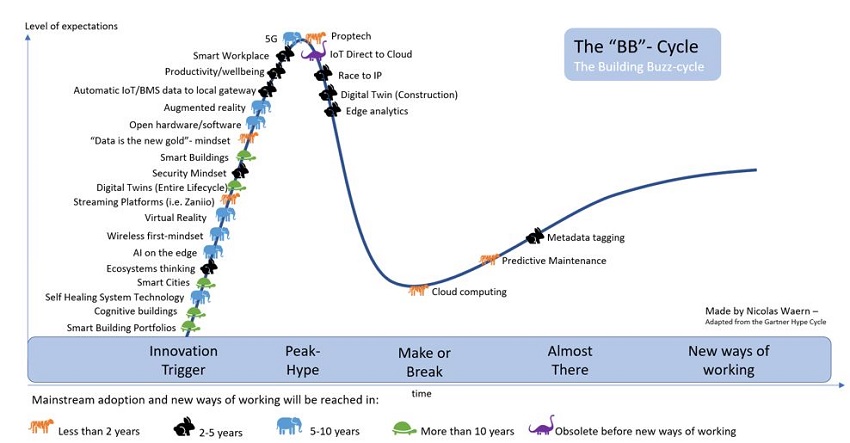
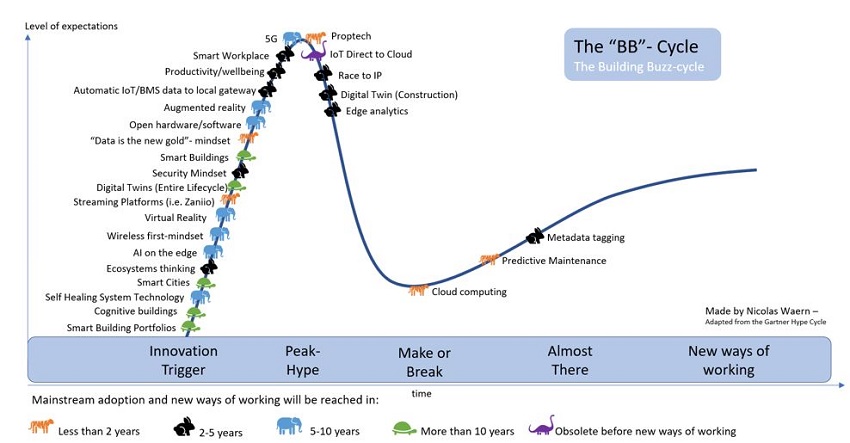
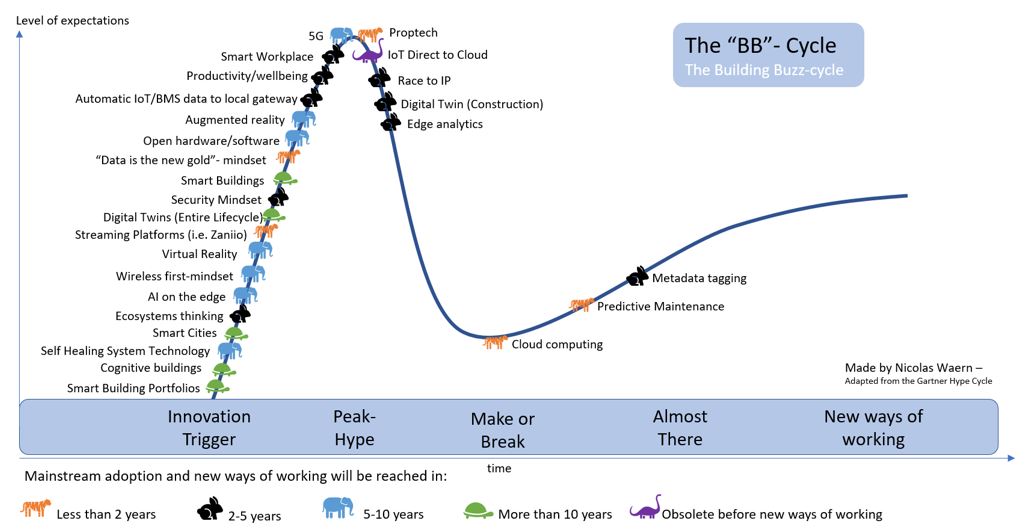
The building buzz lifecycle, depicting emerging technologies and mindsets in the realm of building automation.

Figure 2. The building buzz lifecycle, depicting emerging technologies and mindsets in the realm of building automation.

MSI’s, Money, mindset, and technology to tenants

In between the old and the new, I see the MSIs. They stand on top of the traditional building automation world, knowing that they have conquered the past, and are on a path to command the future together with their customers. They see the future of IT technologies where they can go in, raise the digital maturity, and help owners and asset managers invite others to innovate with their buildings. But they are still struggling with the correct tools to do the job, and it still takes too much time to raise the digital maturity levels at scale.

Will, a construction company, become the new APPLE and actually build the first SmartPhone (Building) from scratch, and usher in a new era?

Even though this probably will happen soon, can we afford to wait for a trickle-up economy where the majority of existing buildings are left to their own demise? Will the change come from the MSI side of things or from the tenants? Will the digital twins, have their way in 2020, and what role should system integrators have in the future? Is there still a need for BACnet? What will make the real estate owners go all-in with digitization? Will we see widespread adoption of portfolio smartness without having technology spread by the tenants? Or is that the key to mass adoption?

I believe the only way this mindset will change is through tying any IT-investment into money. Either money saved or better yet, money made. Part in selling data, but also more traditionally where tech-companies learn the lingo necessary for real estate owners to throw money at technology providers.

I’m still a bit worried that the “apps” that are generated for buildings will become like apps we see in the smartphone market where most of us only use 10% of the apps we have. But at the same time, I see that the core of building automation will be exactly that, automated.

There are still many questions that need to be answered and probably even more questions that need to be asked. But until then, fail fast, learn fast, and, most of all, get out there and get started!

Panel discussions at the AHRexpo

Since there are so many questions, it’s a good thing that there will be education sessions at the AHR Expo next year and other exciting talks.

I’ll be partaking in two sessions.

  1. “Next Generation HVAC Controls: Open Discussion For Open Future” 
    This was a hit last year with a room packed to the rafters.
  1. Moderating a panel discussion on Monday the 3rd of February at 9.AM with fellow panellists;

Steve Jones,  Managing Partner at The S4 Group, Inc
Jason Houck, Hepta Systems, IoT Warez & CIO and Founder at EntroCIM
Troy Harvey, CEO at PassiveLogic
? Open for suggestion.

Topic not yet set, but there will most likely be an open forum about everything that is going on, enabling the audience to interact with the amazing panellists above,

There are still two more spots to be taken, and I’d love for a real estate owner to come on board if possible. If you have someone that you know of, please let me know!

Sincerely,
Nicolas Waern
The Building Whisperer


Digital-first Real Estate

 and a Wireless First Strategy


I love technology. For the ones that have read my previous articles, I think that’s quite evident. Building automation, as we know it is becoming more and more digitized. IT/OT and soon IoT convergence where Facility IT and security is high on the agenda. I see real-life use cases with edge applications from Siemens, and well thought out articles from the likes of Zach Netsov at CC. Smarter technology and Open APIs are becoming the norm, and there is the trickle up-economy that is slowly taking place. All of the technologies and mindsets below will find their way into the building automation arena. And there’s an equal amount of things happening with Asset Management, Digital-first Real Estate banking and the #Proptech scene in general.

The "BB" Cycle

Technology is great, but it’s the outcomes and how it will influence people and the planet that are of utmost importance.

Will the future be built on a RIP and replace approach or a combination of existing systems and wireless solutions? And what could be different aspects of a wireless solution?

Where does wireless fit into all of this?

The introduction to IoT article that I wrote almost one year ago also delves into the realm of wireless as well as the Internet of things and connected systems and devices.

I am also in the middle of a “wireless-first” approach for a digital twin company here in Sweden, where we discuss how to start and what solutions should be offered to companies as “packages.”

The BB-cycle depicts a grim future where it will take 5-10 years to get a wireless first mentality to reach widespread adoption. But the ones who can start now will definitely have an advantage over others if they play their cards right.

Going Wireless first depends on a myriad of underlying assumptions on what and where to use wireless. Where one of the most important aspects is if there’s a business case around it describing what challenge should be solved and what benefits are supposed to be derived.

Here are just some of the different things to consider.

  • Data-speeds
  • How often
  • Where data is coming from
  • Where the data is sent to
  • Security aspects
  • Support
  • Onboarding
  • Business Model
  • Data only/Application bundle
  • Scalability
  • Repeatability
  • Packet-losses
  • Reliability
  • Open APIs

Reliability, scalability in a BACnet/Mesh format

During a great conversation with Reza Alaghehband at Envio Systems, showcasing their brilliant looking software suite, I could hear that the hardest part is getting 100% reliable wireless communication. They are working with some great vendors, but the challenge has definitely been there since… forever. And this is something which I have heard a lot from other players as well.

Most of the technology so far lose data at times, and the only way anyone has ever been able to get anything to work reliably is through hardwired connections. I think there are about five technologies that could provide the same results for a fraction of the costs of wired solutions. I’ve heard good things about all five and seen great things from one of them, Conectrics.

They have an ultra-scalable wireless networking infrastructure that allows self-installation and no maintenance of real-time wireless sensor networks. Togetherwhen I was acting CEO of Go-IoT, we created the BACnet/Mesh solution. Which basically was auto-deployment of wireless mesh sensors that could be seen instantaneously as BACnet objects and devices, through BACnet/WS.

This allowed for rapid scaling and easy integration to any application, including any Cloud infrastructure as well, with direct integration to Azure IoT platform and the likes.

Cloud challenges

One of the biggest problems right now seems to be that everyone wants you to use cloud API connectors. And what I’ve heard from several companies is that most startups and people don’t realize it costs millions of dollars to architect and maintain clouds. You cannot maintain an API based on a 1-time hardware revenue; you need a SaaS. And you cannot stack SaaS on top of SaaS or the cost is too high for the customer because 50% of the SaaS will always overlap, you are maintaining 2 clouds for 1. So the API always breaks, and we never get the data. The model of putting the data on the edge is critical. Because it is the only way to scale.

Edge, scalability and the future of a wireless backbone

It means that you have to have a completely virtual system. Endpoint agnostic to hardware and software. Basically, something that is virtualized, distributed, decentralized, non-existent, that could add to existing BMS systems in the entire world. Something totally wireless! Invisible! Works at the speed of light and can drive grid interactive buildings in a wireless way.

Here, we only have a handful of players in the world right now.

Some of the challenges with Bluetooth mesh, Zigbee Mesh and other smart home stuff is that it’s not scalable to 50 000+ devices. In a commercial setting, most technologies are not scalable enough, with major security flaws, and they cannot be totally updated over the air. The one’s building platforms on top of these technologies could be in for a world of hurt when wireless really hits the fan, and the demands for quality data will increase from all sides.

Calibrating for the 2020 vision with Wireless Mess technology is something that I see will happen more and more.

  • Construction companies have opportunities to become the new APPLEs and TESLAs by building the first SmartPhone (Building) from scratch. And potentially usher in a new era.
  • Retrofitting can boast a lightweight digital twin as well as a wireless backbone in weeks. This enables data-driven decisions to be made, creating wins for the whole 3/30/300/10000 formula – allowing a much granular focus on people and the planet.
  • The Smart Building Recipe will thus be prevalent in both the construction phase as well as the retrofit phase. And the digital wireless movement will form the wireless mesh needed to turn existing dumb buildings into the grid-interactive buildings we need to reduce energy consumption worldwide.

There are still many questions that need to be answered and probably even more questions that need to be asked.

But above all, we need to fail fast, learn fast and get things done!

Panel discussions at AHR Expo

Since there are so many questions, it’s a good thing that there will be education sessions at the AHR Expo next year and other exciting talks.

I’ll be partaking in two sessions.

  1. Next Generation HVAC Controls: Open Discussion For Open Future”

                                  This was a hit last year with a room packed to the rafters.

  1. Moderating a panel discussion on Monday the 3rd of February at 9.AM with fellow panellists;

Steve Jones,  Managing Partner at The S4 Group, Inc
Jason Houck, Hepta Systems, IoT Warez & CIO and Founder at EntroCIM
Troy Harvey, CEO at PassiveLogic
? Open for suggestion.

Topic not yet set, but there will most likely be an open forum about everything that is going on, enabling the audience to interact with the amazing panellists above,

There are still two more spots to be taken, and I’d love for a real estate owner to come on board if possible. If you have someone that you know of, please let me know!

Sincerely,
Nicolas Waern
The Building Whisperer

eSIM-Born Connected

– The Next Generation of OEM’s

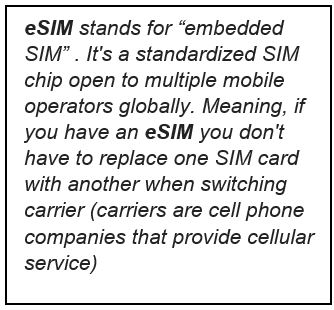
There were a couple of reasons I wanted to write about this topic right now. We are soon at the 2020 AHR expo in Orlando where the HVAC OEMs are everywhere. Also, I listened to this great podcast the other day, which got me interested in eSIMs and the connectivity play for OEMs. Having an eSIM allows OEM’s to get their products connected separately from that of the cloud, which could be a great strategy to have for future business.

In last month’s issue of Automated Buildings we could read about the Call Home Strategy from Scott Cochrane. It tells the tale about products already being connected and that the “phone-home” way of working is here to stay. He also discusses the risks inherent to the IoT/IT/OT/IP convergence with stuff getting to the cloud, and the classic Mexican standoff between IT departments and the surge in getting stuff connected.

Add to the facts that a lot of the products are being removed from action, even though their lifespan still has another decade because of lack of interoperability, connectivity. And, that the lock-in effects are still severe and are stifling growth, where owners want more control of their data and information.

  • But what if there’s a way to get products connected from the OEM-side without the security risks mentioned?
  • And that OEMs have an extremely valuable position in moving closer to the end customers, whilst creating better products and upselling in a sustainable way?
  • Could this also lead to added value for the products and lowering the threshold of innovation for the total value chain?

How much of this is being done today?

“Phone-home” has never been this easy when entering the world of eSIMs.

It’s a fact that products today, as well as people, are born connected. Having products connected from the get-go will not only benefit the OEMs, but done right, everyone else that takes part in the value chain. It will lead to better products being built over time, as well as rapid feedback loops between the R&D departments and the users, extending the product life cycle, which in turn has the potential to minimize waste, impacting the world in a positive way through products that will last longer, and work better than the predecessors based on data-driven decision-making.

eSIMThree kinds of products

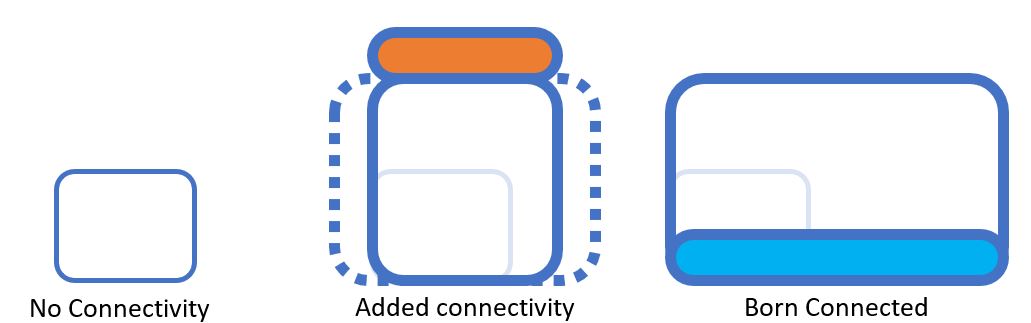
For simplicity’s sake, let’s think of products in three different ways.Figure 1

  1. Products with little to no connectivity
  2. Products with added connectivity in place
  3. Products that are born connected

The products with little to no connectivity are most of the products that are out there today. And when I say products, I mean the field controllers and edge gateways, but even more so the “traditional” equipment that haven’t been connected at all.

These aren’t connected in the slightest and they aren’t built for that purpose either. Feedback is taken in via the classic way of focus groups, re-actionary approach if something is broken and quite long feedback loops between the OEMs and the customers as well as the users. Market intelligence shows that most of the value is lost and there’s a lack of standardized feedback-loops between the OEMs and everyone else in the value chain.

The products with added connectivity are products that are made “smarter” by someone else than the OEMs further down the value chain. Could be a typical IoT-play where someone else wants to get the data out, make better decisions, and possibly also sell the usage-data back to the OEMs (Digital Twin play). The added connectivity allows for an extended product life-cycle due to continuous feedback based on accurate data in conversations with OEMs/technical support functions. It also adds potential for new markets requiring connectivity, and decision-making of how the product is being used in real time. This could be at an aggregated level, edge controller, or supervisory controller most likely, but also sensors and actuators.

However, the added connectivity play is still a challenge due to existing vendor lock-in and the challenges that comes with metadata-tagging being inconsistent across vendors and industries. The whole “pull-out-the-phone’s SIM, that’s a 90s- to now technology that’s not future proof in the slightest. And the Wi-Fi, direct to cloud- phone home is risky due to security concerns all around.

The products which are born connected have the possibility to solve a lot of the challenges prior to even becoming problems in the first place. Adding the possibilities for connectivity enables OEMs to get to a “Born connected” strategy which has many benefits. This is not only for the OEMs but also for the customers and other stakeholders in the total value chain. The benefits are the ones described above, but it’s also a paradigm shift on how things are done and will be done in the future.

I would argue that almost all products can, should, and will be born connected.

Utilizing eSIMs from the get-go enables OEMs and others to choose and change the connectivity providers in a much easier way than today. OEMs can offer more services out of the box to customers, either by themselves or through an ecosystem approach. They will have the possibility to get more information about the product, extend the product lifetime value, minimize complexity for the OEMs as well as the customers, get more value out of the value chain, innovate on top of the products in a standardized way leading to faster time to value creation for all.

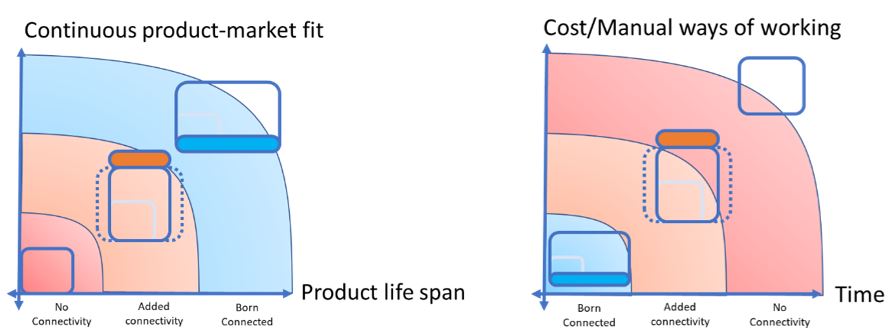
Improving the continuous product-market fit and product life span

The “traditional products” that are mostly out there today have little to no connectivity options in place.

Figure 1

Figure 1. Illustration showing the relationship between connectivity and life-span, product market fit, automated ways of working and time to value creation

Figure 2

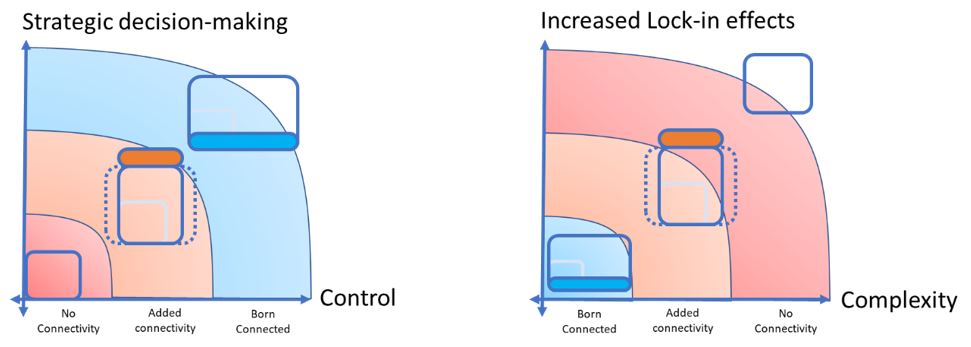
Figure 2. Illustration showing the relationship between connectivity and strategic decision making, control, increased lock-in effects and control.

The thoughts, the tech and the bullet points

Born connected products and strategies can lead to:

  • A higher degree of transparent continuous product-market fit.
  • Possibility to extend the product life-span as well as manufacture better products based on near to real-time data-driven decision making.
  • Faster time to value creation, reducing cost and manual labour for data-gathering. Both for OEMs as well as customers further down the value chain, allowing OEMs to radically improve and innovate with business models, partners, cost structures, making more money through the entire product life cycle.
  • Getting products connected from the start, with the correct partners, will (can?) lead to more control and strategic decision-making taking place much faster.
  • This, in turn, leads to fewer lock-in effects and much less complexity where products are connected from the start requiring “only” a strong partner, or different skill-sets inhouse.

A better world for everyone?

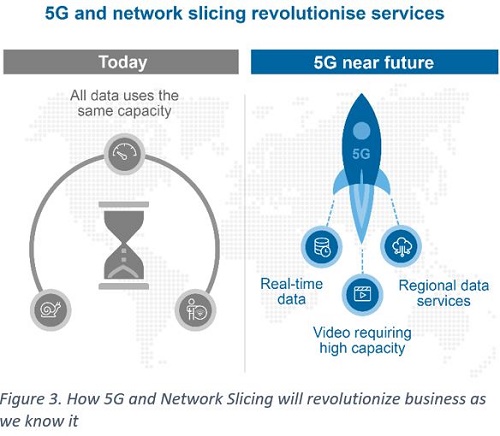
Figure 3Getting products to the stage where they are born connected can enable anyone to change the connectivity provider, offer more services out of the box to customers and a lot of other exciting things depicted above. This, in turn, will lead to the rise of MVNO’s, where 5G will become more and more interesting and Network Slicing will come into play for real.  This is an area which I love to talk about more and will be a game-changer for everyone. Network slicing will allow products to cater to demands demanding different kinds of data- and data speeds in an efficient way.

NEXT Generation HVAC Controls revolve around Open Standards, which we will be talking about at next year’s AHR Expo in Orlando.

Players need to get acquainted with a much more open mindset where buzzwords will become the de-facto ways of working in the industry, such as:

  • Having a data strategy
  • An Ecosystems approach
  • Disruptive business models
  • Head of innovation and ecosystems thinking
  • Creating new revenue streams such as HVACaaS
  • Doing the right things instead of doing things right
  • People as well as products that are born connected

And much else, incorporating all that I’ve written before below the surface.

Achieving organizational speed is on the agenda

OEMs and other companies need to look at the organizations they have and if they have the processes, the people, the culture, the hierarchy as well as the IT-infrastructure in place to capitalize on said opportunities. After all, technology is just technology. It’s all that other stuff that is much more important. Technology done wrong can quickly become a source of added complexity instead of the benefits promised by the hype in the industry. OEM’s and everyone else should take a hard look at where they are today, where the market is going and where they want to be as well as need to be in the next five years. There are a lot of things they can do, but perhaps more importantly, a lot of things that they shouldn’t do. This could also lead to added lock-in effects and everyone here need to tread smartly, perhaps even more so today than ever before.

With that said,

Think Big, start small, but above all else, start! And as always, reach out if you have any comments, questions or just want to talk smarter buildings!

Sincerely,

Nicolas Waern,

The building whisperer – making buildings talk to people.

Are Existing Companies Built to Die?

his article is about the importance of understanding how and if businesses can capitalize on all the shiny new tech that exists in the market. And how the embryo of a re-born connected strategy might look like. If you are worried that new technology isn’t delivering as expected, and wondering why that is so? Then this might be something for you.


Did you ever hear the tragedy of the companies failing to adapt to change? I thought not. It’s not a story that technology companies would tell you. It’s a Management legend. AI, Machine Learning, IoT, sensors, Digital Twins, open standards and everything in between have the ability to make companies powerful and wise, beyond belief. Comparing to the current state of things, new ways of working could be considered to be a pathway to many abilities, some consider to be unnatural.

“Change is the only constant, and the ones who don’t

keep up with it are destined to fail.”

Does this help most companies out there today? No. Unfortunately not.

Yes, companies are built to die

Because I do believe that most existing companies are built to die. The reason is that most companies aren’t built for change, nor have the capabilities needed to change fast enough. They are built for a purpose. Maybe that purpose was to build phones in a certain way, to build cars in a certain way, or to build or manage buildings in a certain way.

But the problem is that change is the only constant, and the ones who don’t keep up with it are destined to fail. We’ve seen it with mainframe computing, with phones and Nokia/Ericsson/Blackberry, with cameras and Kodak, with car manufacturers, in pharma, and we are starting to see it in the CRE space.

Some people know about it. Some don’t. But it’s a fact across the board that disruption is the name of the game.

I will discuss my thoughts on why this is. And also, if companies can be re-born, again, anointed with all that magic that a connected society will bring about. I’ll tell you of a way to learn this power. But it won’t be about technology.

Born Connected – A new business reality

I wrote about products being born connected, alluding to the fact that people today are born connected as well. The millennials, the X, Y, Z generation, or whatever you can call it are saturated, even marinated, in the hypes of digitization in arguably most parts of the world. And soon with Space Internet becoming a reality, we’ll get exponentially more connected as time goes by.

New companies are leapfrogging past existing companies creating exponential value with organizations that are software companies through and through.

Slide .i

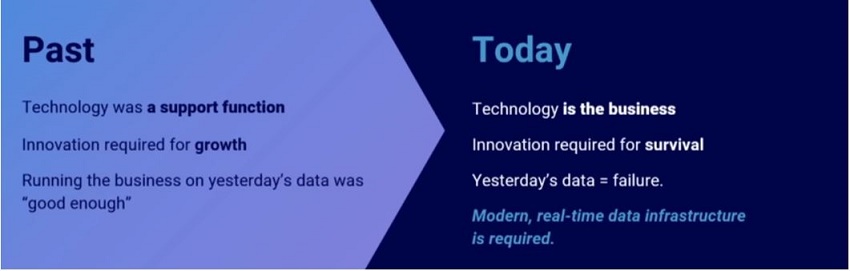
i. Slide from the Confluent Kafka Summit in London 2019 about the importance of real-time data

“Major banks that see themselves as software companies that just happen to deal with money. Major retailers see themselves as data companies just happen to sell shoes. If companies don’t reinvent themselves with technology, they will lose” – Neda Narkhede – Confluent

But I would argue that having great technology is only a small piece of the puzzle for existing companies.

Understanding the organization

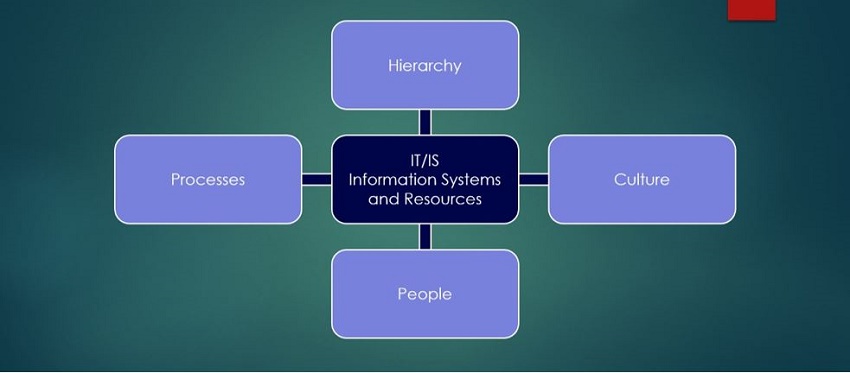
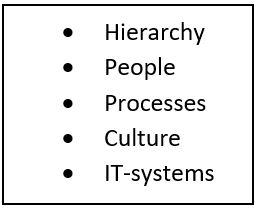
Viewing companies today, utilizing the Five-model, we can see that they consist of five main perspectives that together form a company. Hierarchy, Processes, Culture, People and IT.

The main thing about the below is not how they work in the individual sense, but instead the interdependencies between them and how this resonates with the organizational aptitude in adopting the speed necessary to keep up with the times.

Slide ii

ii. The “Five-model” depicting the main perspectives of any organization

A New Company

A new company built from scratch today can decide everything about how the company should operate and what IT systems to buy, which people to hire, and so on. Existing companies don’t have that luxury. They always have something to adhere to. Sometimes it’s a good thing; sometimes it’s a bad thing. But it’s seldom easy.

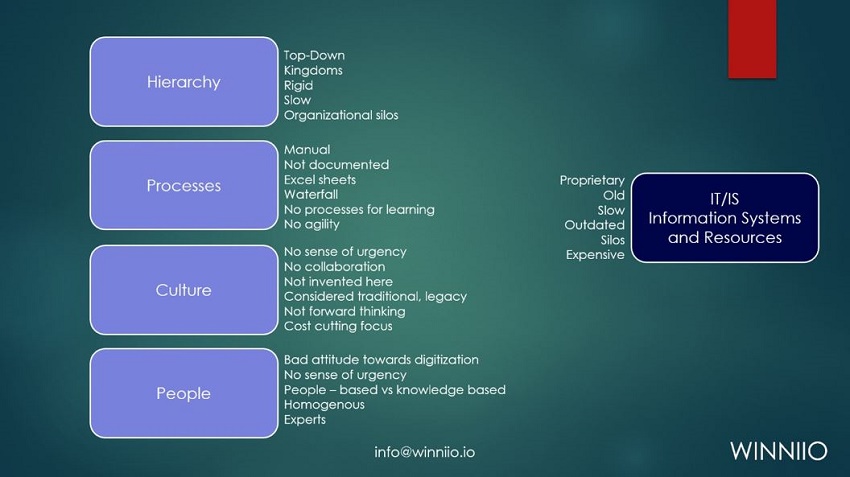
Companies are built to die eventually. Unless they have strategies in place on how to change and evolve in a continuous fashion. But that requires an understanding of where they have been, what path dependency they are on, and where they want to go and to keep up with the times. Because business models expire like yoghurt in a fridge. Understanding the business utilizing the Five-model is one thing. Understanding what the company does, in its context, and what it should do next is something for another article. But let’s start with that of a “Traditional Business,” depicted below.

Slide iii

iii. A slide depicting the current state of workings for a traditional business

Even if you had the most connected product in the world thrown at this company, they would never be able to capitalize on it from an enterprise perspective. Not in a million years. Because the existing systems wouldn’t be capable of ingesting the data. The people wouldn’t even want to try it out because it could threaten their jobs. And new people with the correct mindset, wanting to do it, would never see it go above their paygrade due to existing structures, partners, chosen vendors and the path the company is taking.

And even if the POC (proof of concept) would be successful, the benefits derived could fall in someone else’s lap, so the decision would be made not to do anything. Or the decision would take months or years to implement and then it will be too late. Business as usual, until they die.

So what’s the point?

Re-Born Connected – Do or Die?

If we have a product that is born connected in the left hand. And in the other hand we have this traditional organization that wants to utilize all of this cool new technology. What do to? Can the company be re-born connected?

Maybe. But there are a few buts and ifs;

  • How long would it take to change the organization?
  • How fast are other organizations moving in the industry?
  • What are the threats from other industries moving forward much faster?
  • Are the barriers to entry beginning to be removed, making it easier for anyone to innovate?
  • Are existing channels being re-invented by new players in the market, circumventing existing ways of working?
  • What are the primary revenue streams of existing businesses, and does that correlate to future ones?
  • How suited is the existing organization to fulfil future needs?
  • What is the need for the companies products/services on the market?

“Companies need to be trying to disrupt themselves before anyone else constantly does.”

And the list goes on. Becoming re-born as an organization requires much more than fancy technology and access to real-time data. It seems to me that the only option a company has is to do either one of three things

  1. Business as usual, thanking everyone for the good time they’ve had so far.
  2. Change the existing organization to capitalize on existing and future opportunities.
  3. Disrupt the existing organization, start new from scratch and out compete the existing one.

Trick question, since the answer is number three. Changing the organization requires a hard look at what should be kept, what should be left by the wayside, and what should be put elsewhere. Where if companies want to survive, they need to be trying to disrupt themselves before anyone else constantly does. Anyone with a “connected mindset” doesn’t want to work for a company where all the data is in excel-files and PDF’s in someones’ Email inbox. Or try to summarize Excel sheets from 10+ different applications, trying to compile historical information that takes days, where they know that the same task takes five seconds from a connected company.

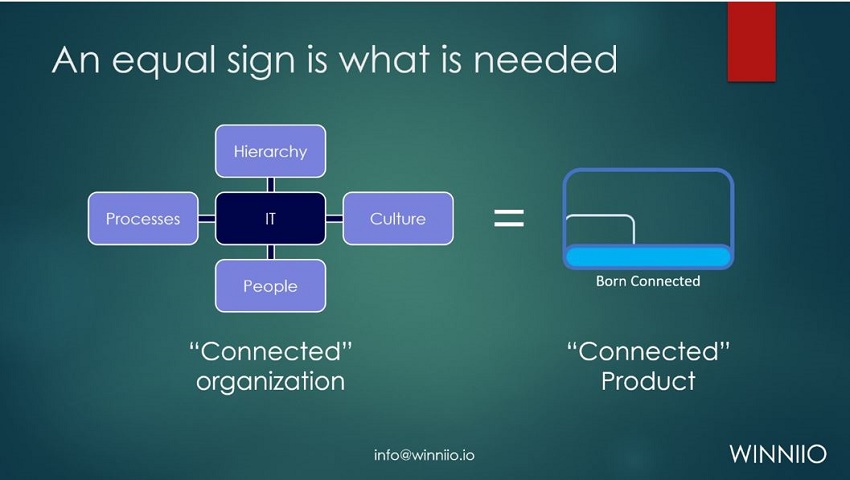
Is this all doom and gloom then? Of course not. But it’s important to understand that technology is but a small piece in the whole scheme of things and adopting a holistic view of the past, present and future is required to spot and capitalize on short-term and long-term opportunities. There’s an equal sign between the technology that exists on the market and the organizations that want to use them.

Slide iv

iv. There’s an equal sign between the level of digital maturity between the organization and the tools it is using

Strategic alignment and a sense of urgency

This is only the start of understanding the challenges as well as the opportunities within the internal organization. And to be able to ask and answer, at a glance, if the company in question has the capabilities to extract the value promised from any new technology undertaking. Because it’s only the organizations that have the culture, the people, the hierarchy, the processes, and the IT-structure in place that can capitalize on the products that are born connected. And this is just the start. What business model the company is using, and how that relates to the existing resources, and which of these (if any) are valuable enough to form the basis of the future organization.

“Doing things right has never been this easy – but doing the right things have never been this hard”

All of this must come together and work towards the strategic goals, with a sense of common urgency. Otherwise, the company is destined to fall behind, sooner or later.

Final words

I have spent the last 4-5 years in the Real Estate industry, and I’ve been diving quite deep into the technological wonderland of all things connected. I would say I know enough right now about IT, IoT, OT- conversion, the lack of data quality for AI, ML, Digital Twin initiatives. The BACnet, HVACR, Lonworks, Modbus, KNX, Dali, Profibus, Canbus, MS/TP, S/C, W/S, GraphQL, RESTful, DotDot, and protocols and whatnot that is out there. I know the open hardware side of things and the connectivity and wireless scene with RPi, Arduinos, Zigbees, Conectrics, LPWAN, LoRa, Satellite, NB-IoT, CAT-M, Sis, MSIs, Open, Proprietary, GSI, NOIs, RS-485, OPC, I/Os, Haystack, Brick, REC, Edge, Cloud, FDD, 5G and yeah, I would say a lot of the things that are going on at the moment. Thinking that this would be the answers I was looking for.

And here comes the paradox.

  • There’s no doubt that companies can transform buildings to truly amazing places to live, work, and that they will have an enormous impact on the betterment of this world.
  • There’s no doubt that most companies operating in the real-estate space, as well as other traditional industries, are in fact, built to die.
  • There’s no doubt it’s more about business and strategy than it is about technology for existing companies.

Because doing things right has never been this easy. And the whole business is slowly but surely moving the way where we are moving to more open systems with quality data.

But doing the right things?

That’s the beauty right there. It’s all about asking the right questions, be willing to fail fast, and to understand that setting, and continuously improving and amending the organizational strategy is the only way forward. Why are we doing this, what should be faster, how does it scale, and a million of other things.

It’s not easy with the myriad of options and the speed of technological development as well as the contextual turmoil in and around the Real Estate Industry. Here’s an article about what was going on years ago from the AI/ML – data science and BIG DATA perspective, where politics are blamed, siloed data, expectations don’t match reality, and unclear responsibilities. Throwing IT, or “IT-people” at the organization rarely works.

And one, two, three wrong moves, might lead to the end of business as we know it. Companies that find what they are good at, work with ecosystems in mind, participating in cross-industrial platform thinking initiatives based on openness, standardization, realizing that there’s no time like the present. Those are the ones that will reap the benefits.

The only way forward is to begin the journey to get re-born in a connected way, in order to understand the obstacles and capitalize on the opportunities that exist and will emerge in the years to come. The real estate industry truly is in the hands of the companies that prescribe to the new land of the free, and it will be the home of the brave. What a time to be alive.


As always, go out there and start something, fail fast, learn fast, and make sure it is aligned with the overall strategy of things.

As a wise man usually says, “To your success!” – And do let me know if there’s anything you need!

Hope to see you at the AHRExpo!

AHR EXPO

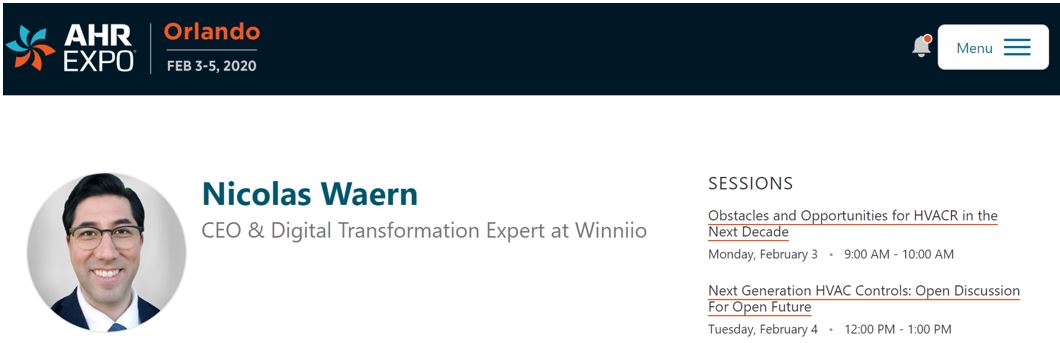
v. Picture depicting the two sessions I am participating in at the AHRexpo in Orlando 2020

Wireless-First Strategy,

what to think about?


(TL;DR) Have the correct data-strategy, think long-term and bi-directionality, understand that different technologies do different things. Think twice about using any long-range technology in buildings (like LoRa) – My advice is using Wireless Mesh.

I am advising clients all over the world on what their Connectivity-Strategy should look like in order to get the most bang for the buck. It could be Digital-twin companies needing data from buildings and existing systems. It’s General Contractors that want to be the next APPLE of the building automation industry. New entrants to the smart building industry wanting the know-how what the perfect edge gateway should look like. It’s Real Estate owners, wanting to see more of a return from buildings and to challenge the status quo.

It’s all about trying to offer the pros and cons with any strategy, choosing the technology based on what the customer wants to do right now, but also in the future.

  • How important is the total cost of ownership, flexibility, security, ease of install, recurring costs, how often to send the data, to where, how much data, battery-powered, location, firmware updates, usability, scalability and a lot of other factors?

And that is why I’m always interested in knowing more about the existing alternatives, weighing alternatives back and forth, and recommending what I think should be the best option. I need to know this. Partly because it’s my job, but most importantly that the future revolves around solutions that can pass the test of time as much as possible. The world depends on it.

The connectivity situation in buildings
Looking at the future projections, it seems that the volumes in the long-run (2025 the earliest) between licensed and unlicensed solutions are 50/50 but in totally different use cases, thus more complementary.

“Licensed LPWANs run on public cellular networks that use the licensed radio spectrum and support the GSM and 3GPP standards. … Unlicensed LPWANs, on the other hand, use the radio spectrum that is unlicensed and can be used by anyone without exclusivity.”

I wrote about it in my last article about “What Connectivity Horse to bet on” after an interesting message conversation with a leading expert in the field (The comment section is particularly interesting since it offers alternative views than my own).

However, for this piece, I am ONLY interested in what solution would be great for buildings. Indoors. It’s about the need right now, and also what future needs look like and how that resonates with the choice of technology.

Existing and future building needs are these

  • Local Control First
  • High throughput data for local smart grid inclusivity
  • Buildings as node-balancers in local energy communities
  • Bi-directional control in order to create automated buildings
  • Deploying sensors that can scale to thousands of sensors
  • Interoperable solutions with as little complexity as possible
  • Battery-powered sensors/actuators needed
  • No packet losses (AI/ML demands quality data; otherwise predictions will be corrupted)
  • Native to Existing building automation systems protocols (BACnet most likely)
  • Secure communication

All the above is the necessity if you want to deploy anything that is future proof. Monitoring purposes only is fine for now and for slow-moving data in small packets, but buildings can’t be run with 20-minute data in the future.

Slow-moving floppy-disk size technology could be used when detecting water leaks in buildings or change of value in temperature just for the insight of knowing something.

But the future of Smart Buildings and Smart Cities demand real-time data to a much greater extent than what a lot of these solutions can provide. Or it conflicts with the Primary law in building automation:

Local Control, First.

This removes the traditional approaches of LoRa/LoRaWans, the NB-IoTs, The CAT-Ms and everything else that needs to go to some cell-tower or some cloud in order to get the data back to the building for control. Because what happens if the connection goes down if any logic resides in the cloud and not at the edge? The building will break. And possibly the people in there. LoRa Edge sounds interesting, to be honest, but it will still take a while to get to widespread adoption.

“Edge computing is computing that’s done at or near the source of the data, instead of relying on the cloud at one of a dozen data centers to do all the work. It doesn’t mean the cloud will disappear. It means the cloud is coming to you.”

All buildings should be able to operate freely where the cloud is just for offloading and pushing down algorithms when necessary. Everything that happens in the building will be sent to the cloud and to be augmented in a portfolio-way. Very similar to that of TESLAs OTA (Over The Air) architecture in that the OS could be updated at all times. But the logic still resides inside the car (read building).

It’s all about reducing Total Cost of Ownership

And that’s why I get a bit annoyed when I see that these technologies that mostly focus on monitoring are finding its way into buildings. Not only because of security risks with LoRa, but mostly because it’s not a strategy that is built for the end with that kind of technology.

Think about it. It’s like knowing that you want hot water running fast next year in a streaming kind of way, but you only install a faucet allowing you 1 decilitre of cold water every 10 minutes. Would your needs change in the future? Do you need more now?

If you need more, you soon find yourself in a kitchen with 5 different faucets, leading to an additional IoT aspect of the infamous “Thousand cuts-problem.” Not only with integration to the other faucets and other applications, but also the cost of install for each faucet and the total cost of ownership when packets are lost, and sensors don’t report data. Because what happens is that companies need to send someone out to fix it, and things will get messy in no-time.

That’s one faucet (sensor). What about having thousands of these already deployed, and the only thing they can do is to give you cold water once every 10 minutes?

I’d rather install thousands of faucets that can deliver hot and cold water whenever I want it, and it’s up to me to decide how to use it for the next 10 years when I upgrade to the next faucet in the same product line.

Your own Digital World with Wireless Mesh

The only thing that I see can cut it in the realm of building automation, and what will pass the test of time is Next Generation Wireless Mesh. It’s like building up your own private digital world with powered routers the size of a mobile dongle, allowing you to deploy battery-powered sensors at will adding, or subtracting sensors that will auto-configure themselves.

These together build up a future proof tent, where sensors can be deployed in the thousands, auto-configurable, no packet loss, one API, one up-front cost, extremely low Total Cost of Ownership, super reliable and an architecture that allows real-time data over battery-powered sensors. Data will be generated at the edge, and this allows companies the power to choose.

If you just want monitoring to start with, go ahead. Run that cold water with 1dl every 10 minutes or every hour. But when there’s a need for more data, that infrastructure will break, and the 20-year battery-life will soon become 5 years, 2 years, 1 year, and you’ll scrap the entire thing because your data-strategy wasn’t matched with the architecture of choice, to begin with. And that’s the thing. It’s about understanding the existing and future use cases.

Using wireless-mesh in buildings will offer comfort knowing that, when customers want bi-directional when data-scientists and AI/ML-powered solutions cry for more real-time data, you have the solution for it already in place. One API, delivering all that data you want and that works seamlessly together with existing and future solutions.

There are a variety of wireless-mesh solutions out there, and one thing to be wary of is the routing tables, which can limit scalability a lot. Home automation stuff like Zigbee-mesh and other things like it won’t cut it in scale, nor for future data quality purposes with an error-prone architecture.

There are maybe a handful of solutions out there right now that are fit for purpose when it comes to smart buildings/smart factories.

Summary

It always depends, yes. It is vital to understand that the short-term and long-term business strategy and the data strategy are linked together.

But when it comes to data collection and control for building automation purposes of today, and tomorrow- Local Control First – is the way to go. Everything else is plain stupidity and possible power-moves from companies with hidden agendas and/or a lack of understanding of what physics allows.

Cloud companies, what do they want? Data. Licensed and unlicensed companies like Telcos and LoRa-companies, what do they want? Cloud and recurring revenue to help you operate the network. The security aspect is also an important factor where your data strategy could go hand in hand with Private-Cloud thinking and on the Edge processing and control. Why send the data to someone else to spy at?

In my opinion, edge and distributed intelligence are here to stay considering that the technology in, i.e. our smartphones are getting smarter, faster, and better and better. Put 10 of these together, and you’ll get your own private cloud with extreme calculating capabilities.

5G, Licensed and unlicensed, Network-slicing, will be phenomenal in offering applications at the top that can leverage data in buildings and provide stellar user interaction, also from a portfolio perspective. But the transport-layer and logic will reside at the edge whenever it comes to building automation purposes.

Future-proof, as it should be.

Get in touch with me if you agree/disagree with this, and if you have any great use cases of wireless of your own!

Originally posted on Linkedin as What connectivity option to choose?

Also related topics:

Smart City Future
The building automation industry is broken

The Rising Remote Workforce

– The exponential demand for Future-Ready Facilities.


This is the way, away from hard-coded controllers and the need for decoupling of hardware and software due to the rising demands of Future-Ready Facilities.

–  Thanks a lot to James Dice and Brad White, providing much-needed inspiration for this article.

The Trillion Dollar Opportunity in transforming existing buildings is a seminal article from Brad White, and it is instrumental in laying parts of the foundation for this article. It’s also important to realize that this is a Hard-coded industry down to the very controllers, where innovation is challenging for the most part, and any modern approach seems to require some level of digital maturity in buildings.

The digital maturity question is impressive on its own, and I will expand more upon it if asked, and most likely write an article on this subject the next time. It might come down to two questions;

  • Do we need to able to attract new people to the existing industry?
  • Or is it so that Future Ready Facilities will attract existing IT-people to a new Building Automation industry that is more IT-centric?

“Ask not what you can do for the building. Ask what the building can do for you”.

I believe that Future-Ready Facilities is the way in realizing a truly open industry where the democratization of smart city innovation is the norm, and global hackathons for buildings will become a mainstream tool for portfolio-wide change. With the underlying reasoning that the future will demand more of buildings, especially if more people will work from home. Organizations need to continue to be smarter along with the structures they are both servicing and managing, or else they risk becoming obsolete in no-time.

Is this the future for a lot of the portfolios out there?

  • Buildings that no one wants to buy.
  • Buildings that no one wants to be in.
  • And real-estate companies that no one wants to work for.

And maybe it’s that hard, or that easy, to realize that the transition starts with hard-coded controllers?

Hard-coded controllers in a hard-coded industry

One of the major obstacles in realizing smart buildings in a fast, efficient way is the hard-coded controllers that are out there to various degrees. As I see it, there are two fundamental options to get them to behave the needed way for Future-Ready Facilities.

  1. Someone has to go directly inside them, to change something in the actual code. Not very difficult, but time-consuming, and it requires specialized skill-set and on-site visits.
  2. Entering “over the top,” scanning the network, controlling the system from the top with “AI/ML” – algorithms (modern tools) to reverse engineer what the problem is.

I’m trying to get away from the first option to come up with something that looks more like the second option, utilizing modern tools. However, this might become difficult because the network is too old (Lon, BACnet MS/TP, RS-485 CAN, Profibus, etc.).

The “control strategy” should be close to the source to avoid chatting on the system, meaning that a more modern approach won’t work due to the old network infrastructure in said building. 

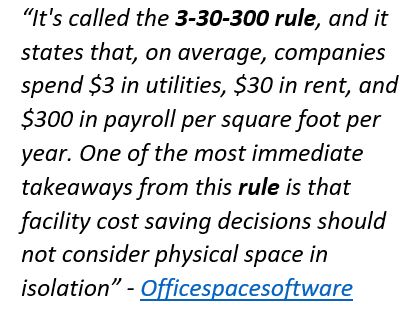
The installation of some over-arching expensive AI/ML-powered tool at the top is kind of like buying super expensive Nike shoes for my grandmother, who is 103 years old. It might look fancy, but it’s doubtful that it will do much for her lap-times. Also, weigh in the fact that the decision to install a completely new system won’t happen because of a lack of ROI. And that’s because the industry doesn’t weigh in the entire 3/30/300 rule in the property so there will be no ROI = The building continues to be stupid and old.

3-30-300 rule

The reason could also be the fact that tenants cannot make demands that owners either do not have an interest in their tenants or they do not have a natural way to retrieve the cost based on actual ROI calculations.

Holistic thinking is the key

The conclusion comes down to two things.

 A-    Use modern technology; buildings need to increase their digital maturity, usually to the “IP level.”
 B-    To get the money for any severe upgrade, we need to count on more than energy costs, factoring in the  maintenance costs, and even more importantly, the well-being/productivity increase metric.

There may be an interest in separating the OT Network with an IT network to avoid time delays and to not talk to the IT department. This reason goes back to the two main rules stated by James Dice in the already legendary Nexus Blog.

  1. Properties that are robustly useful and attractive to tenants (and stakeholders who work with the property), where the digital-twin mindset is the key.
  2. Properties that contribute to increased value, lower costs, increased revenues.

Challenges with rules number 1 and 2 are impressive, thinking about the benefits with the /30 and the /300 well-being stuff and how any investments correlate with an increase in that area.

And, if it’s not something where the owner owns the properties, and have their workforce, how can they benefit from increasing well-being and productivity monetarily? (super important since this is the case for a lot of buildings).

It boils down to the ROI, where Phillip Kopp said something brilliant. If the ROI is six years for the energy play, it’s six months for the maintenance side; it’s six weeks weighing in the well-being productivity factors; even less if the “NOI-factor” (Net Operating Profit) enters into the account. The whole increase in the asset value, including less paperwork and hunting for information for the /30 side (maintenance) not only for the technical asset management side but also for the whole organization. Not even considering the need for new business models to take place, which needs a platform to stand on.

A holistic measuring tool/framework would make the original project ROI come back in two weeks or less. A no-brainer? But what should be done?

FRF-ready at the IP-level with LOPI as the main driving force.

…what?

FRF= Future-Ready-Facility
IP-level = All infrastructure at the IP-level with open APIs and tagged data
LOPI = Loss Of Possible Income

Factoring in the 3/30/300/10 000 (I like to call it 10000) side of things (the future revenue streams based on new business models) based on having an FRF, Future-Ready-Facility (FRF assessment), means that every day the buildings are not at the FRF stage, owners don’t have the possibility to make money based on data-driven decision making, utilizing data as the new tenant.

Let’s repeat that. If the building is not modern enough, enabling access to all of the data in a couple of mouse-clicks, then it will be extremely difficult to stay relevant for the next decade.

The ROI should be tightly coupled with the LOPI (Loss of Income) based on the inexistence of a future-ready platform to build new business models and new revenue streams on. Every day, not having an FRF, will lead to a value decrease for buildings all things considering, or at least a status quo, because other buildings, will become exponentially better. In a couple of years real estate owners will try to sell their assets which would be akin to an old car running on petrol, without any technology in it, when all competitors are selling Teslas and electric vehicles.

Good luck finding buyers. Especially when people are working from home in a much higher capacity. Owners, as well as companies need facilities that stand out and cater to their tenants to a much higher degree than what we see today.

The workforce of tomorrow will expect more of what buildings can do for them. Therefore, it’s up to us to understand what we need to do for the buildings today so that buildings and cities can pass the test of time, becoming robust, useful and attractive places for decades to come.

By doing that we can help create a society where we have;

  • Buildings that everyone wants to buy.
  • Buildings that everyone wants to be in.
  • Buildings that are managed by companies that everyone wants to work for.

I have spoken.

/Nicolas Waern
  
I’m probably still in Corona quarantine in Sweden, so please reach out to me on Linkedin if you have any questions or comments. And please check out the first podcast Episode with James Dice, and also sign up to my future podcast series here if interested in more content like this!

The Road to Future Ready Facilities and Digital Twin Thinking

The podcast with James was a great discussion between him and me about our past, what we think about the future, and the whole idea of decoupling hardware and software.


Sinclair:  Hey Nicolas! How have you been since AHR? How’s Corona treating you?

Waern:  Well, not too bad to be honest, considering the global turmoil. The whole family’s been stuck in quarantine now for about 12 days. It’s been a lot of monopoly, watching Pokemon and also recording some meetings for my new podcast. Not only waking up to wireless ways and thinking about The Smart City-future day and night but even letting others know what we talk about!

Sinclair:  Yeah, I saw that! You and Captain Planet, James Dice, hitting it off. Well done! What is the podcast about?

Waern:  The podcast with James was a great discussion between him and me about our past, what we think about the future and the whole idea of decoupling hardware and software. James is a titan in the industry, and I appreciate what he is doing with his amazing newsletter.

The overall idea with the recordings is to spread as much knowledge as possible to the ones that need it the most. I guess similar to the intent with www.automatedbuildings.com and ControlTalkNOW.

My idea with my future “podcast” is about giving WINNIIO customers, my network, and everyone else a transparent view of my weekly conversations. (Sign up here)

Just this week has been engaging with new customers coming in and existing customers phasing out.

Sinclair:  Can you give us some examples?

Waern:  Absolutely! I managed to record about 5 “podcasts” last week with companies and people that I work with/are interested in. Here are some examples:

–    Everything connected strategy
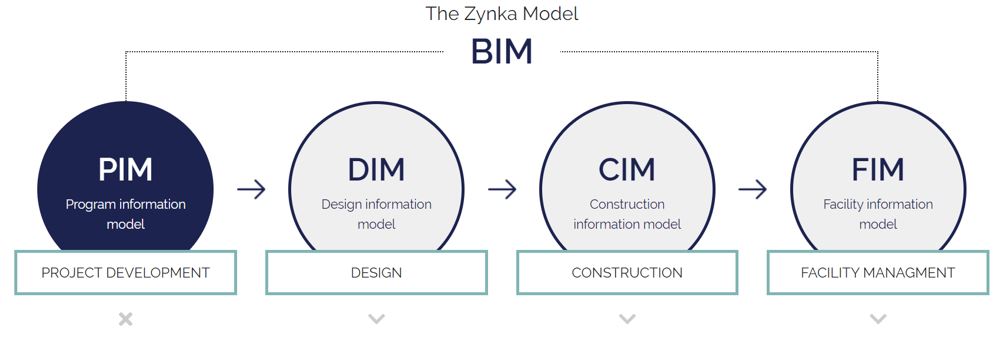
Connected strategy for the leading Digital Twin company in Sweden, Zynka Group and their Digital Buildings approach, on how to get data out and in, of buildings. It’s a strategy for data collection from the buildings that have intelligence (BAS/BMS) that don’t have any intelligence, as well as a connected approach for new construction focusing on future-proofing the industry as much as possible.

Zynka Model

i. Zynka Group and Digital Buildings knowledge capital turned into Digital Buildings Platform thinking-    Going full-on TESLA/APPLE approach for construction

Digital Twin thinking for a Prefab construction company in the APAC region-building four new hotels and a couple of apartment blocks. They want to go full TESLA-approach in building a software product, with some walls around it – thus making smart from the start, also turning them into the APPLE in the construction industry, delivering a Smart Building to their customers.  Enabling them to take care of the technical asset management side of things extending their value offering to the Asset Management side since we’ll help out in creating a “self-driving” building. I’m advising on future connectivity strategies, also putting together a smart building-package with suggested vendors and technologies.

–    Corona-fighting through a Digital Twin

Combating future pandemics through a European Digital Twin initiative regarding a Pan-European National database. I helped a Digital Twin-company with a Euro Horizon2020 Granting proposal, with ecosystems thinking, overall value proposition and getting a consortium together based on my network and knowledge of cutting-edge technology with a benefits-driven approach.

Basically how 200 databases could be ingested and indexed into a Digital Twin database, being able to trust that data, harmonize it, tied to a real use-case utilizing edge thermal imaging, crowd analytics, scalable mesh sensoring to help curb existing and future outbreaks based on heat, movement, air pressure and humidity factors in and around smart buildings and smart cities. This is a combination play with SEKAINatixBumbeelabsConectric and Platform of Trust also with Winniio partner company Wiredhut.-    Increasing organizational curiosity

Remote speaking engagement for a listed giant working with Industry 4.0 initiatives. They have an ageing organization with a traditional approach to everything. They want help in demystifying AI/ML, blockchain, IoT, for their employees, and enabling a more mature view of modern technology to provide cutting-edge offerings to their customers, also attracting new talent with modern ways of working. We are setting up a 1,5-hour seminar as well as education blocks for self-learning and how to get started in their organization.-    Resolute Building Intelligence and the 3-seashell strategy

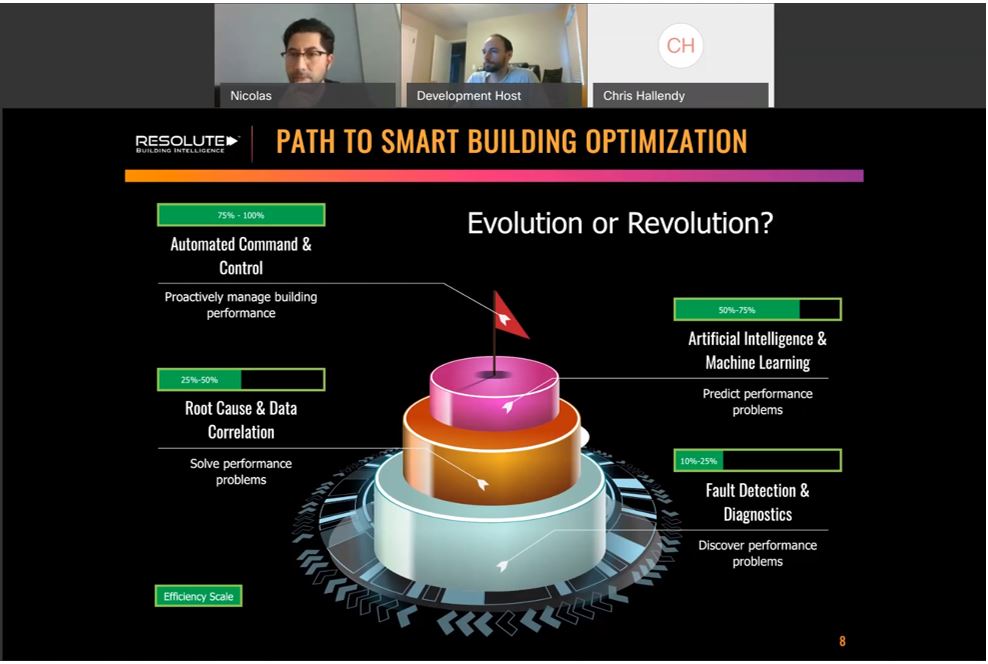
Vendor spotlight on several companies, including Resolute Building Intelligence, with their Building-performance analytics & reporting solution based on Niagara installations. I had a blast discussing the past, present and future with Chad Ruch and Chris Hallendy. The conversation will also be a podcast episode for the new show – with a basis in the extremely relevant 3-seashell strategy.

Resolute Building Intelligence

ii. Resolute Building Intelligence depiction of the Smart Building Layer Cake

Teaser – these guys know what they are talking about. The next step after monitoring is when bi-directionality takes place in an open, secure, future-proof way to get to those cognitive buildings of the future. Something which I can help with for sure.
–    GTM – Go To Market strategies

Go to market strategies through sounding board advisory for a couple of Small-Medium-Sized companies. It’s a classic scale-up advisory where the need is for a scalable, repeatable product to become one with a scalable and repeatable organization—creating solutions to the challenge “how existing companies are meant to die” and how to operate in a supposedly “broken” industry.

Sinclair:  I see that you are making the most of your time in quarantine, very interesting! I understand that there is a lot of Digital Twins there. Isn’t that just a buzz-word?

Waern:  Great question. I think everything sounds like a buzz-word if you don’t have a good understanding of the benefits, limitations and current status of said buzz-word.

I think that the True Digital Twin will take a decade to reach global market penetration. It’s not so much about the technology as it is ways of working that need changing. The TRUE part is a Digital Twin for the entire lifecycle that won’t die. Readers can read more here about my thinking as well as Leading players in the industry.

If we go back to the trusted tool of the BB-cycle, we can see that it’s indeed a long way to industry mainstream adoption. Data shows that this will most likely correlate with more IT-intensive organizations coming into the building automation industry, as well as a younger work-force, demanding new ways of working.

But as the article states, everything is possible right now. And I’m glad that companies are reaching out to me to get it done!

The BB-Cycle – Building Buzz Breakdown

The BB-Cycle

iii. The Building Buzz Cycle – “The BB-Cycle”  – breaking down all the building buzz in the industry

Sinclair:  I can see that you are busy. I guess this is why we are not getting an article from you for March? What do you have for us in April?

Waern:  Yes, I’ve been trying hard to help companies that are busy focusing on their core, to get the most of what the world has to offer as a sounding board for everything future-oriented. Most companies act reactively, waiting for vendor products to hit the market. This is great for the “main-streamers” but not the ones that want to innovate and become digital champions. That’s where I want to help out, in turning knowledge into wisdom in an action-oriented way.

I’m thinking that the May-article will focus on the ways to get to a smarter industry. And for that, I need to read the latest of www.automatedbuildings.com, which I haven’t done after the AHR expo.

Both the April article and even more so in May will hopefully have more bullet points than text, and I’m going to try to keep it very streamlined and action-oriented with practical advice more than anything. My recent connections and already recorded podcast guests, Go-to-Engineer John Sullivan, and Veri Smart City Expert Anthony Veri Jr will help frame that article with their immense amount of knowledge into adjacent industries.

I hope that both the April issue as well as the May issue will be the best ones yet and they will hopefully give some practical advice on the way to a future-proof building automation industry!

Sinclair:  Thanks a lot for this, Nicolas! Any final words?

Waern:  Two things.

  1. I need a name for the podcast.  The leading one is something Chad Ruch came up with.
    How about “Setting It Straight with Nicolas Waern,” to emphasize your leaning tower concept, and what you’re trying to do for the industry?
  2. To continuously encourage companies and people to keep innovating!

As always, don’t hesitate to reach out to me on Linkedin if there’s anything on your mind, and you want to do the right things, as well as doing things right!

/Nicolas Waern

3D-Printing and No-Code-Platforms and Digital Twins, oh my!

“There is nothing so useless as doing efficiently, that which should not be done at all.” – Peter Drucker


Ken Sinclair: Nicolas, two articles this month? And an interview? What is going on? You are leaving everyone else in the dust! Let us limit this to 3 questions, shall we?

First of all, what’s new?

Nicolas Waern: Hopefully, I can get my podcast going, as well as the newsletter. I have 8 podcasts/meetings recorded around some interesting topics. After all, it is the data companies do not have that will change their life, and that is why I am trying to share information.

“The Data to Impact loop will be at the core of every strategy”
– Nicolas Waern

And about article writing, well, I hope it is quality I am putting out there and not just quantity. But you are right, it has been an eventful month to say the least. All this Covid and Corona craze the last month has made me even more productive than before and I have had phenomenal conversations and new customers coming in, and even more in the pipeline.

Discussions this month have been around these topics.

  • Construction companies are starting to digitize more and more, understanding that everything can be improved, and realizing that even more can be removed.
  • Smart City initiatives where data harmonization from different silos need to be merged and trusted for citizen happiness indexes.
  • Smart City initiatives focusing on existing and future resiliency metrics around critical infrastructure and supply chains. Such as food supply, water supply, energy supply and others.
  • Smart City initiatives incorporating a Digital Twin Strategy to find missing data by providing contextual information around hundreds of thousands missing assets in the city.
  • 3D printing companies selling printers able to print 1500ft2 structures up to 4 stories high, ready to ship all over the world, also with engineering expertise to help companies from start to finish.
  • Data Centres utilizing plug and play wireless mesh to see vast improvements affecting insurances, green certifications, and of course resiliency and efficiency on a platter.
  • Blockchain and IoT incorporated in resilient Smart City metrics to understand important trends about the past, present, and the future.
  • Industry 4.0 initiatives where edge analytics is done locally reducing cloud spending by over 90% utilizing distributed logic.
  • 5G initiatives where both private cloud and hybrid clouds strategies will be the norm.
  • Organisational/Ecosystem-wide data strategies emerging as one of the most important aspects of any organization.
  • Digital Twin creation platforms utilizing an ontology of ontologies and a Google/Facebook approach to data manipulation (possibly getting rid of the standards-wars, and taxonomy-wars out there) to get data from hundreds of thousands of assets out in the field in less than 1,5 milliseconds.
  • No-Code/Low-Code Platforms will be the next VERY big thing in traditional industries, enabling people and companies to adopt technology like never before.

Ken Sinclair: That sure sounds like you are living on the edge! Very interesting Nicolas. But it seems like there’s very little method to the madness. Can you please explain how all these things fit together?

Nicolas Waern: That is exactly what my customers pay me to do! But I can say that with new and modern tools, it gets easier and easier to create the things people have always dreamed of, by the people having had the dreams for a lifetime.

Take the Low-code/no-code platforms for instance. Imagine domain experts doing the job of 10 developers, not having to translate information back and forth between different disciplines. Reducing the time, the cost and the complexity needed to do something ground-breaking will certainly make the world a better place much faster than ever before.

Combine that with data harmonization platforms that can take data out of existing systems and silos and create new end2end processes where there is a red thread of all the data. And enabling companies to make sense of not only existing data, but also the data that they did not know they needed.

Utilizing platforms like Platform of Trust allows companies to break silos, see the data trickle out, use self-service tools to make sense of the data in a faster way. And not only stopping at data harmonization, state of the art Digital Twin Platforms like SEKAI can stream data from different applications enabling data to become tied to physical objects. As such, people from different disciplines can make sense of data together through Augmented Reality/Virtual Reality and Mixed Reality, being able to make decisions around a shared truth. All of this without any need for vendor specific standards, protocols, and taxonomies.

And thus, turn data into information, and information into insight, which will hopefully lead to an action and an impact, that is then turned into data, and there we go. The data to impact loop is born, and it will be at the core of everything.

  • Data harmonization at the top.
  • Digital Twin “storage” as the one true source. As it should be.
  • Minecraft world, here we come.

Ken Sinclair: That is truly democratizing smart city innovation… very interesting. I thought that Digital Twins were all about the visual aspects, but you are saying that it is more than meets the eye? Any information/documentation to share? Any other final comments?

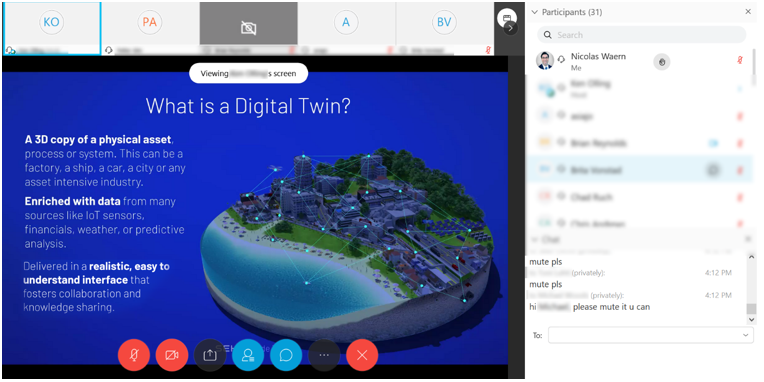
Nicolas Waern: I want to tell you about 3D-printing, but first Digital Twins. It depends on what you mean. As always. A digital twin can mean a lot of different things depending whom you are asking. In fact, I facilitated a presentation last week for 31 industry professionals about True Connected Digital Twins that I believe will revolutionize existing and future developments in all areas. Here is an audio-recording of the session and the folder also contains an amazing presentation (just reach out to me if you are interested in knowing more).

It was a 82% turn-out of the ones invited, which showed that it was something people are interested in knowing more about. Industrial companies with factories, turbines, solar farms, wind farms, automotive, etc are the usual suspects. This due to the fact that they have money, have a need, and still trying to make sense of data in order to improve up-time in factories, and also extend the lifecycle and efficiency of products out in the field.

“There is nothing so useless as doing efficiently,
that which should not be done at all.” – Peter Drucker

However, Construction companies were one of the more interested parties because they have so much information from all different places. Which also makes them very interesting. And construction sites seem to be riddled with coordination challenges, where a no-show might lead to almost exponential cost increases and delays. By pooling in information from different sources, tying that to a physical location/asset, it can save millions for large construction sites.

Digital Twin
i. Digital Twin Creation Platform for construction, systems integration, real estate and Smart Cities

Doing more with less, and utilizing modern tools is the key. But with the advent of the thousands of platforms and technologies, it becomes even more important to tie them into strategy and decision-making. Because even though many companies try to throw some technology at a problem, it is (unfortunately) not always that they can find management buy-in. It is more of a norm that companies have a solid business case, and a way to scale up technology initiatives internally as well as externally.

Knowing where to get started, get going and how to succeed with anything digital these days require an understanding of the global landscape, business as well as technology, and how to piece all these things together. It is as Peter Drucker has famously said,

“There is nothing so useless as doing efficiently, that which should not be done at all.”

Which is the cue for 3D-printing.

I have talked to professionals and companies that have done various initiatives with 3D-printing over the last month. And it has been mind-blowing to say the least. 3D-printing was just a novelty for me, but having seen videos like the largest 3D-printed buildings in the world, made in Dubai last year, I can’t state enough how impressive I think it is.

I believe we will see much more of a demand for rapid strategies, rapid construction, due to the changing landscape of both businesses, and… well the landscape. Due to Climate change a lot of people will be displaced and now also with Covid and Corona, I fear that we will see more homeless people than before. And more people in need of affordable housing. With modern technologies, cities will have the possibility to create new areas for people and families in no-time. There is also a convergence in technology where people can control home energy systems from distances including heating, electric, lighting and ventilation systems. And for cities to be able to provide security services based on CCTV footage data in the vicinity.

This gives cities and municipalities cutting edge tools required to create spaces and places where people can feel safe and have control of their life in an improved way.

Companies like Black Buffalo 3D not only provide aforementioned IoT and Blockchain solutions, but they also build 3D-printers for houses. These can print 4 stories high, and in sections of 1500ft2 (by combining segments very large structures can be built at a fraction of the cost and time of existing ways of working), and the 3D printing industry is still in its infancy, which means that we will see amazing developments happen in the not so distant future.

I definitely think that forward thinking construction companies need to start taking this seriously. Especially if they do not want to spend millions of dollars, and time, on making obsolete ways of working more efficient.

  • It’s not the data that companies have that will change their life.
  • It’s the data, as well as the technology, they don’t have that will change their life forever.

And that is why we are here to tell companies what the world is going to do a month, a year, a decade from now. WINNIIO have a complete understanding of what is needed to stand out from competition, advise on pros and cons, and be the strategy partner for both technology and organization-advice in a Smart World Environment (Construction/Industry/Smart Buildings and Cities).

Please reach out if you have any questions on how to get started, get going, or how to succeed in the next decade!

Sincerely,

Nicolas Waern

Digital Transformation Expert – Helping companies find their role in a Smart City Context

WINNIIO

The New Normal

Achieving a True North Star(s) Strategy

Covid, Corona, Pandemics and the new normal for real estate. This article will focus on the new normal and offer a snapshot of our WINNIIO perspective on what needs to be done. And some ideas on where to get started.

“It’s not the data that companies have that will mean the world to them.It’s the data that companies don’t have that will change their life.”

I see this all the time. Companies are trying to use the data that they have to make better decisions. The information that they have collected and stored for ages on how they have been performing. Utilizing this data inside the silos where it was formed is almost useless. If they want to use the data to do something which they have always done, but better? Go ahead. Companies will move even faster on their dependency and might also move more quickly towards the end.

Companies need to realize that the future is changing and that they, as well as buildings, have to pass the test of time. Leaders and decision-makers need to be looking ahead. If companies don’t change anything, nothing will change.

Yes, companies do need to make data-driven decisions based on the data they do have. But they need to do it in a different context, not looking at it in silos; and not with the same people that are part of the problem. Decision-makers need to boldly go where they have not gone before. They need to invite other perspectives, more perspectives and promote curiosity and viewing problems from more ways than one.

A great way to start is by looking at the horizontal process and inviting all stakeholders to discuss the end2end process together. Using a round table approach where new input is allowed and debated. Because it’s the data they don’t have, that will change their life.

The two things for companies that want to get started, get going, and succeed with digitalization.

The first step in solving a problem is recognizing there is one. And by understanding there is a problem, there is hopefully room for some problem-solving. On the road to industry leadership, companies should start by doing two things.

  1. What is the organizational strategy, mission, vision?
  2. What are the top four problems today?

Number one – re-aligning corporate strategy to the true north star.

This might seem “fluffy” as hell to be honest, and you might be thinking that it does not have anything to do with you, or anything practical.

You could not be more wrong, and I will tell you why.

Have you seen that companies have a hard time justifying new IT investments? That the whole industry has a hard time changing? Why is that? What are the actual values real estate owners deliver to their tenants? For housing, it is probably offering a sense of security for people in the comfort of their own homes. And for commercial tenants, it could be that the buildings should help deliver services that lead to increased well-being and profitability for their tenants.

But today these companies probably say that they collect rent, and their strategies are all about saving money, and energy efficiency. They are not aligned with what their customers need, and therefore, not their buildings. And any investment made, cannot be justified, because they do not have a clue of what value they are failing to provide.  They are using the wrong metrics.

“By getting the strategy right, all investment decisions can now be justified towards the true north star.”

That is number 1. If the strategy is done correctly, everything else will have a more substantial likelihood of taking the company in the right direction. Without it, much-needed technology investments will never happen because they do not provide any justifiable ROI. But if the other option is bankruptcy, and not being relevant, the ROI will find itself rather quickly (hopefully). If nothing changes, nothing will change.

Number 2. The Four P’s. 

Now that the company understands what they should do/where they want to be in the future, they should see where their pain points are. Is it the people, the processes, the IT-systems, the culture, the hierarchy, or something else that they need? Maybe the assets?

Whatever it might be, they should get started somewhere. Usually, it’s best to begin to dig where processes stand, shave off 10 minutes on a process, start with the tasks that take the most time, the tedious tasks, or anything else that is a hindrance to the true north star. The benefits of starting with the low-hanging fruits are that it is easier to create champions of change in the organization and get a momentum going. If companies do not have top management buy-in, this is important. But it could also lead to places where companies do not want to be as summarized in my final words.

Don’t be useless – Conclusion and common pitfalls

The true north star for any company is to provide the value to their customer better, faster, and more efficiently than anyone else. And in today’s world, companies that work with buildings need to make the most of modern tools and technologies.

And it is up to the organization, usually the CEO and the Board to lead this way. If companies do not have management buy-in and start doing things on their own, things could backfire. And like Peter Drucker said,

“There is nothing so useless as doing efficiently that which should not be done at all” – Peter Drucker

Try to get management buy-in, or if that fails, do it anyway. It is better to do something than nothing and then fail fast. The capabilities companies working in the real estate sector needs to have are the same as the building that the tenants are requiring. Companies need to be flexible and to have the ability to adapt and leverage modern technology for themselves as well as for their customers. If companies do not work digitally, whatever that means for the organization or the customers, companies will soon find themselves out of a job, or an asset, or both. The future is based upon adaptability and creating resilient companies and buildings.

Buildings are  part of a larger piece in the whole Smart City puzzle where technology is a small but essential piece.  Strategy, people, knowing where companies are, where they want to go, as well as how to get there before anyone else does, is the key.  Achieving digital leadership requires modern tools as well as partners in an ecosystem, leveraging unique skill sets and working with people in the know of what their True North Star is.

We are here to tell companies what the world is going to do a month, a year, a decade from now. WINNIIO has a complete understanding of what is needed to stand out from the competition, advise on pros and cons, and be the strategic partner for both technology and organization-advice in a Smart World Environment (Construction/Industry/Smart Buildings and Cities).

Please reach out if you have any questions on how to get started, get going, or how to succeed in the next decade!

Sincerely,

Nicolas Waern

Ecosystem Architect – Helping companies create optimal value in a Smart City Context

WINNIIO

    This will close in 20 seconds