“Come gather ’round, people, wherever you roam, and admit that the waters, around you have grown. And accept it that soon you’ll be drenched to the bone. If your time to you is worth savin’ and you better start swimmin’, or you’ll sink like a stone.
For the times they are a-changin'”
Bob Dylan, 1964
To pass the test of time
To keep up with the pace of today’s and especially the world of tomorrow, the next decade, the next 100 years is a daunting feat. Are organizations today able to pass the test of time? Are the decision-makers capable of making the decision based on the future and not the past?
Do the buildings that are built today, capable of passing the test of time for the next century?
What capabilities should a building like that have?
I believe that a building, as well as its components and solutions, needs to be robust, useful, and attractive. It is the same as it has ever been. Buildings must pass the test of time.
Robust, Useful and Attractive – Firmitas – Utilitas – Venustas
Most companies today feel that the world is moving faster than their company. That technology is leapfrogging ahead and that we need to expect more of our buildings, as well as existing processes. That’s where the classic three Vitruvian virtues can help.
“Today, I would argue, that a building has to be able to adapt to its users, to be open, flexible, and that is the true testament on how to pass the test of time.”
Firmitas – Robust back in ancient times meant that it should pass the test of time and to be everything but modular. It was built like a brick house. But we see today that a building must be able to adapt to its users. It must be open, flexible, and that is the true testament to how to pass the test of time. Robust = Modular.
Utilitas – The usefulness must be tailored to the many roles and masks the users wear in a building. The solutions which a building consists of must be useful in themselves. Solutions must be helpful for system integrators, owners, users, guests as well as for other solutions in the building. The only way that will happen is through open standards, service transparency and digital twins—the core tenants of #ND4B, which was described in a new deal for buildings.
Venustas – The venustas part is perhaps the most interesting one and an elusive one in this traditional industry. A building can be both useful and robust, but the emotions it will evoke in a person, if the building is not attractive, will not be enjoyable. A building must be all these three things from the beginning to the end if there even is one. We have seen it with Apple products. And we will see it even more with all products going into a building and even more so with the ones to which end users connect.
This segment was initially posted during my time with Go-IoT as the acting CEO back in 2018.
Resiliency, flexibility and Stakeholder KPIs
But what does this mean for some of the existing stakeholders? What should they be able to expect from buildings? Done right, every stakeholder should assume that the data they need should always be available when they need it. And the time it would take to get the data should roughly be the same amount of time it takes to google something and scroll down to some answers.
Post-Corona and Covid, we see that tenants expect and demand more from their buildings. And we will see that real estate owners need to be able to respond to these demands of their tenants. And to be able to deliver the services that will match said demand.
Is it a reliable internet connection?
Is it mission readiness for the military?
Is it safe for tenants?
Is it productivity, profitability and well-being for the commercial tenants?
Hygiene, clean spaces and making sure the correct certified cleaners are available and know where to go to hospitals?
Or even to find equipment in the hospital?
Find available meeting rooms?
Ingest geographical data, any data, to make better decisions?
Act as node-balancers in a smart city/smart grid environment?
Possibilities to make ancillary incomes through e-commerce ready digital malls?
Services needed to deliver insight into retail?
To harmonize any kind of data from anywhere into actionable data?
It is all the above and more. Buildings should be able to deliver the value for ALL the stakeholders that have anything to do with the building. It should consist of useful, robust and attractive interfaces for all, for all time. And have the ability to adjust accordingly without too much pain. “Ask not what you should do for the building.Ask what the building should do for you.”
Today and the future
Look at the stakeholders of buildings today, beyond the tenants. What will the stakeholders look like in the next decade? The following 20 years? Will it even be possible to deliver the value for tenants with the tools that companies are using today?
Doubtful.
The best exercise to do is to create a map over the existing stakeholders in the industry today. Map out how interactions are made and how they need to shift to cater to the same stakeholders in 20 years. There is no time like the present, and buildings, its components, as well as the companies and people servicing the buildings, need to be able to adapt. Otherwise, someone else will take their place, your place, to do the job better, faster, utilizing modern tools that are robust, useful and attractive; how it should be.
“Your old road is rapidly agin’ Please get out of the new one If you can’t lend your hand For the times they are a-changin'” – Bob Dylan
And that is why we are here to tell companies what the world is going to do a month, a year, a decade from now. WINNIIO has a complete understanding of what is needed to stand out from the competition, advise on pros and cons, and be the strategic partner for both technology and organization-advice in a Smart World Environment (Construction/Industry/Smart Buildings and Cities).
Please reach out if you have any questions on how to get started, get going, or how to succeed in the next decade!
hanks to Ken Sinclair, Rick LeBlanc, Rick Rolston, Therese Sullivan and Brad White for inspiration and comments in an email conversation. YOU are the inspiration! (Please click the link and listen to the sone when reading the article for some added ambience).
The head of research here in Sweden from the largest PM company in the Nordic said that more people were moving to Stockholm from abroad than it was internally in Sweden. Swedes are moving away from the city out into the suburbs or rural areas. This was even before COVID, whereas now, I predict this will increase.
Location, location, location, in the big cities will matter some, but they probably will not drive innovation. The big player HQs might, but not the city as a whole. It might be different in the US, but still, more people will move domestically from silicon-valley type settings to more suburbs, rural areas, keeping most of the salary if not all, but still working from wherever. The companies that are 3D-printing houses, and building smart from the start could buy up some land in rural areas, develop properties, and make a… living? 🙂
i. The background for my new newsletter/podcast series that should come out in June if all goes well – Beyond Buildings.
The semi-old-new-not-so-normal? Some thoughts. Routine will soon enough set in and that a lot of things will go back to some kind of normal. But, the workforce, the global landscape, government income, all these things will change a lot, and the US especially has a lot to do in comparison to most countries around the world, which might drive innovation even faster than other places.
Will the gap between the poor and the rich increase or decrease?
There is a lot to be said about the Covid-response and differences to Sweden and the US, but I don’t want to get into politics. Personally, I dislike the stance Sweden took/did not take, sacrificing the lives of the people who built this country, but some other aspects have been… Okay.
Buildings will become more proactive, predictive, and possibly also prescriptive once the data-impact loop has settled in where people understand what the data is telling them, and are able to take action on it.
Industry 4.0 I am involved in a possible new build of a factory here in Sweden where it seems that industrial players also want to do more with less (who doesn’t?). Partly because they want to, but most importantly, because they have to, where energy savings will be a bonus for trying to get the building in shape. The classic one today is the gap between the production line digitization and everything else, including the HVAC side, but also MES systems in general and how to expand digital maturity seamlessly.
The new build will definitely be building the digital twin first, and then the building will come. Then in 3 years, when they will actually build it, they’ll probably 3D print it, build it Smart from Start, and have it connected throughout the company, the supply chain, making the building TRULY aware of what it needs to be aware of. And not only the building, but the people in it.
Touchless and hospitals
When talking about touch-less interfaces, that can also mean voice, which is rather simple to do. I’ve been talking to some specialist companies in the field, Talkamatic, which states, “Dialogue first, user firstest.” Could/should be an alternative to other mechanical approaches.
I also recently got in touch with some people responsible for FM in hospitals as well as tech vendors providing digital twin connectivity through and through not only making the building smarter, but also predicting, preventing, and reducing the number of lives lost, through a holistic view of what’s going on. Post-COVID compliancy will be at the forefront in most areas, I assume, but not really Sweden. Here, no one really cares.
Some of the questions I still see Ecosystem thinking is beginning for real, where vendors, customers (especially customers) understand that no one solution can do it all.
But, there are a lot of questions right now. Where the most obvious ones are, how do we start? And if companies have started, how do we continue? And if they have continued, how do we measure success? And some other questions below.
What is the digital maturity now – what is the “now situation in general” of a building?
People are trying to throw tech at problems they don’t know enough about.
What is it that they want to achieve?
How far should we take it?
What are the first steps?
How to avoid vendor lock-in?
How do we integrate the thermal, the IoT, the HVAC/BMS, classic IT/OT/IoT conversion with sensors, etc.?
What does it mean for us as a company in our field _____?
If wireless, what to choose?
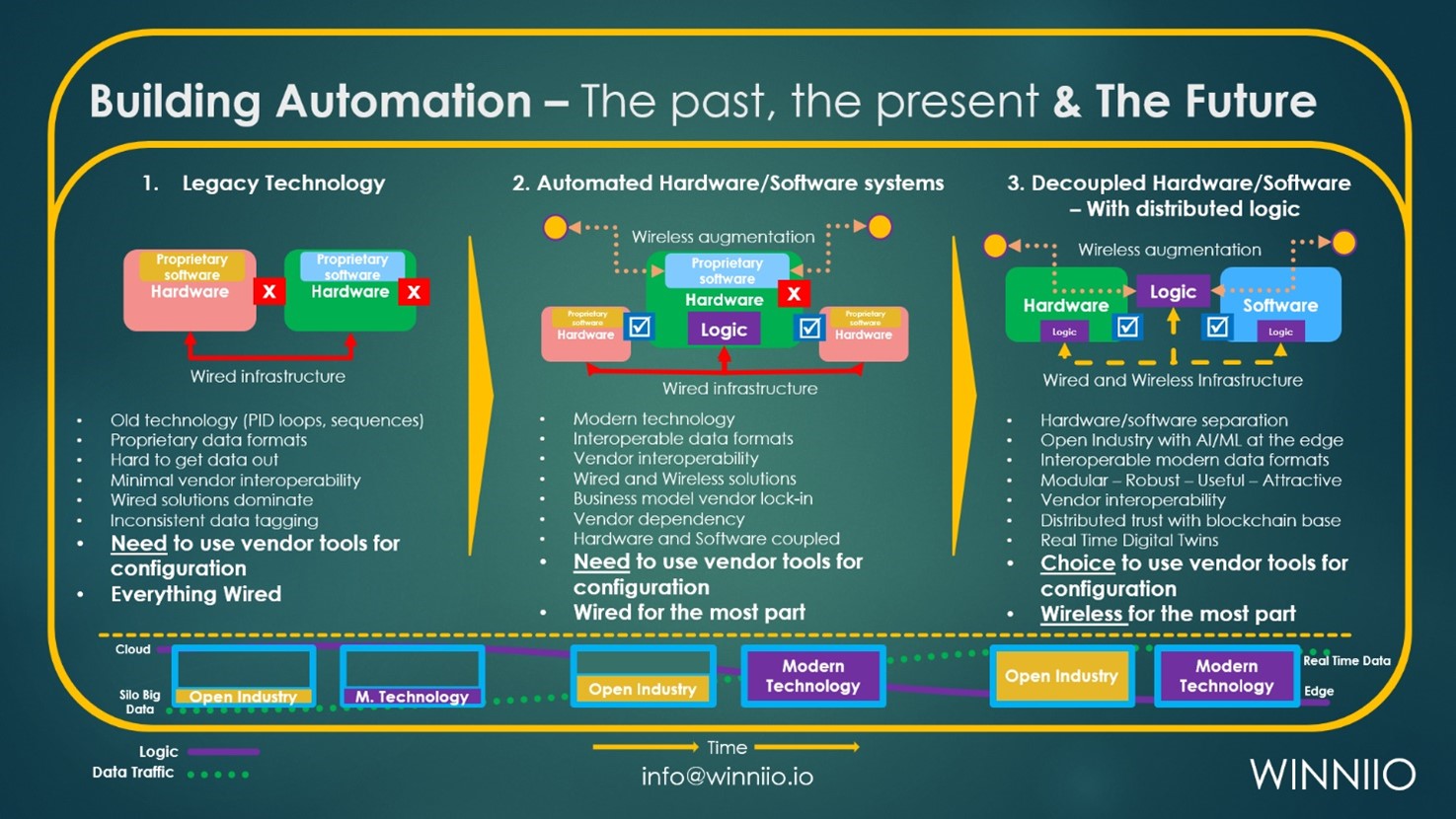
And for the more mature ones, what does the data strategy look like, security aspects, legal, regulatory, edge and cloud in a hybrid approach, distributed intelligence, harmonization platforms, REAL digital twins, and again, an understanding that the ecosystem play is the way to go and that hardware needs to be commoditized where sw and hw need to be separated, where control strategies aren’t held hostage by vendors.
Four years ago, the legendary rocket-scientise, energy expert, overall snake oil advisory thought leader – Brad White wrote this seminal article below. You could see it was a while ago because his hair was short and not the Kurt Cobain-esque, statuesque energy guru that he is today.
Is the Trillion Dollar Opportunity here now? Well, yeah, it’s always been here. BUT, will someone grab this opportunity by the forelock, and go after it?
YES! Probably everyone! Is it happening right now? Yes, most likely! Wellbeing, health, people health, building health, all of this will be in focus, where energy savings, as well as lower maintenance costs, will be the added bonus of turning dumb buildings into smart buildings and creating future-ready facilities.
will definitely be the norm, and my thoughts are that the workplace side, co-working stuff (we-work but for real) will drive innovation in a smart “large” town kind of way, and not so much the big cities. They are still extremely complex where People, processes, existing systems, culture, hierarchy stand in the way of doing something fast, that works where people, companies, can reap intended benefits.
The definition of done and business models is also not there yet. I was in a Smart City seminar this morning, and they deemed that the first cycle was ready when everything was “in place.”
…. in place of what? Sensors sending data to somewhere? Is just open APIs enough? Or should someone be able to make sense of the data and to turn it into information? Or that information into insight? Or that insight into some action? And for that action to have been measured to some impact? What’s the definition of done?
And also, what’s the business model for companies providing solutions? Capex or Opex? Can they be flexible? How proven is cutting edge? And how obsolete is proven?
To bike or not to bike Will more people take the bike? Will more people walk? Possibly. But still, the US seems to be built for cars. And there are predictions that the COVID craze will lead to less public transport, for obvious reasons of social distancing etc. Although, when unemployment seems to rise, the question is if people can afford to spend. Will car-sharing improve? Doubtful again in regard to contact tracing.
Biking? Possibly. Maybe invest in an electric bike, leasing something, and if you get it before the first of July, we’ll through in some high-velocity safety masks as well. Guaranteed to stop bugs coming your way – Corona-and-the traditional ones.
One thing is for sure; the companies not having a strategy will be left by the wayside because buildings are becoming more and more part of a Smart City context. Luckily, I help companies find their role in a Smart City context, so just reach out if you need any help!
Those are my thoughts right now, definitely subject to change so ask me again next week. 🙂
/The (Swedish) Smart City Shaper – Reshaping cities for future generations
“Innovation doesn’t start with the future. It starts with the now and continues into the future”
It’s critical to begin the journey in realizing Smart Buildings with the end in mind. Picture not only the buildings and what they look like but also the organization in the future. What will it look like? What business objectives have been set for the next year, two years, five years or decade? Strategy is the map, design is the route and implementation provides the vital milestones you’ll need to ensure success.
It is often found that if the changes identified could be undertaken, many of the benefits could be realized with current systems, indicating that the problem is the way individuals are working or using existing systems or the inability of the organization to implement ‘best practice’. A concentration on the business benefits and the change management implication at the start of the process will also encourage business managers to become involved. The challenge is that while technology should be the enabler, and the tool to realize business benefits, it’s not seldom that companies talk about the tools more than they talk about the benefits that should be derived. Innovation doesn’t start with the future, it starts with the now. And continues into the future.
“Innovation doesn’t start with the future. It starts with the now and continues into the future”
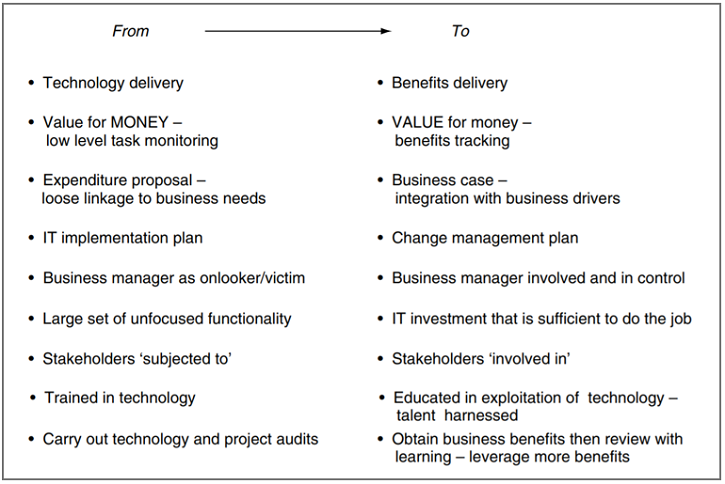
i.Comparison of benefits management with traditional IS project approaches, Benefits Management by Ward & Daniel 2006
The effective engagement of business managers is often lacking and it is recognized as a factor that repeatedly causes organizations to fail to realize benefits from IT-initiatives. Discussions that are essentially about the functionality of IS/IT, or are dominated by this, are usually of little interest to business managers who can even feel threatened due to their lack of technology understanding and are therefore unable or unwilling to contribute to the project.
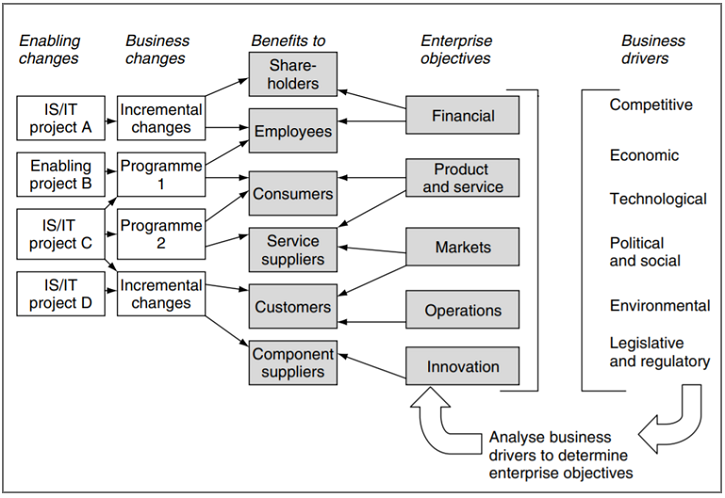
ii. Business strategy described as a high level benefits network, Benefits Management by Ward and Daniel 2006
Starting from the right, understanding the global context, what drivers are needed and then reverse engineering this to understand the “as-is situation” could be the key for future innovation efforts. This could be tailored to not only the enterprise objectices, but also to specific initiatives where companies know what the desired outcome they are looking for. An example of this could be a decision maker that needs to make data-driven decision making on how they should work with Smart Buildings in the future. What would be the benefits they are looking for? For whom? What changes needs to be done? Who would own then, and at the last stage, what technology should be used to make these changes happen? Understanding the as is from an organizational perspective is vital because technology is the easy part. Because as I’ve argued before, existing companies are built to die. But with this approach, they will definitely increase their likelyhood of success.
One key aspect of the benefits management approach described is to create an environment in which both business and IS/IT staff participate fully and willingly in the discussions, to contribute and share their knowledge and learn from their colleagues. These conversations would also benefit greatly when having a Digital Twin perspective in mind, adding to the fact that they have a shared understanding in both the benefits that they want to derive. And also that they now have the visual building in the middle, where they can actively show how investments could be beneficial for whom, much easier.
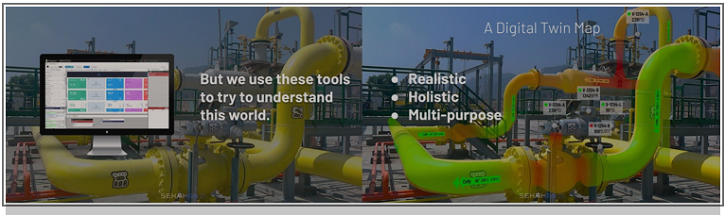
iii. The same data, the same infrastructure, but with visualization and benefits realization in mind
The most important rationale for joining up the network is to understand the dependencies between the identified changes, the people and stakeholders that need to be involved and the realization of benefits, and who owns what part of the process during the initiative. The linkages show that a given benefit will only be realized if the connected changes are successfully achieved.
Where the digital twin once again provides the contextual value necessary to bring it home, and act as the one true source of data for the whole lifecycle. Also utilizing harmonization tools, it is easy to grab asset data from one data source, add that into either just a drawing, or the BIM models that have been handed over from the construction phase. Easy right? Yes, it actually is. But who will do it? Who can do it?
Mind the gap – handover, what handover?
And here is the big problem. Today, with how current companies are working/not working, the value that should follow the building during the whole lifecycle gets destroyed during the handover phase. That is why all this technology focus, in silos, talking about what constitutes a digital twin, doesn’t always make much sense from a real-world perspective.
Because who will buy it? Which company today during the asset management phase have people responsible for digital twin management? Who has the people that know how to create value from it during the entire lifecycle? Who has the culture of wanting to innovate and create value during the asset management phase, where benefits are talked about and there is an actual vision and mission of providing value to whom? Do companies have a North Star-strategy depicting what the New Normal means?
In the world I live in, no they do not. And that is the challenge.
I’m writing more about this over at Beyond Buildings where’s there’s also some in-depth material to understand this challenge to its core. Because it is such an apparent problem that no one seems to understand or care about. Possibly due to the simple fact that communication across disciplines with the building lifecycle in mind, does not happen, at all. Not within the different disciplines during the construction phase. Especially not during handovers, where there’s a rush to get things done. And the utilization of modern tools in the property management phase in a holistic, organizational way, is not how the world operates. Yet.
Which is why WE need to go beyond buildings, understand the benefits that needs to be derived, use modern technology to do things better and start realizing the TRUE potential of buildings.
And that is why I am here to advise companies what the world is going to do a month, a year, a decade from now. WINNIIO have a complete understanding of what is needed to stand out from competition, advise on pros and cons, and be the strategy partner for both technology and organization-advice in a Smart World Environment (Construction/Industry/Smart Buildings and Cities).
Please reach out if you have any questions on how to get started, get going, or how to succeed in the next decade!
Sincerely,
Nicolas Waern Digital Transformation Expert – Helping companies find their role in a Smart City Context WINNIIO
A big thank you to Melissa Boutwell at ASP who helps owners realize the true potential of buildings by educating their employees stay in the now to deliver value for real. To Sam Holt at JE Dunn who’s the national Director for Construction company JE Dunn, enabling the industry to build Smart from Start. Ken Olling at SEKAI, Digital Twin creation platform who helps companies take decision on ALL of the data. Toni Luhti at Platform of Trust who helps companies harmonize data from different sources without the need for taxonomies and ontologies. To Mats Persson at Tribia.as who’s helping construction companies with BIM coordination and value realization during the whole lifecycle. Thanks for inspiring me to write this article. And a big thank you to my former Professor, Kalevi Pessi for introducing me to the book Benefits Management by Ward & Daniel on how to deliver value from IS & IT Investments.
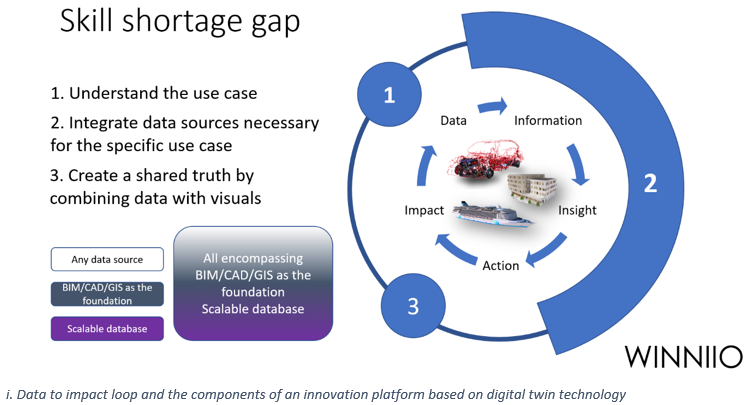
We are not only looking at a skill shortage gap, but also the skill transfer/knowledge transfer gap.
Do you want to solve problems for real? Do you want to collaborate with experts all over the world, and realize the true potential of buildings from a lifecycle perspective? Do you want to stop making decisions in a vacuum and share ideas with others all over the world? Reach out to me here on Linkedin if interested and stay in tune with Beyond Buildings where we will announce something shortly. We are about ten people already from the entire lifecycle that want to solve problems for real, together. It is energy people, FM, technical asset managers, HVAC people, owners, construction, consultants, IoT-people, smart city people and others. And now, on to the article.
Setting the stage – skill shortage and knowledge transfer
We are not only looking at a skill shortage gap, but also the skill transfer/knowledge transfer gap.
How, if ever, can we make people from different backgrounds agree on a shared truth?
How can we enable collaboration and communication between experts in their respective field, and with people with zero understanding of HVAC, lighting, pneumatics, valves, BACnet, vendor lock-in, the cost to do something, where stuff is, etc etc.
How do we get them to collaborate?
How do we transfer the knowledge from the one person who knows everything, into the minds of the 5 people with different backgrounds, working in separate parts of the organization/building?
How do we agree on a shared truth between engineers when they only have access to BI-dashboarding tools, that offer a glimpse into a part of the building that is also reserved only for experts?
“Trying to learn what Web Services Digital Twins are by dissecting the acronyms is like trying to learn how to drive by studying an automatic transmission” – (Paraphrasing) from the legend Steve Tom (from his seminal article about BACnet/WS in 2004)
Agreeing on something that is based in space and time Picture a factory. That factory consists of systems that are usually not interconnected. They consist of HVAC systems, the actual pipes and plumbing, people, manufacturing processes and people with responsibilities in different areas.
Suddenly! A pipe bursts on the far-left hand side of the factory!!!
What to do? The one in charge of that has no clue where it leads to, and their BI dashboard does not show the correlations to the entire plant, only their area!
The one that knew all this retired a month ago, and the 4 people in charge do not know where to start and how everything is connected.
And the one person that has an idea, cannot explain well enough, nor get the understanding from all the different dashboards.
What do to?
Luckily – they invested in an innovation platform the other week that solves these challenges! What does it do?
They have integrated the data from different applications, sensors, and systems across silos into an innovation platform that is built upon a Digital Twin database.
It absorbs data from any kind of source, irrespective of standard, API, and it makes sense of the world as it is by mapping data sources to a non-industry specific ontology.
Initially, data was mapped towards the visual aspects of the Digital Twin and attached to CAD/BIM/GIS data from a template building/the real building to enable people to understand and see the space that they are all in.
Everyone can see why the pump burst, what it is related to in the entire factory, and they can all agree what the problem is, and what the solution is. As well as run simulations what will happen if they do x y and z and get suggestions from the system itself.
They can quickly come together and determine what needs to be done since the systems are talking to each other, and that people can communicate around a one true source that is the visual digital twin. Not just dashboards.
Other data that hasn’t been available help them in an invisible way of making decisions by eliminating possible outcomes that are too risky, too costly, or will lead to unintended consequences for any of the other disciplines in the factory/or organization.
This pipe bursting is of course a hypothetical case since this would not have happened in the first place. Everything would have been connected and this would have been prevented before it happened. Managing risk, is after all one of the major benefits with a connected innovation platform.
Why this is important
Since everyone today is working in silos, ALL companies have a problem creating solutions that work flawlessly in the real world. Therefore, companies are not realizing their expected return on investment when executing AI-initiatives and analytics efforts in scale. People are not collaborating as they should be, and there are not the laughs and real-time decisions we read about in the beginning of the article. People are not hailed as heroes, legends, and heroines. It is more about scapegoats, and everyone is trying to protect their piece of the fiefdom. Whole organizations have a problem seeing the big picture and this is detrimental for the world since we need better solutions now. Maybe even yesterday.
The skill shortage gap will not go away in the short term but utilizing systems that can bring data sources together AND visualize them in an understandable way is the key. BI dashboards are, and forever will be a remnant of lost times made for experts working in silos. They can exist, but there needs to be more. Automating work that should be automated. As well as minimizing the dependency on people that knows everything. With an approach that can scale across boundaries and systems, we will see an exponential increase in levels of collaboration and communication, and faster time to market for innovative ideas, control strategies for the built environment, and more holistic undertakings at large.
If you want to read more about this and also understand what the future will look like, head over to Beyond Buildings for the full article! My role is to advise decision makers and companies what the world is going to do a month, a year, a decade from now. WINNIIO have a complete understanding of what is needed to stand out from competition, advise on pros and cons, and be the strategy partner for both technology and organization-advice in a Smart World Environment (Construction/Industry/Smart Buildings and Cities).
Please reach out if you have any questions on how to get started, get going, or how to succeed in the next decade!
Forget about Smart from Start, antifragility, and classic business models that don’t offer anything new. The future will be about buildings that stay relevant and get exponentially smarter over time.
“You can save hundreds of millions of dollars with continuous improvements to a Smart Building, which is a stark contrast to other Building Automation Vendors that do something else continuously:
– Ask you to pay again!”
A Battle of business models
One of the major reasons why Smart Buildings are winning against its competition hands down is completely overlooked, underrated, and rarely mentioned. It is the continuous value creation for customers and that buildings grow better over time. Other manufacturers have no answer for this.
The companies creating Smart Buildings will add value for its customers like no other companies in the world. I am not talking about safety features, being fun to be in, or sustainable energy efficiency of soft values, but about hard dollars in the pockets of companies, tenants, and especially real estate owners. This has nothing to do with automated buildings, or AI-infused robot buildings, which, if they arrive one day, will add 6-digit value appreciation on top.
What we are experiencing today is not a competition about who has the best net-zero building with the best energy efficiency rating on the planet, the best technical asset management team, or the newest silo solution from a building automation vendor. What we are experiencing is not a competition between automated buildings and traditional buildings, but the competition between two contradicting business models.
“When Smart Buildings will become the norm, it will make ALL the difference”.
The incremental value Smart Buildings create per building for its customers is higher compared to other buildings, and that is critically important for a successful business.
Smart Buildings will be the norm because if owners, as well as tenants, get a better deal financially, why should they ever buy again from the competition?!
Why would anyone want to use an old building when a Smart Building is so much better?
And that it also has the possibility to get better over time, for free?!
The business case a smart building offers to its customers is worth some hundreds of thousands, up to millions of dollars per building over 10 years, and no one can compete with that.
Are Smart buildings the most misunderstood opportunity in the world?
Even today, with continuous strong coverage in the media and a ton of analysts turning every stone over to understand the potential of Proptech, Digital Twins, Smart Buildings and Smart Cities, almost nobody understands the basics of the possibilities of a fundamentally different business model.
The approach from incumbent Building Automation vendors to sell solutions with enhanced hardware features makes sense since they earn money with every solution sold, and even more important, with spare parts, lock-in effects, and services in the aftermarket. Their global fleet of hardware/software offerings is the cow they milk until it dies in an accident or by old age decades later. And they still get the business because they were there first, the lock-in effects are too great, there’s only a handful that knows the system, or an SLA that is infinite. Why not compete on value and outcomes?
Without the after-sales business, most Building Automation Vendors would be structurally unprofitable, because the revenue stream from the continuous lock-in effects is tremendously large and much more important for their bottom lines than new building solution sales.
Suppliers of Smart Building solutions will initially not have a large offering or significant after-sales business, so how can it make any profit, especially when giving continuous building improvements away for free? If you do not have an answer to that question, you do not understand what a Smart Building solution will provide for its customers.
If you want to read more about this and understand what the future will look like, head over to Beyond Buildings for the full article! The full article is an 82,6% intentional copy-paste ofthis fantastic article by Alex Voigt which is depicting the business model introduced by Tesla. The article intrigued me because it was eerily similar to what I believe is happening to the Smart Building industry.
The reason why I read everything is because my role is to advise decision makers and companies what the world is going to do a month, a year, a decade from now. I try to have a holistic understanding of what is needed to stand out from competition, in order to better advise on pros and cons, and be the strategy partner for both technology and organization-advice in a Smart World Environment (Construction/Industry/Smart Buildings and Cities).
Please reach out if you have any questions and comments or if you have any ideas on what I should write next!
What have we learned, and what thoughts and questions have arisen from the first two episodes?
Falling in love with Smarter Buildings
In episode one of the series we talked to Tommy Hagenes who came from the building automation side and is working with Smart Technology and is a driving force in the Proptech space. We talked about what he is doing, what the differences were with APIs, BACnet introduction, secure communication to and from the building and that BACnet still has its place. It was a great episode and I remember laughing and learning a lot. It ended with us discussing if building connectivity challenges.
Questions after the episode:
· Should building automation systems be in the cloud?
· Should logic reside on the edge?
· What will 5G and distributed intelligence, small footprint AI-algorithms have to do in a Smart Building setting of the future?
· What is the ultimate connectivity strategy to create sustainable buildings with a software/hardware layer that can pass the test of time?
· Do we need a decoupling of hardware and software?
“AI is not a magic wand; it is not Terminator; it does not mean dystopia; it is just a tool. Treat it as a tool designed to make lives simpler.” – Garry Kasparov – Dealing with inevitability
Taking buildings to the cloud and into the future
In episode two of the Beyond Buildings Podcast we talked to Chris Hallendy and Chad Ruch from Resolute Building Intelligence on how they solve problems for customers. They are using the ecosystems approach to some extent, and leveraging the Niagara framework and Honeywell systems approach. We talked about what is going on in today’s landscape, what AI means in the context of building automation, getting data in and out of buildings and also about the data-strategy side of things. Resolute has spent millions on setting up a robust cloud infrastructure to support their customers and I remember that I brought up the edge strategy side of things as well.
Questions after the episode:
· How will distributed and edge intelligence affect cloud spending and cloud strategies?
· Where to start with crafting a data-strategy?
· When is a good time to start with AI and Machine learning? (yesterday)
· How can building infrastructure be designed to pass the test of time?
· Will future companies be software companies that just happen to do real estate?
· What are the drivers for change in this industry and how to align with where the world is going, as well as where customers are right now?
The answers to these questions
These episodes were recorded “a long time ago”. I don’t know about you but I learn something new in every meeting I have and what was right 6 months ago, should definitely be right now as well, but the context just keeps getting larger and larger.
The episode Digitalize my asset with the legendary Tyson Soutter answers a lot of these questions above and newer episodes that haven’t aired yet will cover most of them. Especially more about digital twins and a natural way of utilizing modern technologies like 5G, AI, ML, edge and distributed intelligence, in a way that people can understand. And not only understand, but also allow them to work in their respective silos, but with a shared context.
The overall summary is that traditional companies need to start to innovate. They shouldn’t necessarily step out of their comfort zone, but actually more stay in it. And define whatever challenge they are having and then work with professionals in getting it solved. If you want to stay in the know, and figure out what the world is doing today, and what it will do a week, a month, a year from now, just let me know!
The reason why I read everything is because my role is to advise decision makers and companies what the world is going to do a month, a year, a decade from now. I try to have a holistic understanding of what is needed to stand out from competition, in order to better advise on pros and cons, and be the strategy partner for both technology and organization-advice in a Smart World Environment (Construction/Industry/Smart Buildings and Cities).
Please reach out if you have any questions and comments or if you have any ideas on what I should write next!
Sincerely,
Nicolas Waern
“Smart World Architect” and Digital Transformation Expert – Helping companies find their role in a Smart World Context
To achieve this below – What would you do? How would you go about it?
“To develop a wireless, self-learning, platform-independent, open (software, API, hardware) control monitoring system that in a continuous optimal way can handle the situation with multiple conditions as described above. The system must be flexible and optimize the heat supply with considering the room (the individual radiator) via the house (the in-house system) to the energy supplier and energy producer. The system shall strive for the lowest possible CO2 emissions for the existing heating system.”
What would you propose? (If anything?)
Background
The background to this article was based on a Smart City tender that we have been pushed through to the final round. A medium sized city in Sweden wanted companies to respond to their public tender that was focused on innovation. The municipality was after exactly what was written above clearly stating, that this solution does not necessarily exist in the market today.
Upon reading what they were after I believe it would be something that most of (future) real estate stakeholders would like to see. All feedback on my thoughts would be appreciated greatly and I hope it might inspire some of you as well. The tender revolved around creating a Smart Heating for 130 buildings of mixed real estate where the first pilots were focusing on three schools. They had an existing IoT-Platform and some other contextual factors to adhere to, but nothing out of the ordinary.
This was the background for a Virtual BAS/BMS.
The dominant way of heating buildings is a radiator and pipe system with water as heat carrier with a thermostatic valve at each radiator that mechanically reacts to the room temperature. The conventional control technology at the radiator is rough and not continuously optimal for the heat supply to each radiator should be optimal from a system perspective (room-building-neighborhood-district) depending on the current room temperature needs and current global conditions (weather, presence, thermal mass, booking situation, etc.). There is thus a great potential here to develop new digitally based control and monitoring technology / system for both existing and new buildings as well could be used in e.g. cooling systems.
And this is (again) what they were after.
The one Solution to rule them all?
“To develop a wireless, self-learning, platform-independent, open (software, API, hardware) control monitoring system that in a continuous optimal way can handle the situation with multiple conditions as described above. The system must be flexible and optimize the heat supply with considering the room (the individual radiator) via the house (the in-house system) to the energy supplier and energy producer. The system shall strive for the lowest possible CO2 emissions for the existing heating system.”
That sounded very interesting. So, I pulled together some 7 other companies, formed a consortium of sorts, and sent in a proposal based on the thinking below. Part of the inspiration for the approach came from the amazing solutions from Passive Logic. And seeing they raised their Series A just now and that I have a good idea of what they do and don’t do, made me wonder what the future could look like. And I’ve also been looking at BrainBox AI that also raised some money earlier this year, and what they are doing in this space.
However, I’ve also been talking at the AHR expo about Obstacles and Opportunities for HVACR in the Next Decade where Troy Harvey (one of the founders of Passive Logic) also took part. And that made me think about more of where the future is heading. And since I was also a speaker for the Next Generation HVAC Controls: Open Discussion For Open Future, this lead led me down the path of openness. I wanted to at least try to see if I could come up with something that would be open enough based on what I believe is the future of building automation as described below.
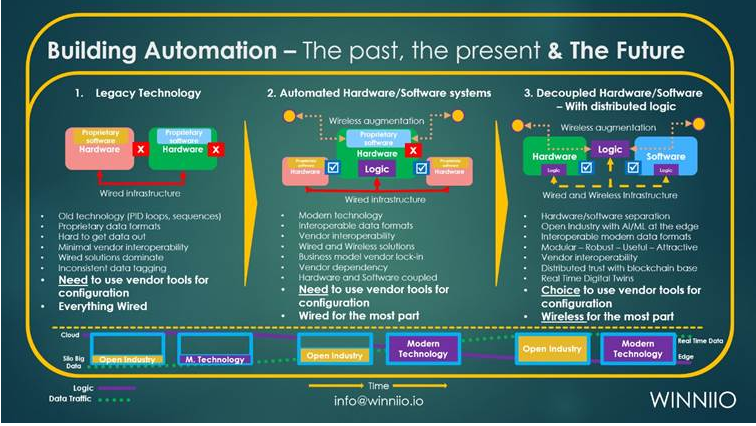
i. The past, present and Future of Building Automation
So that was what I set out to do. But it was not that easy. I was thinking about the API economy and the pitfalls, and if my thoughts would just be creating a Frankenstein’s monster as Brad White said to me once.. or twice. I saw the challenges if the municipality wouldn’t have one “throat to choke”, but also about vendor-lock in, knowledge transfer, skill-shortage gaps, IoT, AI/ML, stream processing, Digital Twins, data-strategies and basically anything and everything that I have learned over the last 5 years.
What would it need to be built on? I could of course create something of my own with some money, but I also did not want to re-invent the wheel too much if not necessarily needed. I talked to several industrial IoT players, and solutions from Loytec, Distech, EasyIO, Lynxspring, Schneider, HMS (the latter was because of a company they are working with, making it easier to distribute AI/ML algorithms from the edge to the cloud) and others. But I did not really find exactly what I was looking for. HMS had an industrial controller that took OPC UA to MQTT, but they did not have BACnet. Intesis had BACnet, but then it had to be daisy-chained together with the more industrial solutions and I was not really into that, even though it might be an option. However, A shout out to the Gateway Guy Eric Dunn, as well as the great Industrial Connectivity guru from Sweden Oliver Hammarstig who pointed me in the right direction. I did get to talk to representatives of their Industrial lab, so the bets are still out!
I was reminded of Ankalabs from the all-knowing Global Business development Manager at Siemens, Tyson Soutter, which was indeed a great reminder! Tyson knows the ins and out of Building Automation which he displayed in this amazing podcast session earlier.
I had gotten a showing of the Ankalabs solution in Atlanta this year while attending the AHR expo and last year in Chicago. It looks amazing and I am very fond of Sedona as well. But I was especially wondering if/how it would fit into the Swedish narrative. And to be honest I am wondering if it is needed to go that deep down into the open waters? But, maybe it is?
I found pieces of what I think I needed from a more commercial perspective, but it would have to be daisy chained together and that would add complexity as well as cost.
“Knowing whom to ask is one of the most important things in my world. “
As described, it was my original intent to achieve complete separation from hardware and software. It needed to be wireless, as well as future proof with bi-directional capabilities and AI-readiness to as much extent as possible. But the truth is that I have been focusing more on the bigger picture the last year, advising decision makers in multibillion corporations. Maybe I had to go back to “basics”?
The Pillars
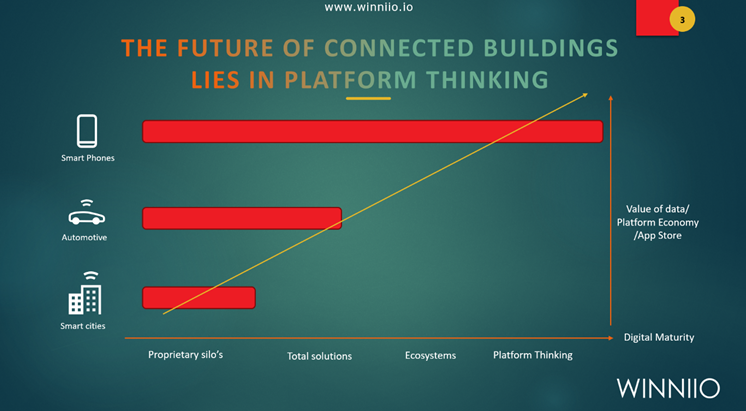
One API to the building approach since that was how I started when I was at Go-IoT, and I still think they were on to something big in having BACnet/IoT everywhere, as in sensors as well as Cloud. I know their solutions are lightning fast and they have sensors that talk BACnet natively, which is part of what I was after.
But at the same time, I also try to look at what companies are doing when it comes to really pushing data around and what kind of architecture is needed. The OTA approach (Over The Air) that Tesla is known for, what Netflix is doing and what 5G, 6G can enable and all these things from an ecosystems perspective. I still do not believe that it makes much sense to build the future on yesterday’s technology or outdated views of what data means, based on a nostalgic perspective. Which is why I just wrote down some things that the solutions could/should adhere to that I could get into a solution in a couple of days.
Some of the pillars that I believe should be in there:
· Remote access
· Separation of hardware and software
· Security out of the box
· Open source where possible
· Having the ability to connect to other parts of the building in a natural way (lighting, AV, access controls, etc)
· AI abilities as easy on the edge, sensor level, as in the cloud and the possibility to shuffle algorithms at will between any part of the system
· Ability to adhere to multiple stakeholders on top of the infrastructure, enabling a future ecosystem approach
· Democratizing Smart Building Involvement at all stages during the lifecycle
· Interoperability and one standardized API to the building
· Being able to work with ANY standard, not just domain specific ones such as Brick, Google, Haystack, REC etc.
· Wireless was a prerequisite and if possible, also wireless RS-485 to transport data between HVAC-R equipment if there were no real BAS/BMS on-site (I didn’t necessarily want Modbus because of potential tag-list problems, but at the same time Sweden only have Modbus so that could make some sense if I would be able to get it into how it would be installed).
· OTA possibilities and security ingrained, not just as an afterthought
· An idea that it would be code based as much as possible and not PID-loops, ladder logic, as such (which is what I remembered about Loytec that they had JSON APIs).
· Building agnostic, working in the same way for retail spaces as well as commercial entities
· Virtual BMS More akin to the PC-industry in the sense of install/uninstall BAS/BMS solutions on top that is in no way tied to the hardware side of things. Anything and everything interoperable/replaceable.
· Scalability in the API side of things as well as the DB, with “graphing” in mind
· Having a building, a portfolio, that would be aware of what it would be aware of in a Smart City context
The ecosystem approach
I wanted to create a BACnet environment in the building to keep it interoperable and then use some security something from a combination of Tempered Networks, Tosibox, with maybe some Totem thrown in there together with some other players. I knew that if I needed additional vendor vetting, based on the outcomes I was looking for, I would just reach out and pay Anthony Veri for some consultancy time to get me where I needed to be. Knowing whom to ask is one of the most important things in my world.
I looked at Finstack from J2 and I had a quick chat with Prabhu from Facilio, Dave Lapsley from Sentinll/Swarm Neuro, and Reza from Envio that all have great software solutions to run a virtual BAS/BMS. They all have stellar solutions that could more or less work from a “one API” to the building approach creating smart buildings over the top. A big thank you to all of them for taking the time to inform me about their solutions.
I also talked to the great Chad Ruch about what he saw in the space and he pointed me in the right directions to EasyIO and others.
I considered Digital Twin creation platforms as well but a lot of them were too industry specific, or just re-branded BI dashboards into Digital Twins over-night such as the offerings from Microsoft Azure and their Digital Twin solutions.
I wanted something that could ingest data from everything and could only find one that I liked. Their ability to handle real-time data, have scalable everything, visualizations from Unreal engine is still unparalleled from what I have seen so far, and it can be applied to any industry.
AI is a must these days which is why I talked to the head of AI at the largest player in societal transformation in the Nordics about what they had done in this space, having worked together for a Smart City AI-algorithm creation hackathon. And they said they have managed to put an algorithm on a Raspberry Pi that works with basically any building type, just optimizes the set points based on data-driven knowledge. That had resulted in about 15% savings, which of course, was very interesting.
I also had an interview scheduled for my podcast BeyondBuildings, with Kai Waehner, the real-time legend that is helping global giants transfer millions of messages per second, to see what he was working on. That helped as well with the data-strategy and the logic. The episode with Kai will come out in a month or so and I promise you that it will be amazing! Here are some good use-cases with Kafka. And if you haven’t read about it yet, you are in for a treat. I talked about it a year ago at a Blockchain conference in Mallorca, and I’ve learned exponentially more since then. Kafka is amazing.
I had already pulled in the CEO of a company that provide Intelligent Smart District Heating solutions into the early stages of the project. Their solutions would provide an important piece of the puzzle in making buildings aware of what they need to be aware of. In the sense that buildings need to be connected to a larger context. And of course, all of this in a Digital Twin of the entire system, that would be plug and play for a Digital Twin of the City, of the Municipality as well as any other discipline in a non-domain specific way.
The whole architecture of the proposal had been forming over the last 5 years anyway. I just needed to brush up on what was needed. The major benefits of being involved in industry associated groups such as Proptech Sweden, Digital Real Estateand Digital Twin Consortium and have an amazing network of 13000+ people, and also knowing technology and strategy I was able to find some answers to the remaining question marks quite fast. But looking back in hindsight, I should of course have asked Calvin, Zach and Brad for advice. And I am still interested in possibly crowd-sourcing a solution like this. But the question is who would be interested? Existing players protecting their legacy? Or new players wanting easier access to quality data in a scalable interoperable way?
Summary – “Frankensteins monster?” and “Who is it good for?”
But what was the result of a solution like this? A Frankenstein’s monster? Or did it tick all the boxes the municipality wanted, and more? How far should the open go? Should it be Sandstar level of openness even into the hardware parts?
There are amazing solutions out there and in an API economy it should not be that hard even though the meta-data tagging could be troublesome. However, done right from the beginning, and it should not present that much of a problem.
But the question is if it is needed and how “open” and self-learning it should get? How should it be serviced? By whom? And who should do the programming if anyone? Should it be actual programmers that write code into the building to become a cognitive something, augmented with python-scripts on a raspberry pie? And that the maintainability of the building would be more towards developers working with technical asset managers or SI capabilities? Could/should everything be done remote? And would there be a need for Sedona type controllers when an AI-augmented algorithm could optimize the buildings based on historic and real-time data?
In my opinion, any solution in any industry has to adhere to the three Vitruvian virtues. They have to be robust, useful as well as attractive, for any and all stakeholders. Maybe I was just over-thinking it? Sensors, gateway, open API, an edge gateway on the side, select any of the up and coming virtual BAS/BMS vendors and…done?
It is quite easy to take out data from a building to an API and then download a software suite of tools that are not tied into any hardware. That controller in the building could even be an Android/BACnet device, enabling the possibility of running a virtual BMS/BAS that adheres to some tagging standards to commandeer the building irrespective of vendor, augmented with some wireless sensors in driving the building from the future, with the help of AI on the edge as well as in the cloud and sensor level.
However, I also think some of the secret sauce in this is how to put it together and go from ingredients to a full recipe, and in what order. I omitted some of the things I see necessary, but I also wanted to do shout outs to the people that have amazing solutions in this space. It was a fun exercise to see if I still got it and I must thank my network for all the advice during the years! And the big question that I want to know, is. What would you do?
If you want to find out what the world is going to do a month, a year, a decade from now and how it might benefit you or anyone you know, reach out! I try to have a holistic understanding of what is needed to stand out from competition, in order to better advise on pros and cons, and be the strategy partner for both technology and organization-advice in a Smart World Environment (Construction/Industry/Smart Buildings and Cities).
Please reach out if you have any questions and comments or if you have any ideas on what I should write next!
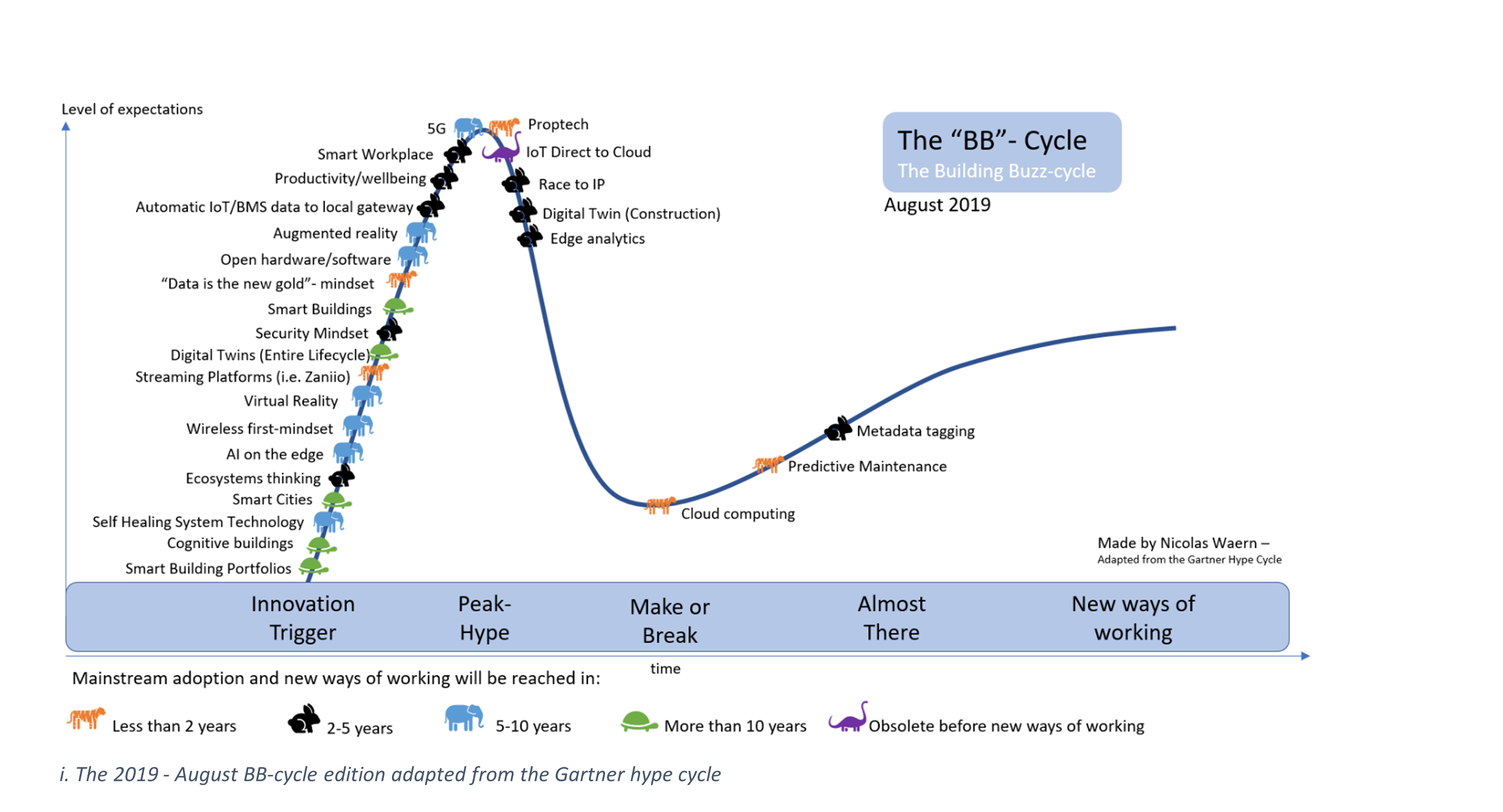
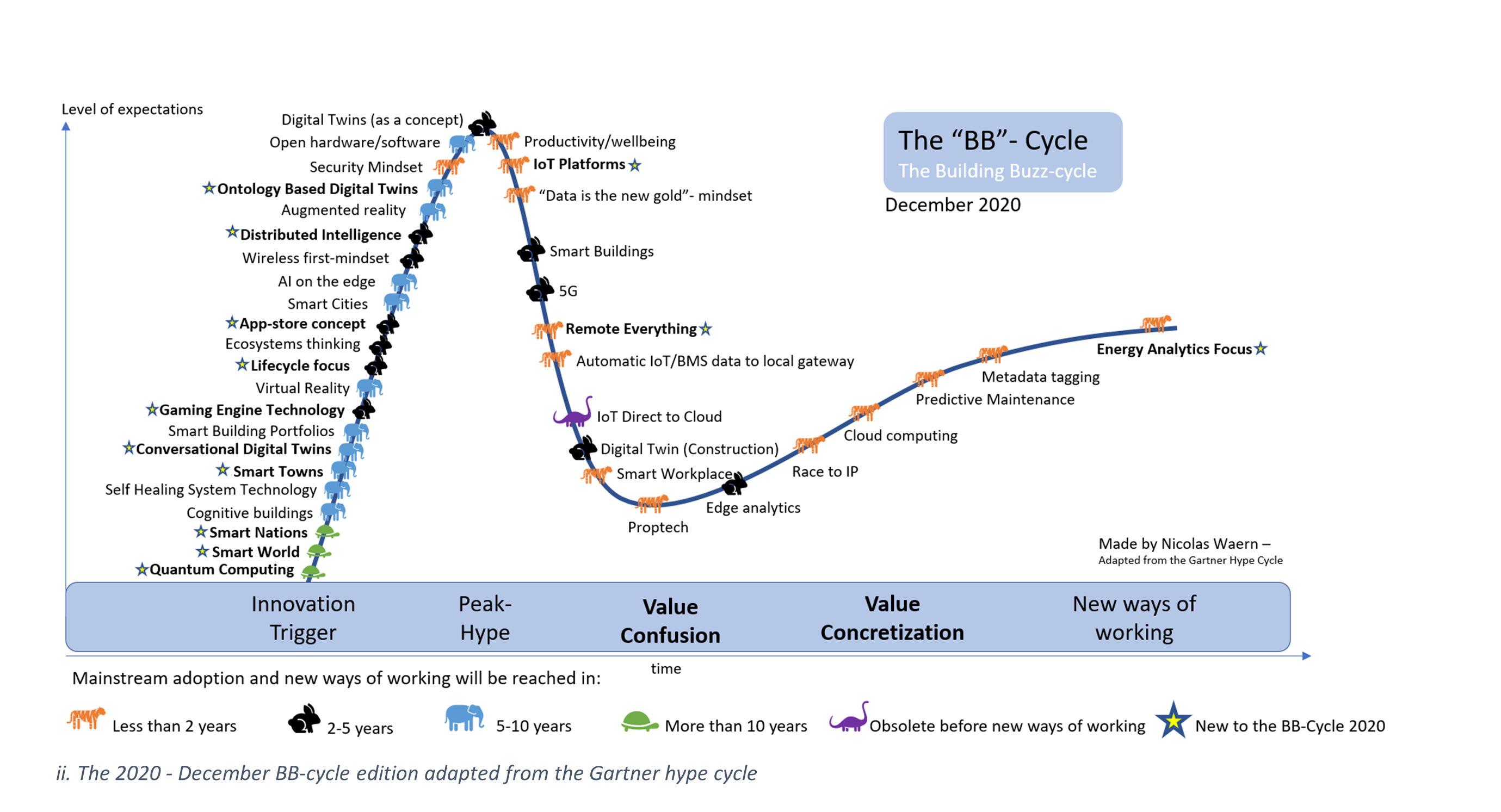
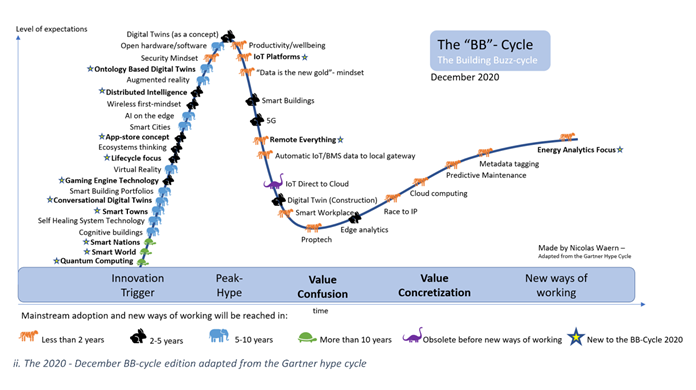
The Building Buzz Breakdown, 2020-edition. Innovation all around.
Smart Nations, Quantum Computing, IoT Platforms, Digital Twins as a concept, Distributed Intelligence, Ontology based Digital Twins and a partridge in a pear tree. It is still a jungle out there, which is why I tried to jot down some of the things I have seen lately and put them in the Building Buzz-cycle depicted below. The perspective is that from a more traditional building automation perspective, and that is why it might differ to other frameworks.
You can find last years’ article below where I go into some detail of what I saw then;
Most of the technology trends can be utilized today but existing market dynamics, slow pace of innovation, will keep it slow-moving for another couple of years. Except for quantum computing I can honestly say that I am working with all of these technology trends today in some shape or form. Which I believe is quite refreshing in the sense that everything is possible, and that the world will truly leapfrog in the next couple of years, much thanks to Digital Twins.
Overview:
First out is the BB-cycle from last year
Next is the BB-cycle from this year
Final thoughts
Summary
Above are the 2019 version and the 2020 version. I have been a lot more bullish in some of the technologies I see reach the market, much thanks to Covid19, and there are some differences and new additions to the BB-cycle.
My intent is to provide a point of discussion, and not so much as the definitive truth. This is based on what I am seeing dealing with innovation projects in many different segments and I am hoping it might add value to some of you. I will post my thoughts on each one of the topics mentioned, either here at automatedbuildings.com for the January column, and/or at Beyond Buildings.
Meanwhile, if you can’t wait until January, or want to know more about this, feel free to reach out to me on Linkedin. And if you like this I think it might be the time to start subscribing to the Beyond Buildings Podcast and Newsletter for real!
If you want to find out what the world is going to do a month, a year, a decade from now and how it might benefit you or anyone you know, reach out! I try to have a holistic understanding of what is needed to stand out from competition, to better advise on pros and cons, and be the strategy partner for both technology and organization-advice in a Smart World Environment (Construction/Industry/Smart Buildings and Cities).
Please reach out if you have any questions and comments or if you have any ideas on what I should write next!
The world depends on us, coming together and making this industry far better than it is today.
From BACnet to Quantum Computing?
It is a Saturday morning here in Sweden and I’m sitting at the edge of the couch, creating the last revisions for the article. Kids are running around, wife wants me to do some vacuuming, which I will, and the sun is shining for once. But after some Linkedin Conversations this morning about the importance of “One API” to real estate I wanted to look through this once more. Volvo cars have just come out with an innovation portal where outside developers could help in creating better cars and that’s what I was thinking about 5 years ago. I described this in my latest Newsletter at Beyond Buildings, and the collective sense of urgency we need to have, together.
i. The platform play for buildings – 2015
This is an article that goes back in time when I had no idea about BACnet, cloud infrastructure or what building automation really was. But that changed quite fast. I knew that this was an industry I wanted to be in, when I understood that buildings/construction combined are responsible for over one-third of global final energy consumption. There’s much value to be created when reducing the impact of nearly 40% of total direct and indirect CO2 emissions world-wide. I still see this as one of the most important industries to change for the better. And now with Post-Covid, the new normal, the importance of well-being, and a great indoor climate is even more relevant than before.
This article is a glimpse into the story that has led me to speaking at the AHRexpo about open hardware and open software, to Digital Twins and Quantum Computing and Industry 4.0 blockchain based initiatives. I have recently taken lead for Lifecycle Digital Twins in the Manufacturing Working Group at the Digital Twins Consortium, and if anyone wants to discuss Interoperability and Integration and want to contribute to the industry, let me know! The great Anto Budiardjo is also in the consortium and we will be discussing these topics soon that will be recorded.
Being in all these working groups helps me go Beyond Buildings to better understand what is being done today in other industries. To come back to the future in Real Estate, to not only predict, but also influence where the industry will go in the next month, year, and decade from now.
My articles are usually a mix between the personal and the professional and this one is no different. There are a lot of links to the past, and I see that I have gone from thinking that gimmicky is gold to becoming somewhat of a building automation bodybuilder myself (referencing this article below discussing the approach to getting started with Smart Buildings, inspired by the great Tyson Soutter from Siemens).
I hope this will be an interesting read and please reach out if you have any questions or comments!
From IoT- Ingredients to Smart Building recipes
I’ve been thinking that I was more in the right 2,5 years ago, thinking that Smart building initiatives have to start somewhere small, and to go with the low-hanging fruits. Because I must admit that now that I know much more of the challenges that exist. I too fall into the trap of wanting to do too much and that rarely succeeds. It’s challenging to go after the (s)low hanging fruits, when there is so much to do. But maybe I need to go back to that way of thinking? How should Smart Building projects start?
In 2021, I will continue my efforts in spreading knowledge around Innovation and Digitalization. From an early focus on IoT enabled buildings with a BACnet base, I am now also involved in national Digital Twin initiatives as well as European Digital Twin simulations that will help stakeholders mitigate climate change in a data-driven collaborative way. I am part of working groups in data-management, digital twin initiatives in healthcare, aerospace and defence, natural resources, as well as infrastructure and real-time real estate.
I have been working with construction companies the last 1,5 years and I can clearly see that it is a broken real-estate industry that needs to be fixed. How can we expect Smarter Buildings when the foundation is missing for the most part?
Covid might help accelerate the much-needed outcomes from automated buildings but it seems that there is more of a mindset shift that is needed than a technological one. People love to talk about what is wrong in industries and fail to act and to discuss what is right and share the good example with others. Innovation still happens behind closed doors for the most part and while the ingredients are out there for the most part, most industries lack the recipes and instructions needed to get started, get going and succeeding with digitalization for real.
Future generations depend on us to fix all these problems together and I know enough by now to understand the problems as well as the solutions needed. Which is why I will try to accelerate practical innovation examples through participation in innovation hotbeds and more discussions with thought leaders in the space through my podcast and newsletter.
The future foundation and the road to get there
“If you look at smartphones, they all have an app store, right? And if you look at connected vehicles, they too are starting to become less hardware and more software where the focus is on building a platform and opening an eco-system. Volvo are now utilizing the Android Platform to build great solutions on top of it. Why re-invent the wheel?” – Nicolas Waern, 2018
That sentence was written 2,5 years ago when I was the acting CEO for the IoT hardware/software company Go-IoT, and it stands true today as it did back then. It comes from my first article at AutomatedBuildings.com.
I’ve had a monthly cadence since then, with thought pieces about BACnet IoT, Edge vs Cloud, Semantic interoperability, the industry and its organizations and of course Digital Twins and AI. But first out are some olden (and golden?) blog posts that I wrote when I was with Go-IoT.
Going back in time is quite interesting. Two years ago, feels like 10 years ago. I have learned a lot in these five and a half years and my focus has only been on innovation and finding, as well as understanding root causes. Pivotal moments were of course learning about BACnet and the whole realm of the Protocol Wars that exist. And I am still surprised by the lack of knowledge of what BACnet has been, what it is, and what it will be. I still hear people lamenting that BACnet is dead, without even knowing that BACnet can transfer data via a RESTful Api in a secure and standardized way. Even more so now with BACnet/SC. But on the other hand, more modern interfaces like Graphql are also utilized to bridge the gap between the existing and the new, where companies like Buildings IoT are leading the charge with insightful leaders such as Brian Turner at the helm.
An early hero of mine was the legendary Steve Tom, having read the seminal article about BACnet/WS at least 20 times. It was also featured here at automated buildings. This article, and the work I was doing at Go-IoT led to me co-authoring the article about BACnet/IoT in BACnet foundations which seems like two decades ago. I remember discussing edge, IoT, and other things that were then new to me and that I was out of my depth. But when industry titans like Bernard Isler made comments like “I enjoyed it immensely”, I kind of knew that I might be on the right track.
The article from Brad White about the Trillion Dollar opportunity is an article I always go back to when trying to understand why we are doing this and the need between a linear understanding about the investment in Smart Building technology and what the outcomes could be. Also an article I’ve read at least 20 times.
But I can also see that we need to go beyond buildings at this point, and more towards the realization of smarter cities, well-being and productivity.
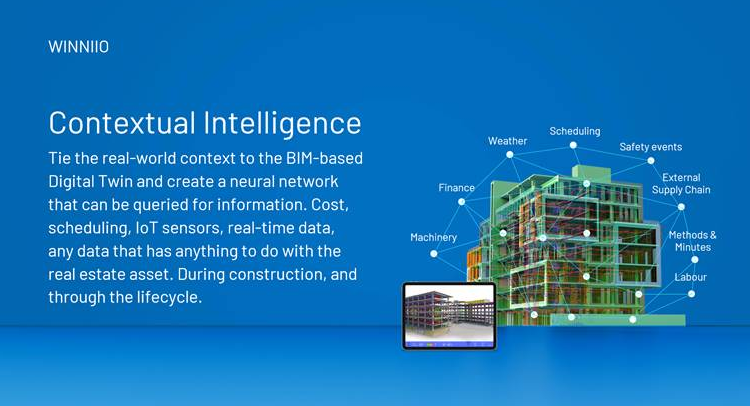
Understanding what contextual intelligence means and how it is related to driving continuous intelligence is paramount in an AI-augmented world. It is even more important nowadays than ever before post-Covid when the jury is out in how many people will go back to commercial real-estate. These questions were definitely not on my mind when I first heard about connected buildings. My dream back then was to unify all (wo)mankind underneath the umbrella and power of Audiobooks…
How it all began
It was the first time I met the founder of the company I had invested in. We had been talking for over a year through video-conference apps and via texts. But it was not until we met at the World’s leading Entrepreneurship conference, Slush, in Helsinki that we met the first time in person. The back-story was that I had been advising a tech incubator in Lagos, Nigeria for a year and decided I wanted to invest in two amazing entrepreneurs with a dream to place Nigeria on the Global map.
Kolapo Ogungbile and Damilola Aransiola. I still remember when these names sounded odd to me, and that friends in Sweden laughed when I told them I had invested in a Nigerian start-up without even having been there. How it happened was that I had been working with the founder of the Tech Incubator, Olufunbi Falayi, for a year at that time and I loved the fact that the world was so small, and big at the same time. The only things I knew about Africa before working with Passion Incubator was that 10% of my food intake when I was a kid had something to do with starving kids in Africa.
I saw Africa as a country, more than a continent. And I had absolutely no idea where Nigeria was located, nor its history. But after a year of networking, I quickly realized that we were the same. It was great to be working in almost the same time zone, and that we shared a lot of the humour, entrepreneurial drive and that we worked well together. I have had hundreds of meetings with business leaders, entrepreneurs and politicians over the years. And I’ve always been extremely impressed with what I’ve seen and heard.
I had no idea that Nigeria had global entrepreneurs like Aliko Dangote and Tony Elumelu. Aliko Dangote collaborates with the Bill and Melinda Gates foundation to combat Polio and Tony Elumelu was included in Time magazine ‘s 100 Most Influential People of 2020 (where Talking Bookz received from the Tony Elumelu foundation). I was constantly reminded as well as surprised about my naivete in thinking that I knew anything about the world we live in. I quickly realized how my Swedish world-view was partly crippling me in thinking that the world somehow revolved around Sweden. I was partly ashamed about the pre-conceived notions that I had about Africa as a whole and I have yet to understand the nuances of the countries and the people that exist in this world, wherever we are.
My goal of one day having/operating a business in all corners of the World is what drives me forward and Kolapo and Damilola continue to inspire me and we are still my friends to this day. Talking about Entrepreneurship, Marketing and everything else in between.
Kolapo and I met in Helsinki in 2015 as well as in 2018. But I have yet to meet Damilola “for real” which today means…what? Covid has changed the new normal and not meeting up prior to doing business will probably be the new Normal for a while now.
But it was at Slush it started. The ones that follow my Podcast and Newsletter- Beyond Buildings, have probably heard this before and it feels almost a story as old as time at this point. I was standing in line to get a cold Helsinki beer, waiting for Kolapo and some other people when I was about to embark on a journey that would take me to the place I am today.
The vouchers I had were exchanged for beers and I turned round, seeking a place of refuge from all the conversations I had been in with investors and other people. But the closest one next to me was a man having a beer and I asked him if I could join him while I was waiting for my team.
He said yes and I asked him what he was doing at Slush.
He showed on his phone that he could see when someone had opened the refrigerator, he could turn on and off the lights, and control everything in his home in Iceland from his phone in Helsinki. This was about 6 months before the IoT-hype took off for real and I had never heard anything about home automation, nor building automation. He said that this was done by just plugging something into the wall and then communicating via existing powerlines. Something which I thought was very interesting and I could see the platform play in my mind.
iii. The platform-play for Real Estate Innovation
We talked about strategy and other things afterwards and I saw the app-store concept and the platform play 5 years ago. I did not think it would take me this long to understand exactly what needs to happen, but now I believe I do. I helped the company with strategy, business development, sales, and I was also in charge of coordination between hardware and software development, introducing and leading daily stand-ups. I worked 80-hour weeks for years combining my day-job as a web-agency owner, management consultant for companies like SWEGON, Volvo Cars and others because I saw that buildings need to be better. People working within the real-estate sector need to perform better.
I got a global network out of those 4 years and a fair understanding about the hardcore nuances of building automation. From hardware development to software development, from BACnet to IoT and why things are happening and why they are not. And that is basically how it started.
I’m still on this journey today and I, the industry, can need all the help we can get. I’m trying to continuously understand how companies can survive and thrive in this industry. I’d love for you to subscribe to the Beyond Buildings Podcast and Newsletter today.
The latest podcast from Beyond Buildings was about 3D-printed 4-story buildings, a new era of construction. Focusing on the need for a sense of urgency by all.
It is high time to utilize our combined industry knowledge and accelerate time to value creation for all.
The mission
I aim to disrupt the ways of working in this industry that will lead to creative destruction for the most part. It will solve the skill-shortage gap with technology as an enabler. It will be people first, and AI a close second. The recipe of going from BACnet to Quantum Computing does exist and for the ones who want to go after it, just let me know and we will do it together. Existing dragons, new dragons, whatever happens, we need to create an industry that do not lock people in. We cannot settle for just modern technologies with old mindsets. We cannot settle for lock-in effects that make it harder for everyone involved to create more sustainable buildings.
The world depends on us, coming together and making this industry far better than it is today. I urge you to join me in going above and beyond to make our future selves proud.
Creating the Future together
Future flexibility and understanding the context will be the focus for future podcasts and articles from the Beyond Buildings Podcast.
3D Printing and the need for an increased sense of urgency
Security and sustainable buildings
The role of 5G and what is the difference between the past, present, and the future.
AI conversations regarding real-time real estate
Ontology-based discussions clarifying the meaning of meaning with Real Estate Core, 223p, Haystack, BACnet, Brick and others.
How ontologies are being used today to create cognitive portfolios
Fixing the lifecycle problem, understanding where they are and what to do about them
How Tridium could be leveraged for more sustainable buildings worldwide
Subscribe now and join hundreds of other Building Automation Professionals world-wide in getting to know what world will do in the next decade.
There is a special discount right now that includes 1 on 1 consultancy for everything listed above, and more! If you are wondering about the linear relationship between BACnet to Quantum Computing, that exists and how it can be tailor-made for you? Just reach out and let us create the recipe together based on the ingredients that exist in the BB-cycle.
And if you just want to stay in tune to what the world will do in a month, a year, a decade from now, please just join in and let us go Beyond Buildings together!
“Wherever there’s complexity, there’s room for AI to help make it easier. Agree? Disagree?”
Hi Nicolas, how are things going on? I see that you are really pushing the boundaries of automated buildings, and talking about 3D printing, energy, railways, national digital twins, and other things. Are you leaving the fold?
It’s more that I have felt a need to “go beyond buildings for real, to come back to the real-estate industry armed with the knowledge that we need to have”, like I said at the beginning of the year. I think that’s the only way to learn, and to understand what others are doing in the industrial space, or even healthcare. Hospitals for instance are a part of healthcare too, so that space is very interesting from a Building Automation, indoor Air Quality perspective.
I will record a session with the CTO from Foghorn tomorrow, Sastry Malladi, which will be very interesting. They have been on my radar for 5 years now and I know they have a great event-driven infrastructure that should scale well.
It is not so much that I am leaving the Real-Estate realm, but things are going great and I am learning a lot. Working in construction the last couple of years have led me to understand the challenges that come from a fragmented industry, and most importantly what to do about them. I am in fantastic discussions with people in a lot of different industries and that is really helping me evolve. I’m having discussions about Digital Twin related strategies in natural resources, manufacturing, healthcare, sustainability purposes, construction and of course also infrastructure and real estate. Real estate has its place in the world, but I’m equally interested in the contextual intelligence of things to better help partners and customers.
Okay, so maybe instead of Location, Location Location, you are saying that it’s more about Context, Context Context? Fascinating. But is there any method to the madness?
Any method to the madness? Well, yes and no. I don’t save any energy for the swim back to shore, so I’m constantly out there in the deep waters. But most recently I’ve taken the lead for interoperable Digital Twins in Manufacturing, as well as the European lead for the Infrastructure Working group at the Digital Twin Consortium. So, if there are people in Europe (or elsewhere) and want to know more about what the concept of Digital Twins can do for infrastructure, just reach out to me and join a session as a guest!
Digital Twins is definitely the new hype. I see it everywhere these days and I heard that some people even say that all buildings will have a digital twin in the future. Do you agree?
I really don’t agree with that statement at all. Buildings will definitely not have a digital twin in the future. They will have hundreds of Digital Twins in the future! The OEMs will have digital twins of their products and there will be digital twins of complete assets, part of assets, and individual components of the HVAC realm as a whole. The buildings themselves need to be part of the Smart Grid Digital Twin and the Smart City Digital Twin which both consists of hundreds if not thousands of Digital Twins. And the owners will probably have a Digital Twin with data built from other interoperable Digital Twins. Knowing this, and also the challenges that exists already with data-integration, puts even more emphasis on the importance of interoperable Digital Twins, and semantic interoperability as a whole.
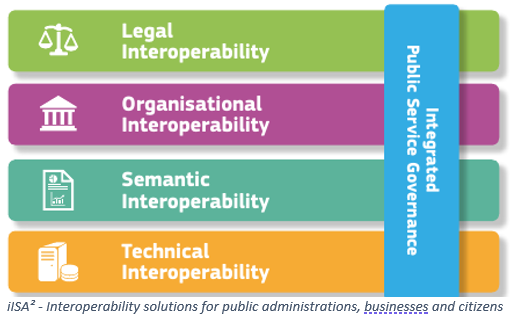
I like the framework from ISA² – which partly depicts the challenges in the space, and even more so on the Organizational Interoperability challenges and the legal interoperability challenges that will appear when data will be shared to a greater extent. There will be a lot of complexity before we can make it simple I think, but that’s also where AI, Digital Twins, and other more modern technologies can help out.
The lack of organizational Interoperability and industry interoperability, obsolete channel systems, constant blame game on the past and focusing on problems, instead of highlighting great solutions are major reasons why the industry is not moving ahead.
I say, set the data free. Provide meaning. And let’s go. That shouldn’t be that hard, should it?
Interesting… yes, technology is never the real problem. Saying that, what are your thoughts on AI and Building Automation?
The LinkedIn post was actually a re-post of an article I wrote two years ago, that got a born again connected via my network. It’s been seen by more than 10 000 people and growing, so I strongly advice people to go in, like and comment and add to the discussion.
“?“All we have to do is control three variables (flow, temperature, and pressure) in two types of media (fluid or air) using four pieces of equipment (valves, pumps, fans, and dampers). The logic is very easy to arrange. The sequences of operation may not take long to write. But it’s the variables of all the dependencies and the physics around it which makes it extremely easy to wreck any setup. And also extremely difficult to get the full perspective. It also helps highlight why A.I. has such great potential in helping radically improve the way we commission and optimize the built environment.” – James Cheesewright
I have some up-to date thoughts on this which I will post on the Beyond Buildings Podcast & Newsletter soon. That will be more inspired by how deep digital twins work in the Autonomous Vehicle industry as well as how McLaren and F1 teams solve problems and what companies like Astra Zeneca, and Oil & Gas platforms do with AI.
Linkedin is an amazing platform to share and get knowledge, that’s for sure. What else have you been talking about lately? And what will your next podcast be about for Beyond Buildings? And to the most important question, when should we do a session?! Are you scared that I will know more than you?
We need to get you on the show. You are the almighty father of this industry so I don’t have a great answer as to why you haven’t been on it yet. And I think we both know that you have forgotten more about this industry that I will ever get to know! But I got 8 episodes in the pipeline that I need to get out first so… we’ll see! I’ll figure something out.
I just read this great article from Steve Fey where I really liked this quote and the high-level view from the top. “Porting IT security technology and practices to address OT security will not result in a more secure OT environment.” Why is this the case?
I think there’s also a need to take into account other attack surfaces, and also something related to Engineering Technology not limited to the world of BAS/BMS but also to that of the rest of the building. IT/OT/IoT/ET conversion. But great read. And I would love to hear more about what role Totem plays in this and where they stop and start, due to the need for interoperable systems/people to work together.
And perhaps one of the most insightful comments that I’ve ever read in my life comes from Joel Bender at Cornell University. Also a titan in the industry, who will be on the Beyond Buildings Podcast soon talking about data-integration and semantic interoperability together with Terry Herr and Eric Oscar Wallin from Real Estate Core. Joel was saying what everyone else should be saying about BACnet, and the success of having such an interoperable platform to stand on.
“…In one sense that speaks to its success because people are more interested in the applications that are using BACnet rather than how it works, and that’s how it should be.”Joel Bender, Cornell
Again, Joel Bender, thanks for this comment. I think that BACnet and BACnet/SC when leveraged correctly together with a proper security strategy is much better than not having it at all.
I remember the security session at the AHRexpo some years ago when the incredible Anto Budiardjo got everyone up at 7AM and I was jetlagged into oblivion. There it was clearly stated that BACnet/SC only did as much, and NIST frameworks, Tosibox, Totem, and many other solutions and applications have to also work together in an Interoperable way. The technical Interoperability that BACnet brings to the table is like you say, under appreciated. Semantic Interoperability is now being “solved” with Brick, DTDL, Rec, haystack, GBO, and others.
The post above was based on the post below from the all-knowing integration expert Andrew Rodgers who’s “Bringing open technology solutions to secure cyber physical systems.
Open vs Interoperable Great discussion about BACnet/SC, open, and interoperability and the value that BACnet brings.
I’ve been working with Data Centers more and more, as well as connectivity strategies for Airports, and looking into Construction Disruption with the help of a handful of players in the industry. And much more…
So what you are saying is that if people are not following you on Linkedin, they should?! Any final thoughts for the readers? Any action you want us to take?
If companies want to know how to predict what the world will do, this is the place to be.
To better help my customers and partners, I decided to join The Digital Twin Consortium and be part of all the working groups. I have taken the lead for the Infrastructure Working Group in Europe and taking point for Interoperable Lifecycle Digital Twins in Manufacturing. Please reach out if this is interesting.
And contributor to:
– Healthcare, Natural Resources and Aerospace and Defense.
Digital Twin Technology is a tool/concept that can be applied to any and all areas, irrespective of Industry. The use cases differ but it’s all the same, but different. Digital Twins have the possibility to exponentially accelerate Scale, Scope, and Learning, in a sustainable way and they can be of all sizes. From the nitty-gritty Digital Twin of a nut, bolt, where it came from, how it’s been used, what material or make it comes from, to a Digital Twin of the entire Supply Chain. It’s of utmost importance that Digital Twins are interoperable and that future stakeholders can derive value from them in a standardized way.
The Digital Twin Consortium aims to be an influence and drive the adoption, use, interoperability, and development of digital twin technology. They propel the innovation of digital twin technology through consistent approaches and open-source development and are committed to accelerating the market and guiding outcomes for users. The goal of the consortium is to be The Authority in Digital Twin as it relates to policy, security, interoperability, and overall development of digital twins. The consortium will define the ecosystem, standards requirements, architectures, open-source code, identify gaps, and publish statements and opinions. This will be done in partnership between industry, academia, and government in a collaborative open environment.
Any final final words?
Companies are data rich, but information poor. And the future is already here, just unevenly distributed. Let’s go Beyond Buildings and back, to transform this industry to what it’s supposed to be. I for one predict that the whole industry will be revamped by 2025. That’s a promise I made to one of the foremost wine-experts and building automation experts in the world. I can’t let him down which is why I need all the help I can get.
Thanks for allowing me to come on to www.automatedbuildings.com Ken. I, and the whole industry will forever be in your debt, and the ones that were here before us.
If you want to find out what the world is going to do a month, a year, a decade from now and how it might benefit you or anyone you know, reach out! I try to have a holistic understanding of what is needed to stand out from competition, to better advise on pros and cons, and be the strategy partner for both technology and organization-advice in a Smart World Environment (Construction/Industry/Smart Buildings and Cities).
Please reach out if you have any questions and comments or if you have any ideas on what I should write next!