Is there a need for Digital Triplets? Quadruplets? Siblings even?

How can we adapt to a world that was, that is, and will be? How can we adapt to a future that is unknown?

3

How can we adapt to a world that was, that is, and will be? How can we adapt to a future that is unknown? Can we make it known by utilizing the concept of Digital Twins, and go Beyond Buildings? Can we simulate the future, having done thousands of AI-driven simulations, and bring the solutions back to the now, knowing what the future will look like?


Knowing that the future is already here, only unevenly distributed. I have made it my mission to find the tools that can distribute the future to the ones that want it the most. Digital Twins are quite in the hype for now so thought I could stir up some noise even more with Digital Triplets.

What started off as a joke, soon became reality in a couple of conversations with partners and vendors last week. I talked to legends in the Power industry having written articles about Triplets a year ago exactly. It came up in discussions with industrial automation professionals regarding simulation capabilities. I mentioned 6G, 7G, or 8G and Digital Triplets in a webinar last week to make a point that we need to talk more about the jobs to be done, instead of the buzzword bingo right now. 

The need to adapt to existing ways of working was also discussed in a webinar [i] for Chalmers University and The Digital Twin City Centre, about Revenue Models and Business Models. The importance of understanding the concept, the situation, and the unique problems that should be solved cannot be emphasized enough, where existing companies are indeed built to die[ii].

Finding inspiration is not the challenge. That is just a google away. Finding what problems to solve, and how to solve them in their unique setting with culture, processes, people, existing systems, and political agendas can only be discovered by digging into the reality that exists. It is known that Digital Twins can accelerate digital transformation efforts. But a lot of the real use cases are yet to be discovered at scale.  But what are the main parts that Digital Twins are made up of?

“The Digital twin is made up of three parts: physical entities in the real world, virtual models of those entities, and the data that connects the two worlds.

– CIO applications

According to the article above that was shared on Linkedin [iii], CIO applications state that a Digital Twin is made up of a virtual model of what’s being “twinned” and the data that connects them. Of what is being “twinned” and the data that connects them. What if there are hundreds of assets, spanning factories, weather, processes, people, and systems in a supply chain? And what about the context? What about the need for visualizations? And what about the need for simulations to be made? Maybe all these things are included and more because Digital Twins can bring real-time data together with the static and are gaining ground where PLM tools falter. The Digital Twin description above feels a bit thin.

So maybe there was some truth to Digital Triplets after all?

Out from a proprietary past and into an open, interoperable future

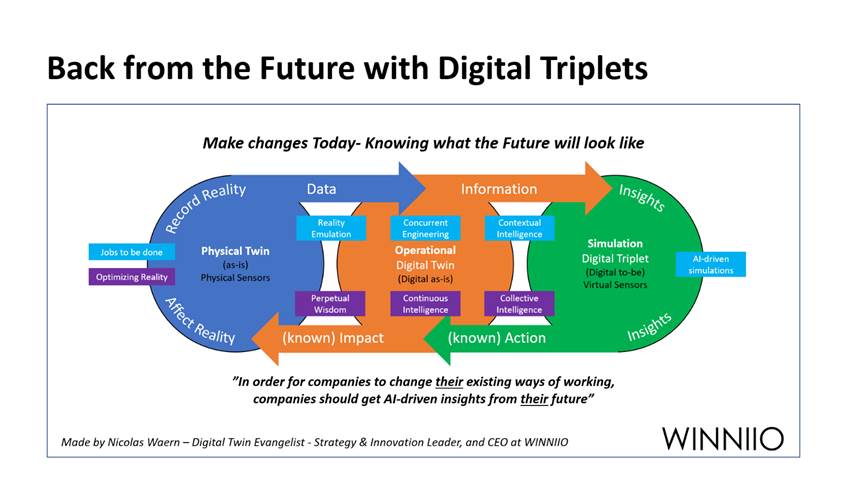
In one of the discussions, with one of the largest multinational power companies in Europe, we talked about the need for an “operational twin”, AND a “simulation/sandbox twin”. They had tried to create a Digital Twin of one of their gas-turbine driven powerplants, but saw these challenges below (and more):

  • Problems with GDPR (General Data Protection Regulation) sending data to “a” cloud half-way around the world.
  • Offered AI-solutions being black-box entities.
  • Impossible to continue to optimize the algorithms and AI-solution themselves.
  • The proposed solutions were not built on open source, nor interoperable enough.
  • The solutions were not able to run on the edge/on-prem, behind firewalls.
  • All the solutions were based on manual ways of working, in need of experts. Where they were after more automated ways of working.
  • A need for AR/VR having seen Microsoft Mesh “Here can be everywhere” for Remote maintenance and training.
  • All the solutions were unable to provide a copy-paste function to other power-plants, re-using intelligence without having to re-invent the wheel at every turn.

The jobs to be done here, seems to be to go from where they are today, out from a proprietary past and into an interoperable and scalable future. And having the ability to augment, and possibly re-invent existing ways of working in a transparent way.

All the challenges above can be solved through various of ways that exist right now. Where the technologies are finally here to make the future happen. But what was even more interesting was their rhetoric around Digital Twins. One of the things that they were after were Digital Representations of the physical world which they called the operational Digital Twin, that should always mirror the Real-World.
6

= Digital Twins.

Which I found to be very similar to what the article from CIO applications defined as Digital Twins. But, what they were after even more was a sandbox environment and the ability to run simulations on top of the Digital Twin to feed data back to the Digital Twin. This to change their reality without waiting for actual events to happen in the real world.

= Digital Triplets?

“The Digital twin is made up of three parts: physical entities in the real world, virtual models of those entities, and the data that connects the two worlds.”- CIO applications


Reading the quote above again, I cannot help but think if there is need for Digital Triplets? Or is it just a lack of understanding thus far, as to what capabilities Digital Twins have? And the road towards Triplets, will lead to siblings, cousins, and go beyond that of Triplets and Quadruplets and turn into a digital slippery slope? Most likely. So for now, let’s continue with Digital Twins, and some questions regarding what they are, and what they could be.

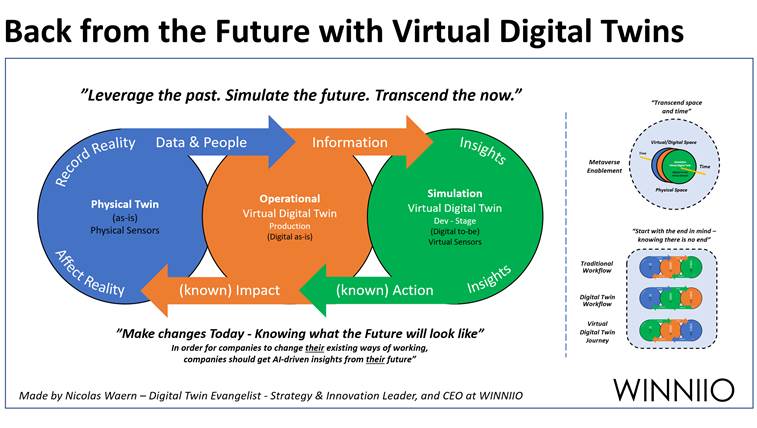
Is it possible to say that people should build the Digital Twin first, and then the physical counterpart will follow? Maybe it is just back from the future with Digital Twins, where the simulation side of things is added as one possible dimension of many capabilities of a Digital Twin initiative. But is it possible to get started on the Digital Twin Journey without having a physical asset? Is it more than possible and should even be recommended?

“Does the Digital Twin always need a physical counterpart?”

This is one of many topics that will be covered at Beyond Buildings.

Other questions for discussion:

–        Is there a need to exemplify the different capabilities Digital Twins can have in a simple way? Does it exist already?

–        Should the Digital Twin have the ability to run simulations on its own, or should 3rd party applications be able to work with the Digital Twin in an interoperable way?

–        Should the Digital Twin be able to work with existing systems, and bring their native capabilities together to adapt to the world that already exists?

–        Or should the Digital Twin platform on its own have all the capabilities necessary to bring everything together forever?

–        Should digital twins be able to work with any standard and how to work with AI-enablement at scale?

–        Do Digital Twins start to exist when they have the capabilities to work with model ingestion, and virtual sensors, and are something else entirely up until that point?

–        Do Digital Twins need to be accompanied with Virtual and possibly Visual Digital Twins? In order to capture the importance of the visual and the virtual part of the Digital Twin?

–        If a building has not one, but hundreds of interoperable digital twins of the assets, as well as their context, what happens with the Digital Twins if they lose their Physical counterparts?

–        Is this not where the true value lies in re-using intelligence and true separation of the boundaries of the real world?

–        Is it not the true value of the Digital Twin to exist in the Digital and Virtual Realm and to be able to re-use the intelligence gained for new projects, knowing what will happen beforehand?

–        And to use virtual models, tools, and AI-driven simulations to emulate reality to understand what the future will look like, based on simulations in an emulated reality?
 

If the new construction of a hospital can re-use the intelligence from a demolished hospital (and or a virtual hospital) and modify it so that a new one can be built, and modified 95% faster than before to match the reality where it will be built. Is that not the true purpose of having Digital Twins? Transcending Product Management Lifecycles and into true meta-verse Enablement? Where we can record reality, and truly transcend the shackles of having to do something in reality first, and only afterwards utilize digital tools and technologies?

–        How important is the visual component to bring people and systems together?
(More on that on the next episode at the Beyond Buildings Podcast)

And do we need to wait for Digital Twin standards? Or should we get going with Digital Twin approaches that are interoperable, built on open source, and can work with any standard?

All I know is that we need to help companies where they are today and get them to where they need to be tomorrow. Most companies today are experiencing severe challenges in turning data into information with data made by humans. What will happen when data is being created thousands of times faster from machines?

That is the thing. Virtual Digital Twins are some of the best tools out there right now, in bringing people and systems together like nothing before it. And some of the platforms can start anywhere to scale anywhere. The visualization aspects are much more important than what people seem to think, and the ones that get to a digital operating model and business model will soon find themselves leaders of the pack, knowing that it is the fast that eat the slow.

Distributing Future ways of working, today.

Because that is the thing. The future is coming at us fast. Adapting to the future, based on the unique needs of companies where they are today, and where they need to be tomorrow is what is needed. It is not about stepping out of the comfort zone for people. It never was. It is about stepping into the comfort zone, describe what that is, in way that people, as well as systems can understand at scale. It is all about bringing people and systems together, utilizing the power of experts in various areas to innovate with the world that exists today. We cannot keep continuing to expect that people need to change when they do not want to.

Define the jobs to be done, stay in the comfort zone. And then invite people to innovate with the world people know best. Easy right?

But if you still need any help with questions regarding strategy, innovation, and figuring out how modern technologies can help you where you are today. Look no further. WINNIIO will always be by your side. Just reach out to me, Nicolas Waern, on Linkedin or check out my Podcast Beyond Buildings if you need any assistance.

Sincerely,
Nicolas Waern
ceo@winniio.io

The future is already here, just unevenly distributed. And it’s my job to distribute future ways of working to the ones that want it the most today”.

[i]  Chalmers Digital Twin City Center Webinar about Smart City Business/Revenue Models

[ii]  Existing companies are built do die

[iii]  Discussion on Linkedin From Dmitrivolkmann.

A Future that is bigger than the past

Is the Building Automation Industry Broken?
 
Or is the Building Automation Industry poised and ready to leapfrog into the future?


I have just finished a meeting regarding infrastructure Digital Twins and I am burning the midnight oil, again. I am waiting for the new domain for the Beyond Building Podcast to kick in. And it will be found at www.BeyondBuildings.online if everything goes smoothly (it never does…) or here.

The upcoming four episodes tell a tale about the past, present and future of building automation worldwide. It will be about the connectivity platform for all, how to work with ontologies and taxonomies at scale and building the foundational layers for AI to take charge. It will be about the much needed sense of urgency, where it will come from, and in depth discussions about the need for meaningful data and reducing friction for digital onboarding.

I have said on numerous occasions that the building automation industry is broken. I have heard about it. And of course, I know that we can do things better. But it always depends. Is the industry behind? And if it is, behind of which industry? And where? And what kind of assets?

My work includes doing research about almost everything and I have the privilege of at least trying to boldly go where not many others have gone before. And that is why I can say that the industry is not that much different than everything else. Healthcare, Automotive, Oil & Gas, Water, Energy, Construction, all of them are plagued with obsolete ways of working. Traditional decision making and companies might possibly be data rich, but most of them are information poor. The future is already here, but it is definitely distributed. And that also goes for all industries, internally and not just from industry to industry. The leaders in one industry might be far ahead of the laggards, and majority in other industries, when it comes to possibilities of utilizing AI at scale (if that is considered a leading metric). I know construction companies that are far more advanced than large healthcare giants, spending years taking drugs to market, and working with worse data management strategies than some of the worst construction companies.

In fact, building automation might be far ahead when it comes to a couple of things which we will discuss later.

A lack of standards + Manufacturer based controls

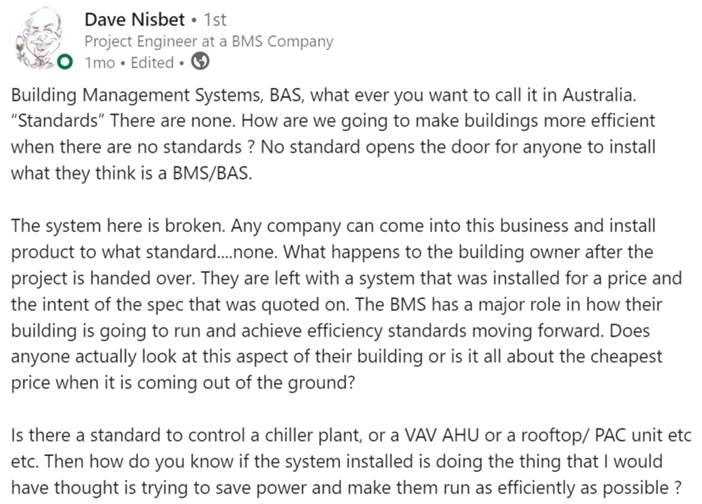
In this discussion on Linkedin we get to hear about the lack of standards in Australia whereupon I started an intense discussion with fellow building automation bodybuilders.

2

And there are amazing responses from all over the world.

Dave Lapsely from the UK commented that their BACnet/IP infrastructure and quite mature industry enables system integration at great speeds. He mentions that the three days spent, would have been month’s with more “traditional” ways of working.

–        In the UK we are pretty spoilt by the sounds of things. We get some very good performance specifications coming out of the door from the M&E Consultants that clearly identifies requirements. That said Rob Huntington has it about right in my opinion. The Model that I personally advocate is a packaged system approach, then add some tech that can make each system or item of plant interact with one another correctly.

–        “We have completed 2 projects recently consisting of Intelligent Lighting, VRF/DX AC & Heat Pump HWS, packaged central Ventilation Plant complete with manufacturer programmed controls, IAQ Sensing on floor plates as well as fully metered water and electricity. The properties were each around 45,000 sq ft and the controls installation took 3 days from start to finish on each site and provided a fully interactive, auto optimised control system…


…if these were conventional systems with central BMS I think it would be fair to say that dependent upon project program we would be spending a month on each site.”

Where he finishes a comment with some building automation poetry:

–        The benefits of energy saving and reduced carbon footprint speaks for itself, mandates in the UK are not yet top of the agenda (maybe they should be though). ESG as a whole is though perhaps one of the biggest drivers. I think that Smart Technology will continue to evolve in providing novel solutions to meet the needs of the built environment from the owners right through to the occupiers in both the new build and retrofit markets. One thing that It does offer is complete freedom of choice and flexibility when selecting equipment and systems whilst providing a seamless look and feel for the user at all levels.

This is a very interesting and enjoyable discussion on its own and we will have the pleasure of hosting a panel discussion around the same topics in a month with people all over the world. Stay tuned.

Standing of the shoulders of giants

BACnet, BTL and the Rockstars of Building Automation.

What is also interesting is the fact that Dave Lapsley says that this is the norm in the UK (maybe parts of the UK) for quite some time. And when I say, “this is”, I mean BACnet/IP, packaged controls and possibly more interoperable ways of working.

It is not the norm in Sweden for the most part where we are in Modbus land and absolutely no industry-wide respect, nor understanding of what BACnet is all about. KNX is somewhat out there but it is not easy to get meaningful data out of buildings. Not in the slightest.

But Terry Herr mentions in the upcoming podcast about Ontologies that he thinks that the industry has never fared better. It is possibly beyond that of industrial automation where they are struggling with a lot of different standards, and even a modern factory has challenges in both technical and semantic interoperability.

Possibly OPC UA being the closest of kin to BACnet, but they also got a lot of stuff to worry about. Most modern factories do not necessarily talk to each-other and it is challenging to get meaningful data out of a factory. Let alone making the integrations between the BAS/BMS and the production line.

Which goes back to my early predictions of having one API to buildings and creating that soon to be infamous “App-store” for buildings that I, and many others, have been dreaming about for ages.

The Future is bigger than the past

But maybe now is the time? And who do we need to thank?

I want to thank organizations like ASHRAE and people like Joel Bender, Mike Newman, John Petze, Anto Budiardjo, Ken Sinclair for AHU’s sake, and everyone else in this industry. We are all standing on the shoulders of BACnet giants and the world is indebted to the early front-runners of BACnet and also the BACnet Testing Laboratory, and the members for the ongoing efforts of providing a robust, interoperable industry for all.

Getting data out from buildings is not that hard anymore thanks to the ones that built this for us. I know this for a fact since Sweden is quite far behind. We need interoperable ways of working, where newcomers like Erik Oskar Wallin, and Real Estate core are doing their part in providing meaningful relationships to the industry.

We will be talking more about these foundational layers in the next episodes of the Beyond Buildings Podcast, so stay tuned for more. And do connect with me on Linkedin if you haven’t done so already!

And if you still need help with questions regarding strategy, innovation, and figuring out how modern technologies can help you where you are today. Look no further. WINNIIO will always be by your side. Just reach out to me, Nicolas Waern, on Linkedin or check out my Podcast Beyond Buildings if you need any assistance.

Sincerely,

Nicolas Waern

ceo@winniio.io

What killed the Dinosaurs? The AI-age!

Is AI over hyped when it comes to the benefits that could be derived when using it correctly?


The need for AI-first strategies.

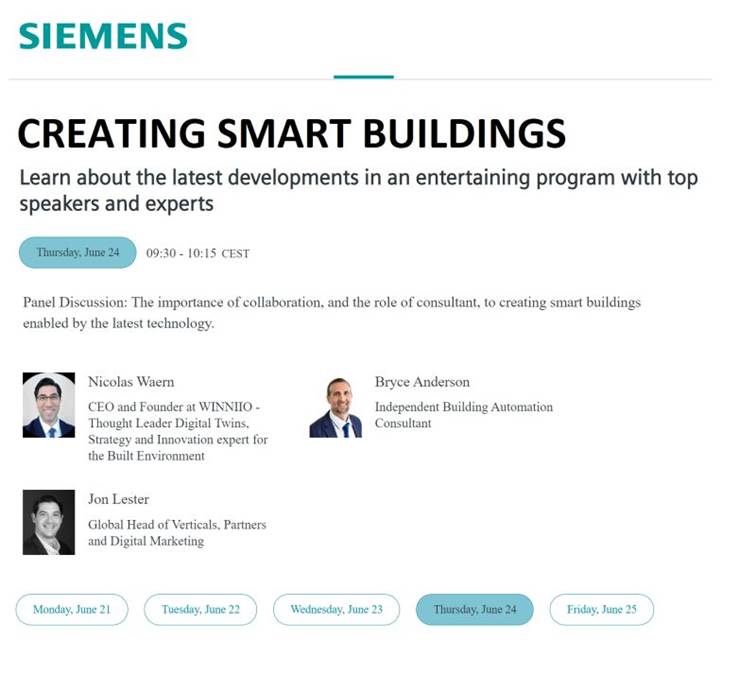
I will be recording a session in 8 hours for a Siemens Global Conference talking about building automation and how to go Beyond Buildings. We were discussing the need to use technology to solve problems, and that we need to use tools of the time to solve historic problems. Not only in the sense of the building automation side of things, but also for collaboration purposes. Which is not that dramatic since countries like Australia are locked in for the next 12 months, and we could still use some of their amazing brain power in other places. Especially when my counterpart for the Siemens panel discussion is no other than the legendary Bryce Anderson.

1

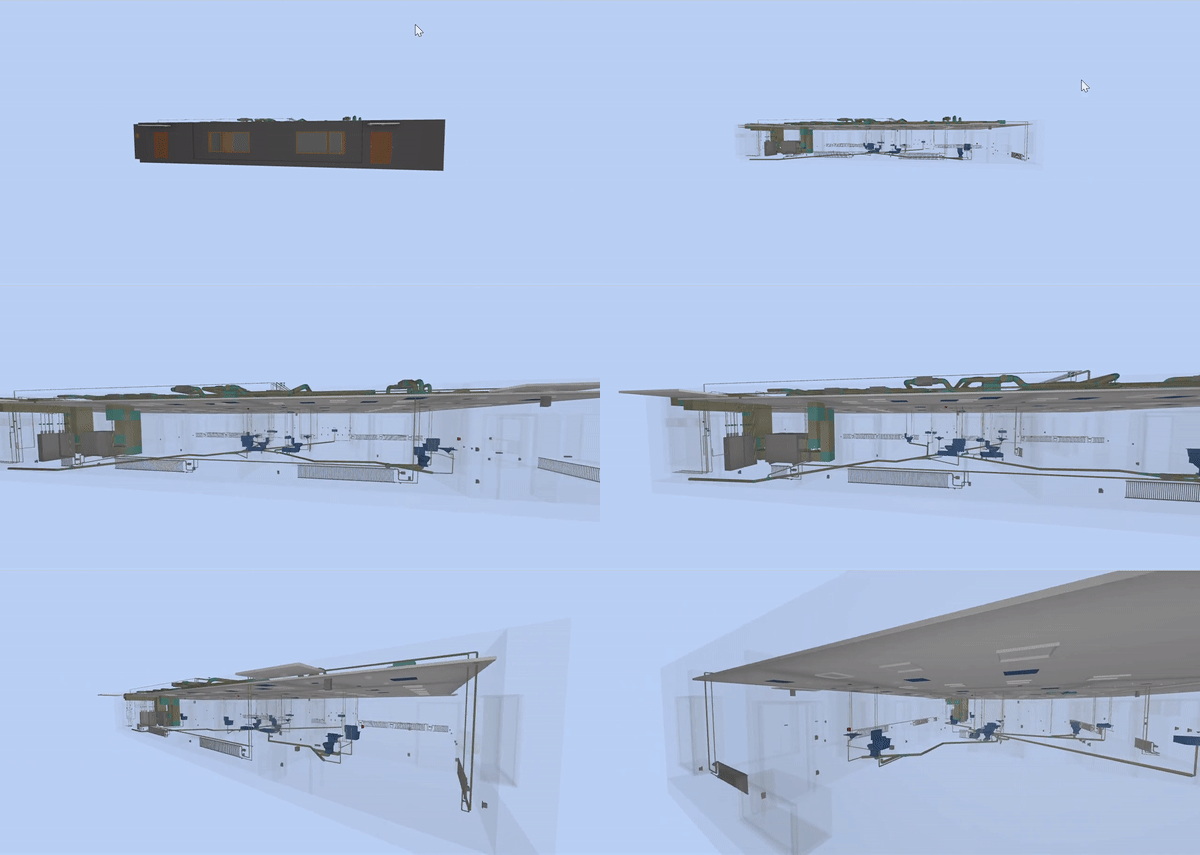
So why continue to collaborate with Word docs and PDFs, when people having could describe their challenges by capturing their reality and invite experts to help them? Wherever they are. We are utilizing this approach in an innovation project I am leading right now for three schools in Sweden, and it helps to get stakeholders on the same page. The 3D-models act as a foundation for future IoT-visualizations. Making reality come to life in a continuous way, forever.

Something that I also heard this week from a self-proclaimed AI-expert was that he was continuously surprised that people in traditional industries (he was referring to the automotive industry) were still researching what food horses should eat to make them run faster. Not understanding that the tools of tomorrow are here today, just lacking a bit of adoption. And companies should be more focused on what Artificial Intelligence needs to feed on.

AI is overhyped as much as Digital Twins, IoT, and everything else to be honest as a stand-alone saviour in otherwise traditional industries. I mean, come on. What are the jobs to be done? how are they being solved now? and why haven’t anything happened since… forever?

Is AI overhyped when it comes to the benefits that could be derived when using it correctly? No, quite the opposite, of course. The domino effects of doing the right things, and not just doing things right will have the effect of not only making processes more efficient. But also eliminate the need for many due to a completely different process altogether.

The questions should not necessarily be what is wrong with any industry, or if industries are behind. Or focusing too much of the problems that do exist. Because the challenges vary, a lot. And the solutions vary, a lot. It is not about technology, it’s more about the people, processes, culture, tools as well as the decision makers that are in each region.

Digitalization efforts are taking time. It is not for a lack of trying. It is for a lack of understanding. Where most Digitalization experts outside the Real Estate industry do not have a clue about buildings. And they think it is as easy as taking data out and then do something with it, not understanding the need for context.

What I do agree with is that we need to use modern tools, or we will be forever destined to be stuck in the past. We are getting there with the help of a pandemic, and it must be about profit as well as a planetary purpose in my mind. One big question right now seems to be if the API-economy of buildings will help in making sense of the data? Or just make it easier to get out, but potentially make it more challenging in the long run?

The need for AI-first strategies.

I wrote about the dangers of the API economy 2,5 years ago, and it still holds true for the most part in the sense that an API-economy might be the stepping stone to more problems in the future. Maybe today more than ever. Other industries are experiencing the problems with data lakes turned into data swamps and some of the largest event-streaming initiatives have also missed out on the meta-data tagging part. Failing to understand contextual relationships at scale.

However, the phenomenal part is that companies and industries seem to utilize taxonomies and ontologies more and more which should make it easier for everyone to digitally onboard buildings faster. There are still challenges with industry specific taxonomies and mapping data too early, too hard to something that cannot scale across domains. But I believe we are on the right track.

And I am of course proud of the Swedish wonder, REC – Real Estate Core, where representatives from my Alma Mater have been instrumental in bringing it to the world (Jönköping University). For the ones that have missed it, Microsoft have partnered up with;

RealEstateCore (a Swedish consortium of real estate owners, software houses, and research institutions) has delivered an open-source DTDL-based ontology (or set of models) for the real estate industry, which provides common ground for modelling smart buildings while leveraging industry standards (like BRICK Schema, W3C Building Topology Ontology) to prevent reinvention.

14

This is a great start for owners to utilize the data for industry-specific applications within the realm of real estate. During one of the latest published episodes of the Beyond Buildings Podcast we discussed aspects of Ontologies and Taxonomies with the legends, Terry Herr, Joel Bender and the co-creator of Real Estate Core, Erik Wallin.

7

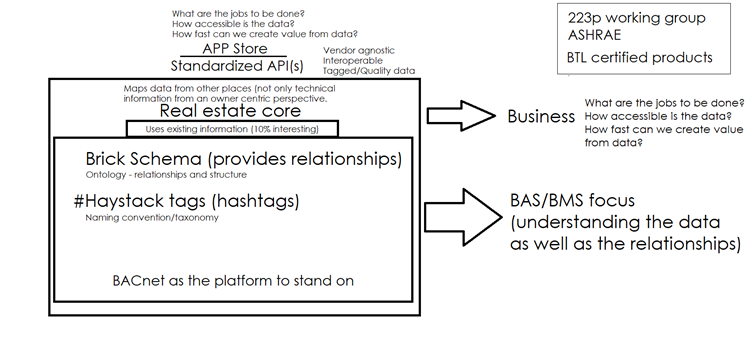
This image was something I scribbled down after the discussion which was late 2020’s, and it has been updated since then. But it shows somewhat that the initiatives back then focused on the real estate realm, and quite a lot on the building automation side of things. Which is great, but if you think about AI, it is also a lot about the context. And not always the context you would immediately need.

There are phenomenal companies out there solving silo specific needs and that is exactly how it should be. They solve foundational challenges for the energy side of things, building automation, the proptech-angle, and in the realm of fire, evac, audio/video, elevators, lighting, FM-services, and everything else that has anything to do with buildings. There are always dangers of the thousand cuts problems, but it seems that we are getting to a future the world desperately needs. But how do we capture meaning from all these existing systems and turn them into fodder for AI?

How can we make all of this come together?

Save yourself from hell!

One of the most terrifying experiences when I was a kid was when I sat in our basement alone, watching the movie Event Horizon almost 25 years ago. There is a segment in the movie when they think a guy says, “liberate me”, which means set me free. It is later corrected to libera te tutemet (ex inferis) “save yourself (from hell)”.

Which is what an AI-first mindset could help companies do, having learnt from other industries that are stuck in API hell and what their challenges lie in leveraging AI at scale. Data lakes could easily turn into data swamps if not understood correctly.

What does AI want for breakfast, lunch and dinner?

AI could eat a lot of things but it certainly prefers quality data. Preferably seasoned with some meta-data. This could come from existing systems, but also something that most people tend to forget. People. People are still providing initial as well as continuous contextual intelligence for systems and AI-initiatives, adding their domain expertise in a continuous way. Where systems might be fantastic in isolation, but when it comes to the real world, bringing systems and people together is a challenge of its own. Most often because domain experts have no idea how to communicate with each-other across domains, and the fact that they do not necessarily know where boundaries stop and start. This takes time that companies do not have, nor the planet.

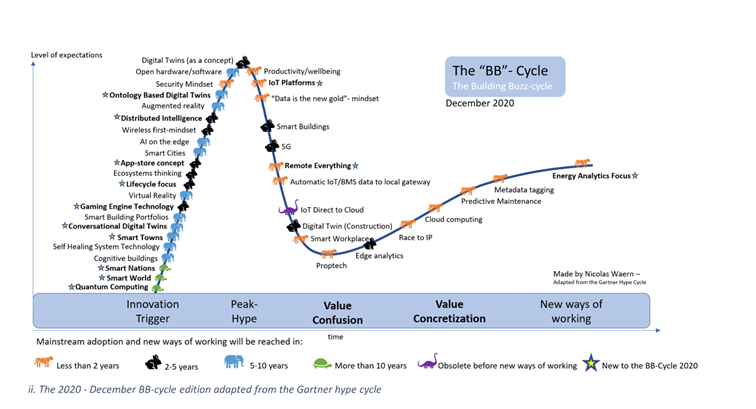
But fear not my friends. Remember that all the tools and technologies in the Building Buzz cycle are available today. If there is a will (this might be the problem…) there’s always a way!

Because what better way for explainable AI to be explained through that of Digital Twins?

8

My perspective of Digital Twins, as well as AI, is that on part should be made for people. And the other side for machines. We need to create a world for humans, and machines. We got graph based-ways of working, taxonomies, ontologies, RDF vs LPG, and everything else that can help in recording reality in the best way possible. What would that look like? And what would the benefits be?

Beyond Real-time collaboration, BIM+ Real-time data.

In the movie Event Horizon which I talked about earlier we get an explanation of the question;

“What is the shortest distance between two points?”

I will not spoil the movie for the ones who have not seen it, but that 2–3-minute segment has been with me for the last 20 years. And in traditional click-bait mannerisms, it is not what you think.

12

The shortest distance is if you can connect both points in space and time. With the combination of real-time data, IoT, virtual reality, taxonomies, we can define our reality and let anyone in the world innovate with us. Not limited by space and time, where the Digital Twin acts as a time-capsule.

How else could I get one of the leading Building Automation specialists is in Australia to help me out in the best way possible? By utilizing the combination of modern technologies, we finally have a way that will allow people, machines, AI, past, present and future to coexist in the same space and time. What can we understand then? What would this to for the skill shortage gap when we could capture the knowledge of domain experts, and that of industry guidelines into a digital twin? This could also be used for education purposes, and not only capture knowledge, but much more easily transfer knowledge from systems to systems, and via domain experts to domain experts.

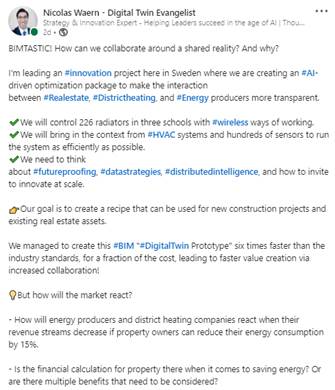
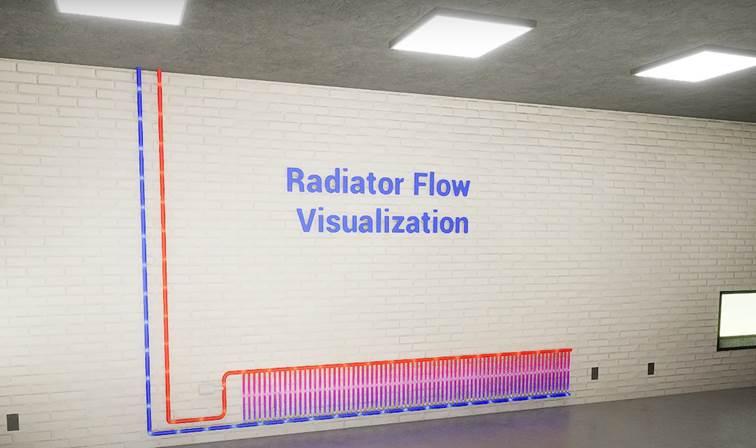
In the project I am leading we aim to bring more transparency to the dynamic interaction between real-estate, district heating, and energy producers in a smart city context.

Simply put, we will connect temp, humidity, CO2, sensors for 70+ rooms with actuators to 226 radiators to control the system via AI-based ways of working. We will go for a distributed intelligence approach, utilizing wireless Modbus, map it to tagging standards, like Haystack, Brick, REC, and create one API to the building. As Sabine Lam wrote last month, Digitalization is surely changing the role of what integrators need to do in order to try get towards future ready facilities. We will utilize wireless mesh, wireless Modbus, standardized ways of working and a combination of RESTFul, MQTT, and in discussions with graphql approaches and Kafka-based streams where everything is built to be bi-directional and data tagged according to multiple standards leading to truly software defined buildings.

Owners should be in control of their past, present and their future and allow others to create value from their buildings. Not having to ask for permission where data and control strategies are held hostage by vendors and integrators.

This is the starting point for this project and there are a lot of other benefits involved as well.

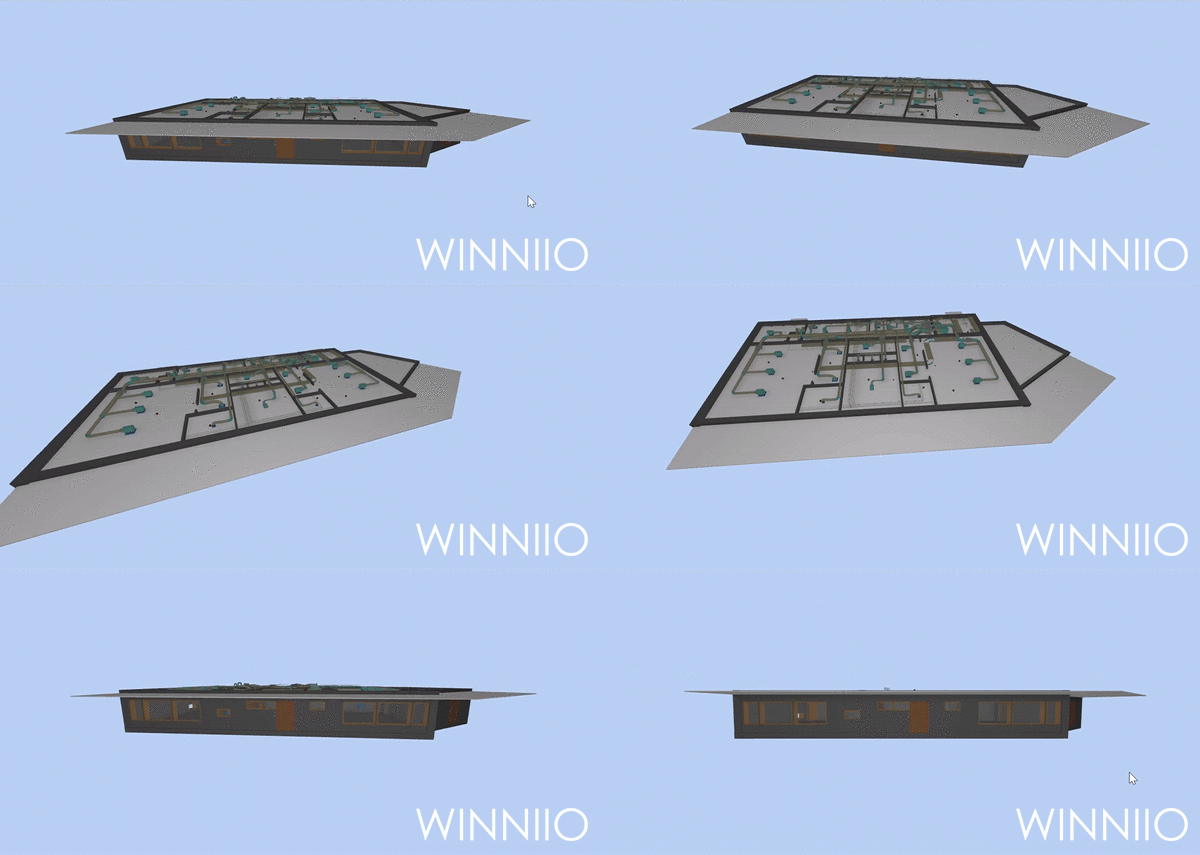
What we also want to do is to lay the foundation of Digital Twins by utilizing the drawings, turning them into 3D-models, and then adding real-time data from everything. Lighting that digital twin up like a Christmas tree. And then just animate it with occupancy so that we can SEE how the system is working, and how it is affecting its context, and how the context affects the system. In real-time if that is interesting, but even more so, do the calculations and simulations and run the building from the future. This will enable all stakeholders to finally pull down the curtains and create transparency into “that Voodoo that you do”. And understand that it is not only about the buildings themselves. It is about the context.

We need to start creating the future, today.

The ingredients exist. The people. The systems. The processes. But they are not in sync. Everyone and everything are operating in separate realities. The combination of modern tools and technologies  can change that. Not only to bring people and systems into a shared reality, but also allow for AI-augmentation based on a contextual data fabric. Digital Twins for instance, can create an organizational wide understanding of the actual content, the products, AND how they relate to usage, supply chain and the overall lifecycle. Steve Jobs explains it well enough when it comes to the obsession with processes, neglecting the content and context. Modern approaches done right could easily help companies make decisions 9 times faster, with access to real-time data. What would that do for any industry?

This below was made by the company SEKAI which have a very future oriented approach when it comes to Digital Twinning. They combine open-source technologies, making them come together through a Digital Twin enablement platform. They have an ML-assisted way of ingesting data from different sources, tying them together through graph-ways of working and ontologies. And then exposing the combined data sources via a Data notebook to simplify data manipulation for data scientists, as well as low-code interfaces for faster value creation. What I like about Digital twins in general is that they aim to work as a complement to existing solutions, bringing them together in a way that could potentially record any reality that exists, has existed, and simulate realities that are about to exist.

13
vi. CAD + IoT + Ontologies + AR + VR = Reality Recording at scale via SEKAI Digital Twin Platform

If you look at the most modern platforms and approaches, this is what is going on behind the scenes. The Digital Twin Consortium members are all about similar approaches, albeit in separate offerings, and in several industries like Healthcare, Manufacturing, Natural Resources, Infrastructure as well as Aerospace and Defence. And Chalmers Digital Twin City Centre, which I recently joined, they are also working with similar tools and technologies.

Again, everything exists. “It’s just bringing it together”. But some take longer than others and work is not always automated, nor simplified through no-code/low code approaches to democratize modern value creation at scale. Time is the most valuable currency we have where open-source tools and technologies do not always have to worry about up-time and SLAs. That is what enterprise platforms are for. The real world usually demands solutions that are robust, useful, and attractive solutions that get the job done. But it is never an either or. Which is why we need interoperable solutions coming together,

We need to go Beyond Buildings.

Because the thing is that it is not only about AI. It is not only about Digital Twins. It is about all these slightly more modern technologies and strategies that need to be utilized. Not in isolation, but in collaboration. Between humans and machines. And how technology can be used as an enabler to improve scale, scope, and learning, and to solve problems. As well as doing more of what is already great. It’s about saving money, making more money and finding ways for new business models to emerge. And for the newly started companies, all of this should be more than an enabler. It will be part of their Digital DNA.

14
vii. The BB-Cycle by Nicolas Waern, adapted from the Gartner Hype Cycle

Just imagine if the building that you manage had could incorporate all the above approaches. What would that entail?

You would be able to zoom in and out in all disciplines to understand them not only from their viewpoint, but also from everyone else’s. AI will not be isolated ways of working to solve siloed problems and challenges in one discipline like energy efficiency. But it would be utilized on top of the asset, the portfolio, possibly with individual, interoperable digital twins where the dynamic interaction between different entities are in focus.

The industry needs to do better. Irrespectively if its behind or not. And I do not think it is for a lack of trying. But I do believe it is for a lack of understanding. From all sides.

We have been taught since our childhood to simplify reality in segments. But that has led to the widespread confusion we see today. Where people are in their individual caves, not understanding what is happening nor being able to explain their point of view to other people except for their followers. What if we could not trick reality? What if we could play with reality?

It is not about knowing more. It is about taking what we know, putting that together with other people that know, and give them a problem they can solve, that can be copy pasted to the same problems in that industry or other industries, so that we only solve these problems once, apply it, and move on. Sooner rather than faster, we have solved the problems 99% faster, in a way that retains knowledge forever for both humans and machines.

Would that kill the dinosaurs? Not necessarily. Just elevate them, capture and transfer their knowledge in a standardized way for future generations. We need to plant the digital trees under whose shade we do not expect to sit. We can clearly see that it has not been easy up until now. We have the skill-shortage gap, and we seem to copy other industries utilizing API-first for decades, which could lead to a data swamp in hell.

We need to think about what Artificial Intelligence needs. Before we do anything else, not after. Otherwise, we will continue to do more of what we are trying to get rid of. We are well on our way towards the future we all need. Dancing with Dinosaurs needs to happen, and we need to learn from each other. We need the dinosaurs with us on this so let us see what we can do to adapt technology to them. Not the other way around.

We will be talking more about AI-enablement the next episodes of the Beyond Buildings Podcast, so stay tuned for more. And do connect with me on Linkedin if you have not done so already!

And if you or someone you know need help with questions regarding strategy, innovation, and figuring out how modern technologies can help you where you are today. Look no further. WINNIIO will always be by your side. Just reach out to me, Nicolas Waern, on LinkedIn or check out my Podcast Beyond Buildings if you need any assistance.

Sincerely,
Nicolas Waern

ceo@winniio.io

How NUDE(D) do we need to be to Navigate the Next New?


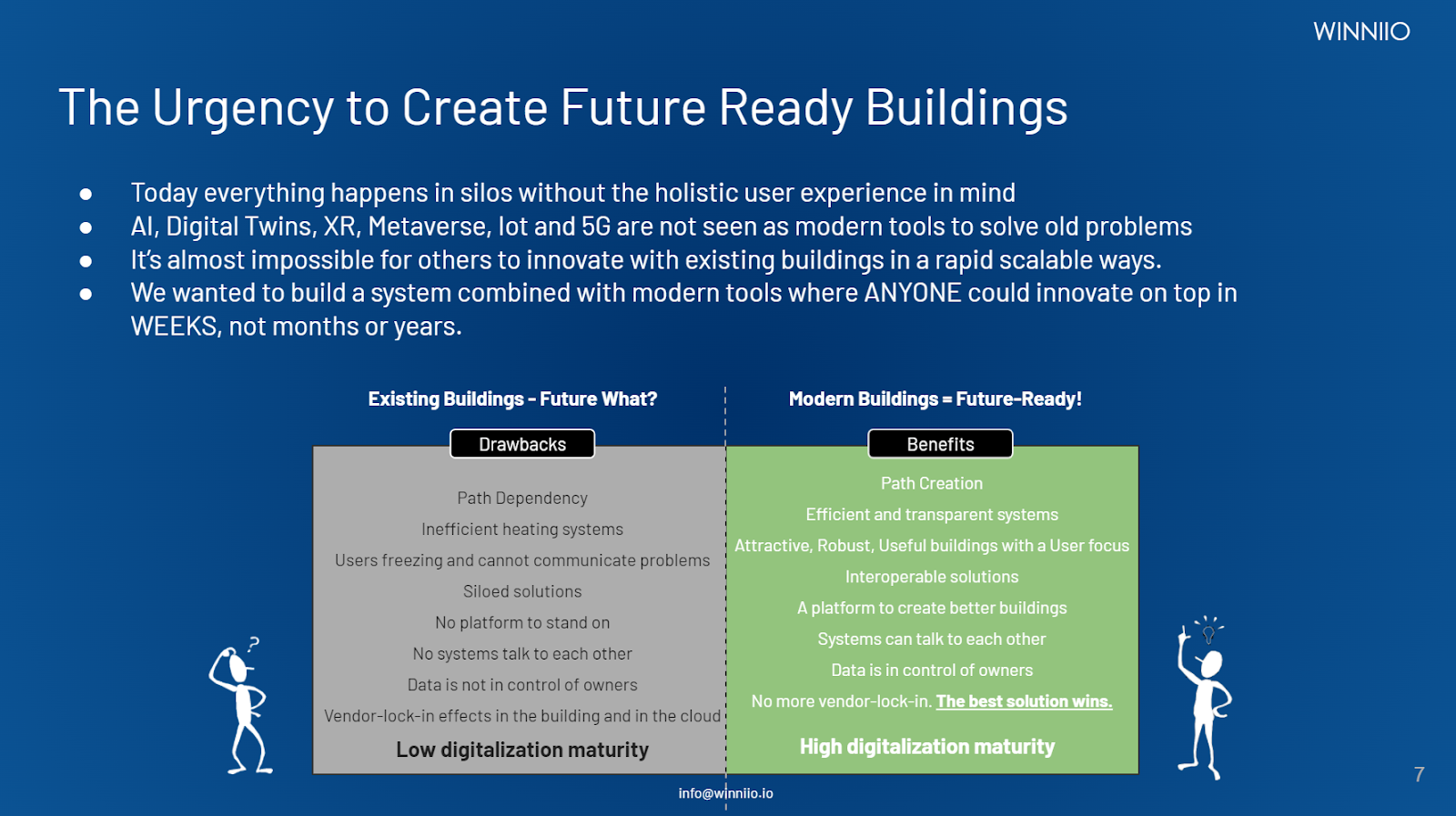
What inspired me to write this article was something I also talked about last month in the article “What killed the Dinosaurs? The AI-age!”. It will be about how companies are viewing technologies and how companies could get started. After all, before we can think outside the box, we first must define the box. And the best starting point to find and leverage scalable and innovative solutions is to have well-defined problems.

What view of technology do existing companies have in the Real Estate Industry? What view do they need to have? Don’t we also need a planetary purpose and advance the industry? How can we create Smarter Buildings together? Does the recipe I created last year still hold true?

Are we collaborating around the same tools as we have always done? What parts of our technology stack are advancing whilst others are not? Should we aim for a world with people first? Or People and Systems working in tandem?

People, Profit, and a Planetary Purpose

What are the trends in society today and what do they mean? The overall trend seems to be that people should be the focus of creating better buildings. Energy savings, predictive maintenance, internet of things, smart city inclusiveness, and all those new techy things are important.

But if buildings aren’t robust, useful, and attractive and if they don’t benefit the planet, nor people, then what are they good for? We talked about this last week in a panel discussion by SIEMENS.

1
ii. Panel discussion around the topic of how to create smart buildings

These where the topics of the discussion and if you are interested, just reach out to me and I will send you a link because it is not out in the open yet.

But going back to what we need to do to create Smart Buildings I cannot help but think that we have some ways to go before buildings, and organizations become more digital. And to also think about the perspective of alternate views on how to get there.

I find that the 3-30-300 rule from JLL is one of the more interesting concepts out there. I have touched upon it before in many of my articles and the one article that I usually circle back to is the Trillion Dollar Opportunity article from Brad White. Read it, and then read it again. It is one of the most prolific articles in the building automation space that I believe has ever been written. And it is only about the fraction of the value that could be created! But is more and more relevant every day, for all of us.

The conclusion to the article is that the only thing standing in the way of smarter and better buildings is a lack of imagination, and the willingness to do what needs to be done with the tools that are at our disposal. The technology exists, even more so today than 5 years ago. But what about the imagination, and viewing technology as an enabler instead of a utility? Are companies in the building automation community embracing new ways of working and utilizing modern tools to do the job? Or are companies stuck with legacy technology as well as old mindsets? Are existing companies built to die? And if they are, how can they get re-born connected?

Be as NUDE as you can be?

More and more companies are becoming more technology driven. Banks are becoming software companies that happen to deal with money. Retail companies are data-companies that happen to sell shoes.

But what about system integrators? What about the traditional HVAC industry and players in that field? Are they too becoming data-driven companies that happen to deal with buildings? Or are the existing processes, culture, people, roles, and existing systems as well as industry dynamics and people-focused business models against this?

Will there be insightful decisions being made or will most of the existing companies be disrupted?

The NUDE-acronym could provide a good starting point to reflect on how technology (IT) is being viewed by companies, as well as individuals. The way how we view IT can be of a huge difference for us, and our organizations. Coupled with RGT, Run, Grow, Transform, NUDE can be a powerful tool to start the future.

NUDE stands for the different perspectives of how organizations can view technology.

None – There are no synergies between business and technology
Utility – Cost/rational perspective, where it is being used, but not thought of
Dependent – The business side of things is linked to technology and is needed to run daily operations
Enabling – Technology is an integrated part of the strategy process and it is a dynamic interaction between the cognition of strategy and technology. Investments are made to create a competitive advantage over others.

And also the new addition to NUDE.

DNA.

A Digital DNA. That is what companies today are competing with. Not their industry peers. Not the dinosaurs of yore. But the companies that have speed, and AI-ready data fabrics in their digital operating models and digital business models.

We need to compete in the age of AI

Companies starting today should have technology in their DNA. I have talked about it at a blockchain conference in Mallorca. Written about it for the Beyond Buildings Podcast.

Where the example of Bank of America with their 212 000 people company services 70 million people. And where their counterpart in Asia, ANT Financial services 720 million people with 11000 employees. Where growth = efficiency.

It is true that traditional industries such as the building automation space might not have had a need for real-time data across portfolios. And where resource decisions are based on past or current needs rather than future needs. But how long are companies protecting the past instead of protecting their future? Is this mindset sustainable? Are we not moving towards individual buildings to portfolios and smart city thinking? When buildings get more and more connected how will companies respond to security threats, and what tools should they have at their disposal?

Will building automation companies learn more about the tech side of things fast enough?

Or is it more likely that tech companies learn the building automation side of things first?

Which side do you want to be on?

Change before you have to. And do it in an open, collaborative way where you focus on what you do best whilst leveraging technology and partnering up with others to create sustainable value. If that is not the only way to take control in an ever-changing future where speed is of the essence, I do not know what is.  

And as always, go out there and start something. That is the only way to learn.

We will be talking more about AI-enablement the next episodes of the Beyond Buildings Podcast, so stay tuned for more. And do connect with me on Linkedin if you have not done so already!

And if you or someone you know need help with questions regarding strategy, innovation, and figuring out how modern technologies can help you where you are today. Look no further. WINNIIO will always be by your side. Just reach out to me, Nicolas Waern, on LinkedIn or check out my Podcast Beyond Buildings if you need any assistance.

Sincerely,
Nicolas Waern

ceo@winniio.io

Smart Buildings are dead. Long live Smarter Buildings!

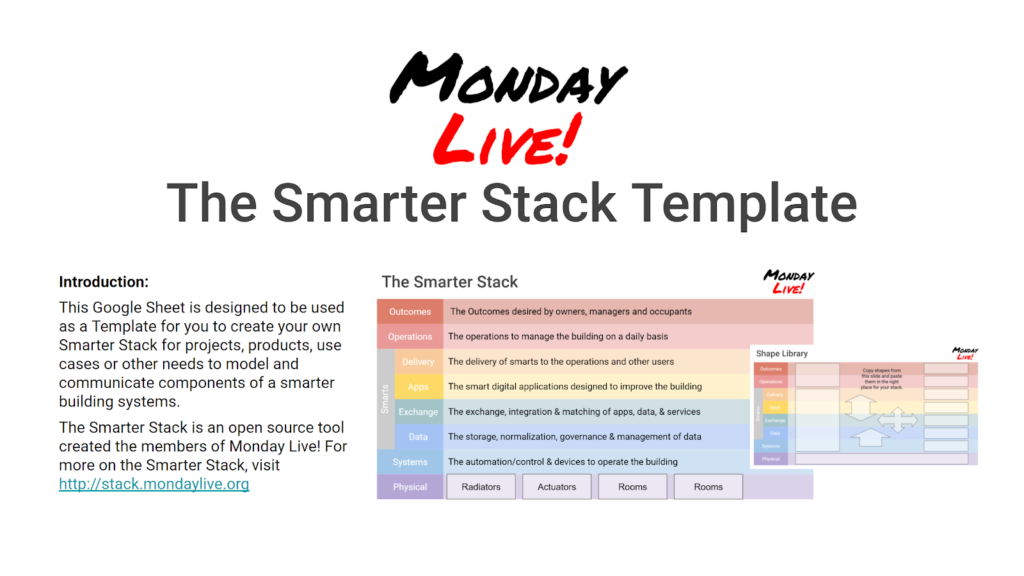
First off – hats off! Introducing the smarter stack!


The Smarter Stack is an open-source tool created the members of Monday Live! For more on the Smarter Stack, visit Monday Live

Really interesting and great approach when it comes to getting started to plot out what smarts go into a building and how it might fit with existing dimensions. A great tool to have and I will try it on for size and see how the tool fits.

The thing with tools and frameworks is that there are a lot of them out there.

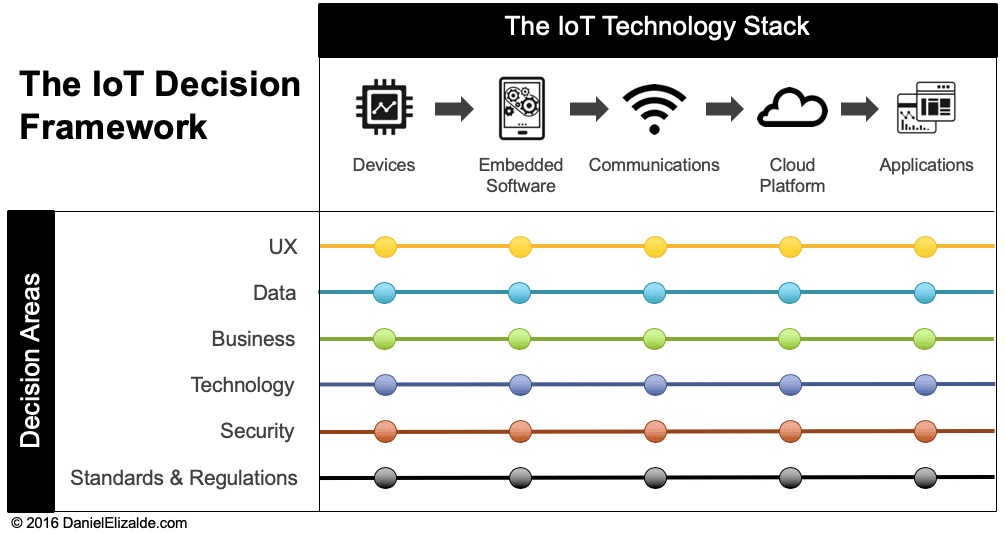
I like the IoT Decision Framework from Daniel Elizalde. If you haven’t seen his work yet, you are in for a treat!

1

And my first question to the Monday Live crew during the webinar was how to get the Smarts framework to be adopted by the ones that need it the most. Which also opens a pandoras box in the sense that all existing stakeholders might need something that makes sense across domains. And as per usual, it is not usually one tool/framework that is needed, but many in conjunction at specific times.

Again, the systems, the people, everything is here as ingredients. But how can we create the recipes? And how can we help each-other become smarter in the process?

“We probably need a course adjustment and keep our eyes on the road still. But to also ensure that we can take our hands off the wheel, knowing that we should be able to take control at any given point in time. “

  • How can we share knowledge between stakeholders?
  • How can we bring in more youthful people to the industry?
  • And how can we enable buildings to become smarter and smarter and possibly Smart Buildings?
  • What was potentially missing from the Smarter Stack?

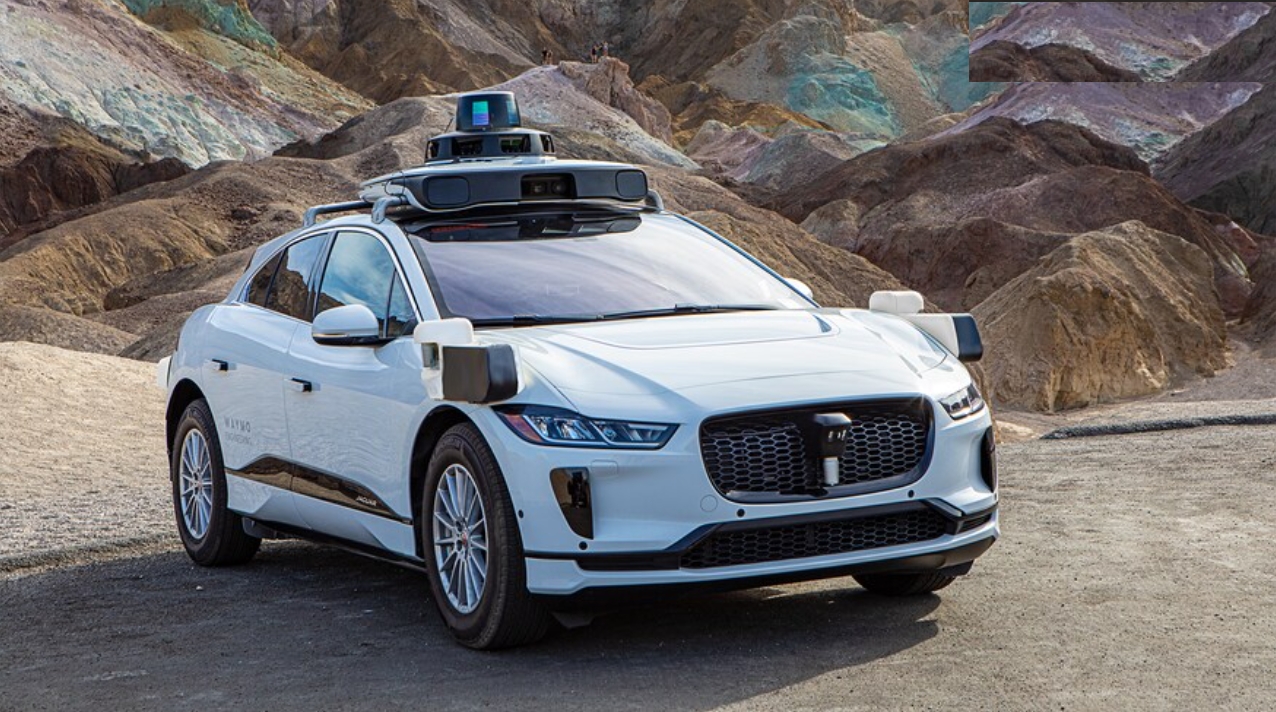
 News Flash: There Are No Self-Driving Cars on Sale Today

A lot of questions for sure and only time will tell. But it is equally interesting that this article was shared the other day.

“What exists today is a collection of technologies called Advanced Driver Assistance Systems (ADAS), which can handle basic driving tasks for short periods of time in specific, ideal conditions. ADAS must be monitored at all times, and the car’s driver must be alert, undistracted, and prepared to take control at any moment. The best ADAS available today allow drivers to take their hands off the wheel but not their eyes off the road.”

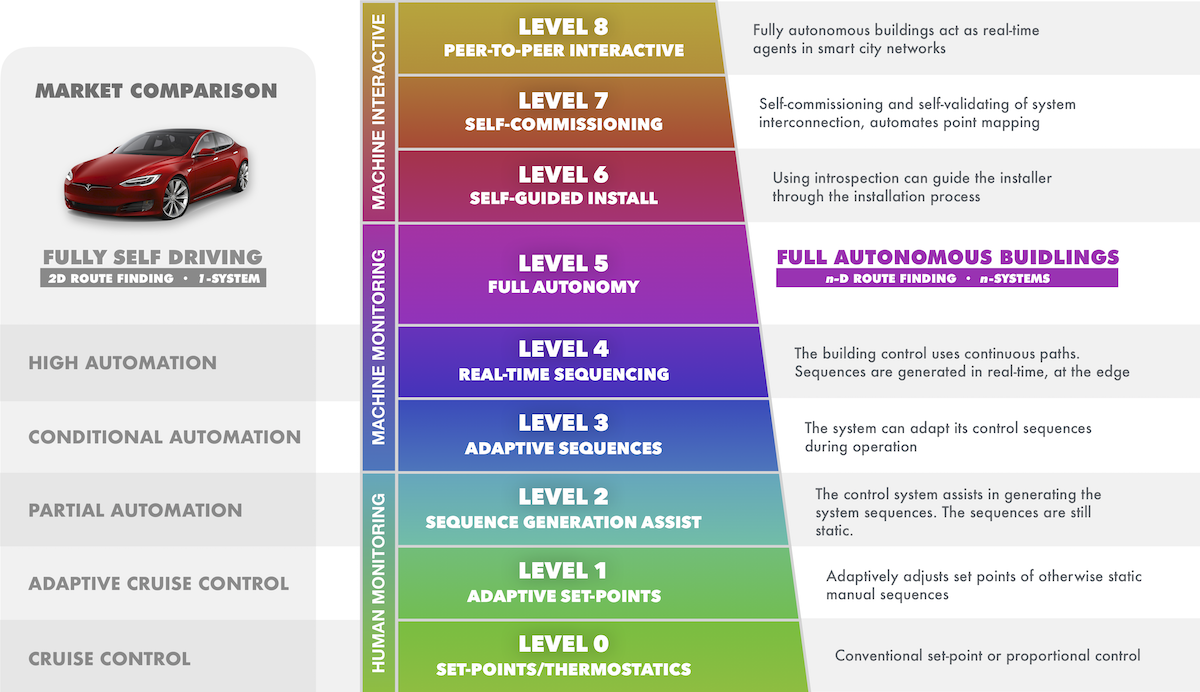
Which reminds me of this article from Troy Harvey, who will soon be a guest on the Beyond Buildings Podcast talking about the past, present and future of building automation.

3
2
iv Full Autonomous Buildings Picture by Troy Harvey, Passive Logic

Maybe it is less about Smart Buildings and more about understanding where buildings, companies and existing systems are and take the necessary steps to become smarter. And along the way towards becoming truly smart we first must get digital. Where buildings might or might not be more advanced than the people and organizations managing them, servicing them, nor using them.

We probably need a course adjustment but also keep our eyes on the road for a while longer. And to also ensure that we can take our hands off the wheel, knowing that we should be able to take control at any given point in time. But we are getting there. And considering that buildings still are energy enthusiastic, we better get to a point where smartness also includes sustainability, security as well as the context of buildings which is the connection to the outside world.

“What I’ve learned is everything that we do, whether it’s FTD, whether its analytics, whether it’s systems integrations, um, that’s not the end goal. That’s the means to the end goal and what everyone needs to keep in mind is this is about climate change. This is about making the world a better place.” – Don Kasper

Coincidentally, this is exactly what episode ?#28 of the Beyond Buildings Podcast was all about! We talked to Don Kasper about going Beyond Buildings and how to get started in commanding the future, where part 2 will be more about AI-ML models and how to enable that level of smartness from above.

6

Going above and beyond

If extreme weather, climate crisis here. And if the ingredients exist, how do we create and share the recipes? How do we move towards systemic change? And what factors should modern systems cater to? People? Other systems? AI?

And where do companies start? Do they start with adding new sensors? Or making sense of the old? And how can we learn from industrial ways of working and share knowledge freely between people as well as systems?

Maybe Automation ML and other tips and tricks might do some of the jobs necessary. But it’s one thing to create tools and frameworks for the ones that want to look at the ingredients. And another thing entirely to get it out there and create value for the ones that need the outcomes of getting the recipes right. I will tackle the Chicken and egg situation with how to get started soon so keep your eyes and ears open.

This and more will be discussed during the next episodes of the Beyond Buildings Podcast and in the newsletter, so stay tuned for more. And do connect with me on Linkedin if you have not done so already!

And if you or someone you know need help with questions regarding strategy, innovation, and figuring out how modern technologies can help you where you are today. Look no further. WINNIIO will always be by your side. Just reach out to me, Nicolas Waern, on LinkedIn or check out my Podcast Beyond Buildings if you need any assistance.

Sincerely,
Nicolas Waern  ceo@winniio.io

Nicolas Waern is the CEO, Strategy & Innovation Leader, and a Digital Twin Evangelist at the consulting firm WINNIIO. He is a firm believer that the Real Estate Industry needs more of a lifecycle focus where we need to go Beyond Buildings and come back with an understanding what tools and technology we could use. And to solve the jobs to be done, together, with an open mindset.

Nicolas is working with leaders in several industries to understand how they can succeed in the age of AI. Predicting what the world will do in a week, a month, a year from now and to best utilize strategies and solutions that pass the test of time. He does this through a Digitalization- on Demand approach for anyone that needs to change before they have to.

Nicolas is a Podcast Creator & Newsletter Editor for Beyond Buildings
Thought Leader regarding Smart Buildings & Building Automation for AutomatedBuildings
Speaker and Influencer Event Streaming Platforms as the Holy Grail for Industry 4.0 Applications
Subject Matter Expert Real Estate Digitalization Proptech Digitalization Expert
Active Member of Digital Twin working groups Digital Twin Subject Matter Expert

Bonus Gif of a reality capture that I took in 1 minute during a trip to the local theme park. Reality Recording is already here, and there’s plenty more where that came from… stay tuned for more!

gif

A Digital Twin World  – Understood by All

Do companies understand where they want to be?
Do they have a clear understanding of where they have been, and where they are?


Too much birthday cake during the weekend, and well past midnight here in Gothenburg Sweden. I have been thinking lately that if given enough time, people will surely solve all the problems that are thrown at us. But that is the thing. I do not believe that we have enough time, seen from a planetary perspective. We need to make better decisions faster, and try to go beyond buildings, and learn from other industries.

Tomorrow I have a kick-off with Veoneer and Ericsson regarding Digital Twin enablement with one of the companies I work with regarding practical Digital Twin strategies called SEKAI. I helped them get into a mobility cluster here in Sweden called Mobility X-lab where big automotive giants, telecommunication behemoths, and small nimble companies try to get smarter together. 

And all the 40+ companies that were selected for innovation prototyping are mostly trying to solve problems in isolation. But in the real world, these systems need to be adapted to large organizations that have thousands of experts, systems, agendas, where innovation needs to compete with existing offerings, and industry dynamics that eat up innovation for breakfast. The thousand cuts problem is real. 

  • Do companies understand where they want to be?
  • Possibly. 
  • Do they have a clear understanding of where they have been, and where they are?
  • One could only hope.

And it is not the access to new technology or even the adoption of new technology for these companies that is hard. It is how they can leverage them with the people they have, processes, systems, culture, roles and of course being stuck in existing industry dynamics with suppliers, buyers, and everything in between. Most companies in the building sector might think that the grass is more digital on the other side of the fence. They might be right, but also wrong.

I discussed the topic of how to leverage interoperable Digital Twins in Manufacturing at a webinar the other week for the Digital Twin Consortium where the industry wants to be able to leverage modern tools that are open and interoperable. But they are also for the most part stuck with data and information that 

And the thing is that these POCs are never about technology. They are always about finding the right people and to see how change can be made in organizations that are made for anything but change. But the thing is just that. They need to change. Their customers demand that of them. The world demands it, and the future workforce as well as AI initiatives at scale.

3

But how can they make complex things understood by all? Can they? Is it possible to be understood by all or is that a dream that innovation strategists dream?

Back to Basics with completely understandable interoperability

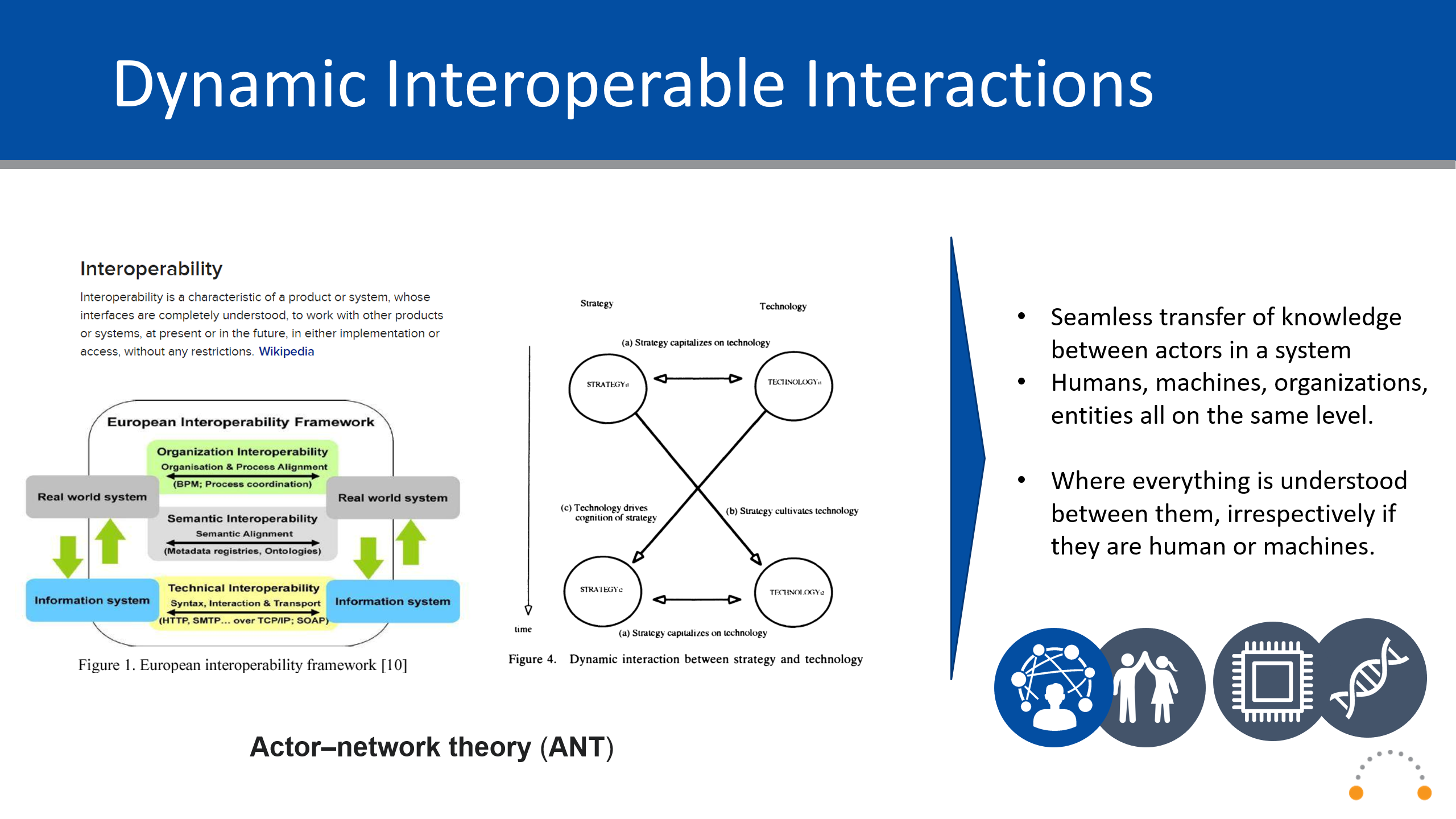
What does interoperability really mean? Is it how well we can understand something? Is it for systems only? Or do we have other ways of interoperability as well?

Diagram

These were the questions I asked myself the other week when preparing the webinar. And based on prior experience I knew that it was everything but simple. But then I found the sentence above which included “interfaces which are completely understood”. It referred mostly to systems, but being a fan of the ANT-theory (Actor-Network Theory) for the last decade I usually try to put people, systems, AI, in the same network, knowing that the reality exists with all of us at the same place. 

And this got me thinking. 

How can we make AI understood by humans? How can we make it understood by systems? And how can we make anything, and everything understood by all? Is this even possible?

I think so. I want to believe it to be true since we are in a people world. But we need to treat even the most mysterious buzzworthy technologies with a healthy dose of curiosity, as well as skepticism. But perhaps even more so, pragmatism. After all, the one thing we are best at, is using tools to reach an intended outcome. Can we try to strive for systems that are interoperable, robust, useful and attractive. Not only to people, or other systems, but also to that of AI/ML approaches. 

What would that look like? 

The road towards Agent Based Models and Multi Agent Systems

Today humans make the most decisions, where we are sometimes aided by advanced tools. Well, not just sometimes, all the time I would say. But when and where do people stop making decisions and where do we go towards decision making where advanced tools to the job?

And if we aim for agent-based models, and multi-agent systems to run simulations based on a reality that is being emulated through Digital Twins, what should be the agents?

Maybe it is that simple. To first state that we need to transfer knowledge seamlessly between systems, people, standards, and AI. And then identify these actors and agents, model them in ways that make sense for mathematical approaches, and also for other systems, and people in a transparent way. And then we can just feed the models with agents from the weather, the lighting, and also adhere to risk, regulation, sustainability, standards in the industry context. And then just run optimal configurations based on the outcome we are looking for. Where the systems will crash into each other and find the optimal course of

action themselves, mimicking any and all outcomes based on a reality that has been emulated.

Timeline

Is this completely understood by all yet? No. But with Digital Twins it can be. Think about it. Anything that you want to feed the Digital Twin, could become a part of a wider data fabric. Not limited by space and time, and where these fragmented parallel approaches could run their separate digital threads, only to be woven together towards an enterprise digital fabric that could solve in-channel analytics problems as well as across channel analytics based on physics-based modeling.

Too much?

Most likely. It’s 1.30 AM here.  

Summary

We need to make smarter and better decisions faster. We need to use the most modern tools that we can find to solve the hardest problems we have. And that is not limited to just collaboration between different end-points but also to that of collaboration between people. And we need to cater to AI initiatives, knowing that AI/ML approaches are seen as the best sticks of our time. 

And we need to make these initiatives understood by one another at great scale so that we do not keep re-inventing the wheel but instead realise that we are all on this planet whether we like it or not. We need to go above and beyond what we have done before to reach the stage of a world that is understood by all. 

Going above and beyond

If extreme weather, climate crisis is here. And if the ingredients exist, how do we create and share the recipes? How do we move towards systemic change? And what factors should modern systems cater to? People? Other systems? AI? And where do companies start? Do they start with adding new sensors? Or making sense of the old? And how can we learn from industrial ways of working and share knowledge freely between people as well as systems?

If you or someone you know need help with questions regarding strategy, innovation, and figuring out how modern technologies can help you where you are today. Look no further. WINNIIO will always be by your side. Just reach out to me, Nicolas Waern, on LinkedIn or check out my Podcast Beyond Buildings if you need any assistance.

Sincerely,
Nicolas Waern

ceo@winniio.io

Why Faster time to Value Creation?

The reason why we need faster time to value creation is not only because of Mass Urbanisation, Climate Crisis, Energy Crisis, and everything else that is doom and gloom. But also because we need to eliminate wasteful practices


Last week I had the pleasure of seeing one of the most impressive Digital Transformation projects I have ever seen. I was introduced to the project from SISAB here in Sweden that took 11 years from start to finish. Where the finish line was basically to be able to do whatever they want in standardized and interoperable ways. BACnet in the middle and an adamant focus on Structure, Visualization, Standards and Scalability.  

1

And a lot of staggering numbers regarding improved well-being and productivity. Being able to raise the degrees in buildings but cut costs drastically regarding energy and maintenance. And most of all, being always in control of their data. And now, when they have a foundation to stand on, they can build things on top like never before.

How much time do we have?

Is this project unique? In Sweden, yes. Because here, most of the building automation projects have zero BACnet in them. The ones writing specifications for new builds don’t even know that it exists. And because the level of knowledge is so low, companies that do know that it exists, hold the data hostage anyhow.

And this is a problem. Because we are not building any buildings to be better than they were a decade ago. It’s almost worse because buildings are not prepared in the slightest to become smart at any stage. Where smart is the ability to innovate with buildings in an easy, interoperable way.

So how do we solve this? And how do we do it faster than what they did? Where do we copy paste on a global scale and how can we get things to happen faster?

There is a global urgency for us to make smarter decisions faster, knowing that there is no business to be done on a dead planet. But today it takes years to create value with buildings because people and systems are operating in separate realities. Artificial Intelligence could do amazing things but the lack of collaboration arenas, non-transparent systems and fractured data, makes it extremely challenging to create value at scale. Are there ways to create value in weeks instead of years? And what is the importance of competing against time?

The importance of sharing best, and worst practices

I know what I know because of people in the industry. And we need to be able to share more, and in understandable ways. Last month I talked about the Future Creation Canvas where we need to solve the skill shortage gap. And upskill existing people. And this can only happen if we share best practices with each other. And, the worst practices with each-other so that we can avoid mistakes before we make them.

But how do we share these things between existing companies? And how do we share this with the people we want into the industry?

And if we have self-learning, wireless, open and scalable systems doing the job for us. What are the tools we need, and what are the roles of people in the future?

I am working on this right now and we’ll see when we have something to show. Because it’s not that hard really. It’s just about using the most modern tools at the right place, at the right time, and to be
aware of where the world is going in a week, a month, a year from now. And cater to the unknown. 

2

This is a slide from a Smart Heating System project that I have been managing for the last 6 months where we have created a solution that didn’t exist before. True separation of hardware and software, distributed intelligence at the core, sensors and actuators, monitoring and controlling a heating system, taxonomy/ontology ready, and “all that jazz” that is needed to pass the test of time. 

Conclusion

The reason why we need faster time to value creation is not only because of Mass Urbanisation, Climate Crisis, Energy Crisis, and everything else that is doom and gloom. But also because we need to eliminate wasteful practices. To get more people involved and start creating a dialogue between users of buildings and the ones whose job is to make buildings better. Not just on a local and regional scale. But on a global scale.

And this must be done with clarity in mind. Where modern tools must come in for collaboration, visualization, and not just for the “technical” side of things. The project above has been the response to this innovation tender “a Call from the Wild” that I won earlier this year. Where the aim is to come at it from the top and meet the world of BACnet Buildings and others in the middle. To truly combine ingredients from the past and present, to create future-ready buildings. And share these recipes in understandable ways with each other.

Where my sense of urgency comes from a planetary purpose. And that we need to create better buildings faster, together.

That is exactly what we discuss over at Beyond Buildings, and what I help customers with at WINNIIO Consulting. 

And I invite you to join a deeper discussion about these topics at the AHR Expo 2022 in Las Vegas. So either you wait until then, or reach out to me if you want to find out what to do, and to truly leverage all that the future will offer, today!

Sincerely,
Nicolas Waern

Future Creation Canvas

How to Win at Buzzword Bingo and to Succeed in the Age of AI within the World of HVACR


How to Win at Buzzword Bingo and to Succeed in the Age of AI within the World of HVACR

If we fast forward 100 years into the future, we will hopefully see that we have done things differently. Education will be different, and there will most likely be a higher degree of digitization. But who are the ones that will make this happen? Why? How? And most of all when? How can we predict the future as well as understand what we need to do to create it? 

Easy. Utilize the FCC to spot the place to be. 

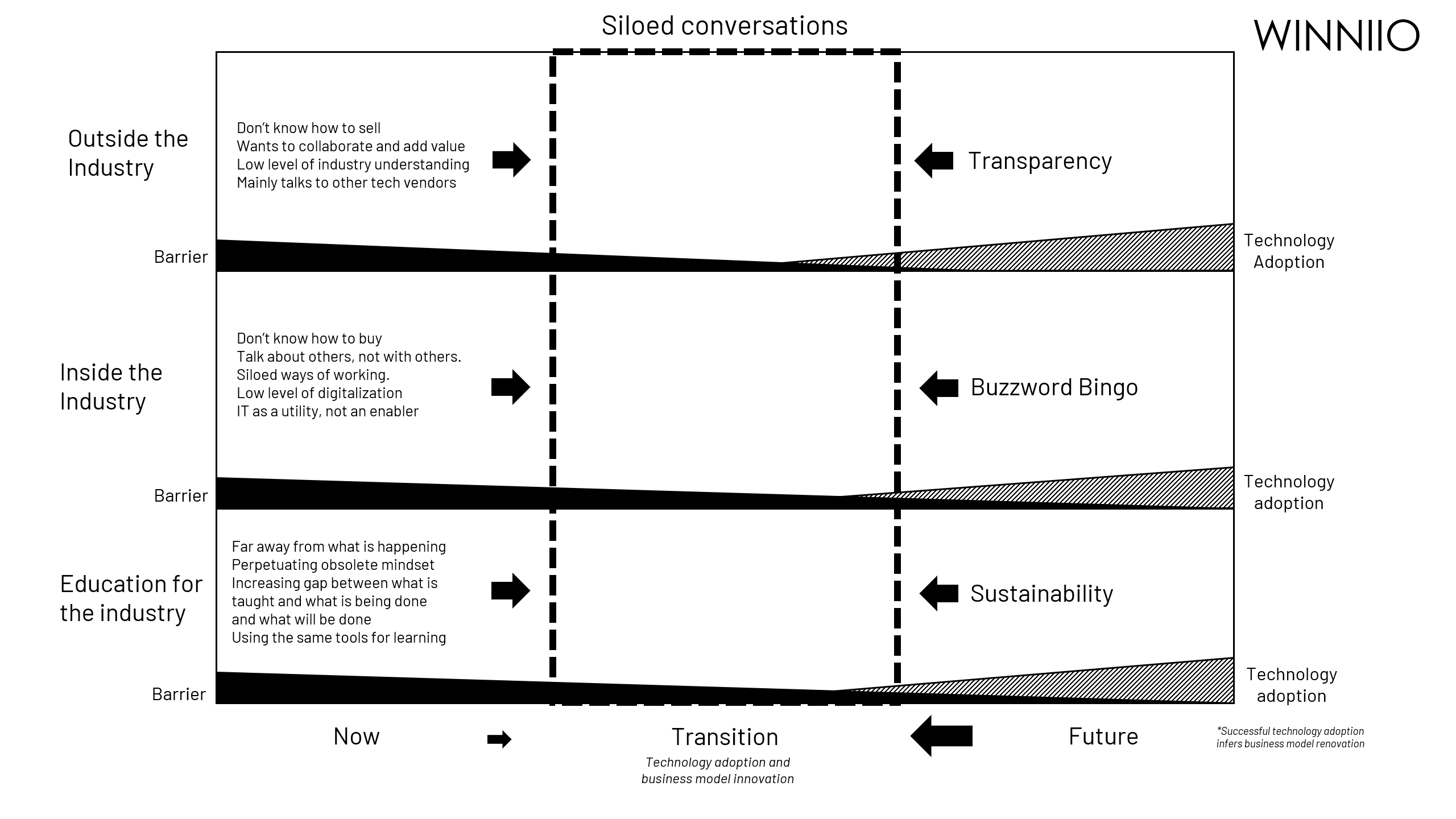
“New companies don’t know how to sell, and existing companies don’t know how to buy.”

3

The Future Creation Canvas is all about communication

I created this during a conversation between a McKinsey lead for Construction in Europe, a Professor of Construction Education in Sweden, a facilitator with an construction background from one of the largest general contractors in the world, and also three newly graduated construction professionals in their early 20s.

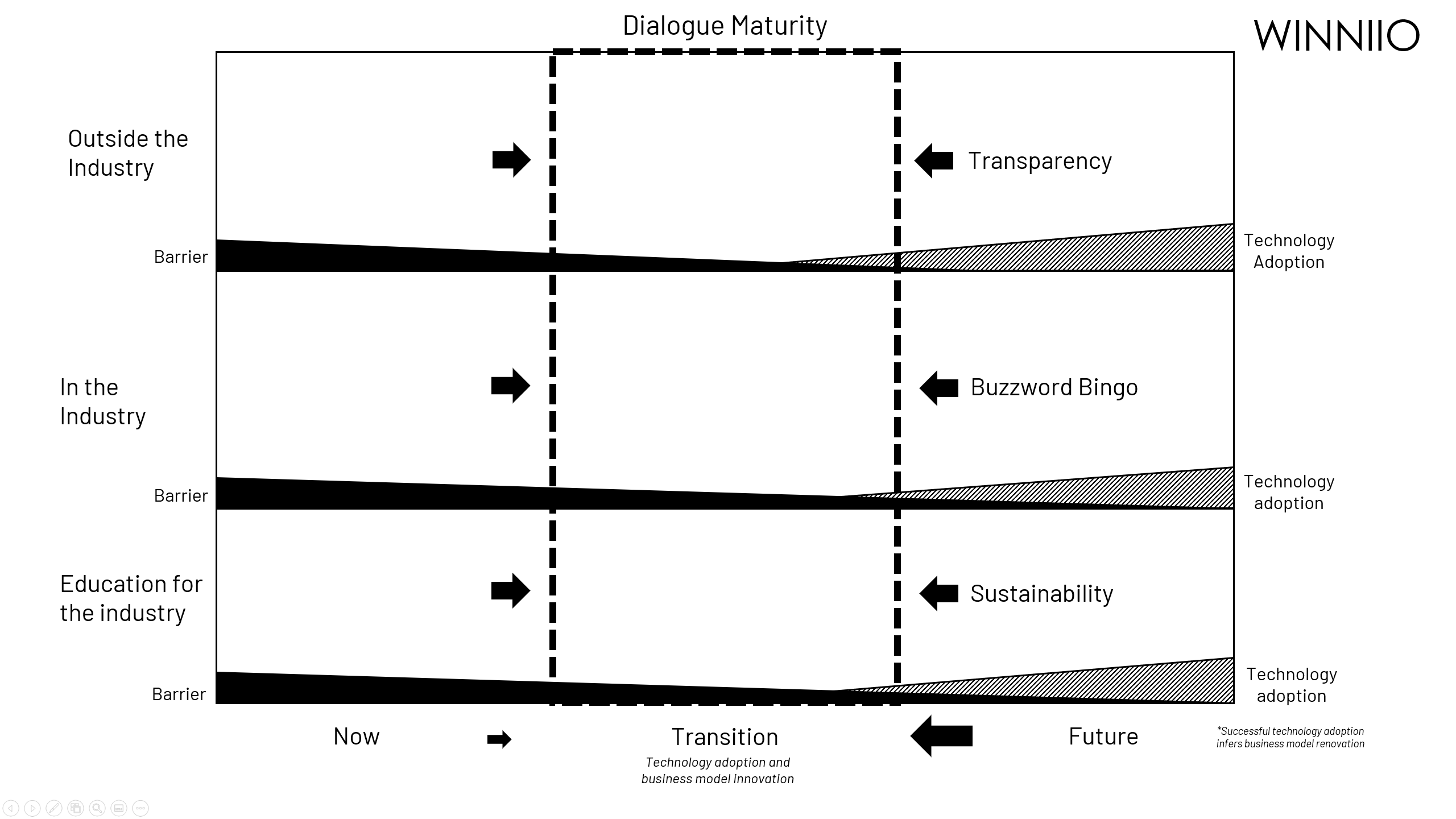
It was evident that there were immense gaps between what could be done (outside the industry) what was being done (inside the industry) and what was being taught at the University (Education for the industry). Where it was interesting to look at these as different swim lanes to better understand what is happening. And most importantly what will happen, and to better predict how it will happen, by whom, and of course when.

The big squeeze

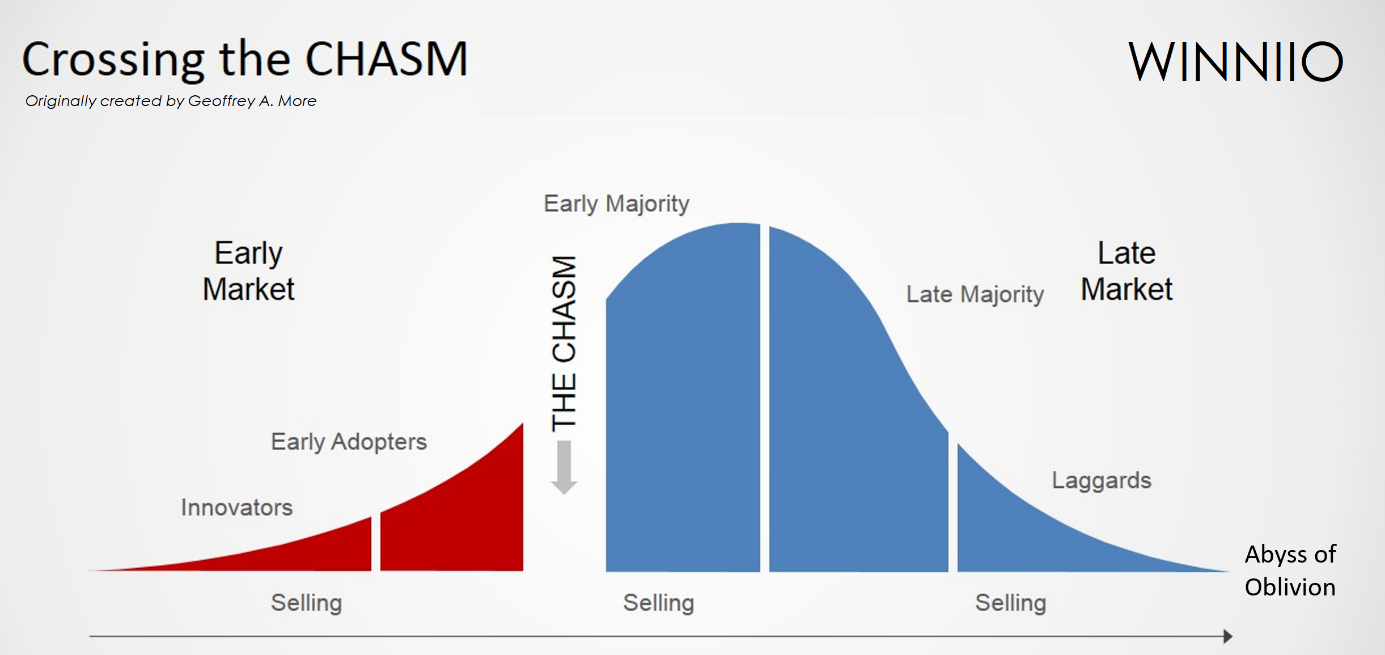
Because what do you think will happen when we start educating people in more modern ways of working where existing companies can’t change fast enough? And where new more modern companies with digital business models and digital operating models find their way into existing industries? The existing companies will of course be squeezed where more companies cross the chasm, and existing companies try to avoid the abyss of oblivion to the far right. 

1

From Path Dependency to Path Creation Strategies

The big dragons have of course managed to stave off the competition by eating up the would-be dragons, chewing them up and spitting them out. Sometimes for the betterment of the world. And sometimes not. 

The question is if the existing practices are good for the world? Or if we need companies that could provide faster time to value creation in more sustainable ways? To be honest, I don’t necessarily care about disruption as long as value is being created and where the best products win. The truth is though that I don’t see that happening within the existing industry. The path dependency is strong and it has everything to do about the (non)dynamic interactions between existing actors, education and the ones outside the real-estate industry in this case.  

2

Where some of the problems today are that some do not have a grasp on how to win at buzzword bingo. Where I have said multiple time before that companies can utilize most, if not all of the ingredients in the Hype Cycle today. But alas, most are fearful of Digital Twins, and do not now how to leverage modern tools and technologies in isolation. Let alone, together. Where new companies don’t know how to sell, and existing companies don’t know how to buy.

2

But the thing is that everything that can happen will happen. And 14 years ago, Smart Phones was a buzzword where existing companies like Ericsson and Nokia thought it was just a marketing hype. And most of us know what happened later. How can we solve the skill-shortage gap? What will be the next 10 slides of this presentation and how to actually start saving money, make more money and make new money today, not wait until the future?

What are the similarities and differences between what is happening within the “Smart Building space?” What can we learn from self-driving vehicles, the automotive and manufacturing sector and how to become best buddies with the buzzword bingo side of things, leveraging modern tools to solve ancient problems?

That is exactly what we discuss over at Beyond Buildings, and what I help customers with at WINNIIO Consulting. 

And I invite you to join a deeper discussion about these topics at the AHR Expo 2022 in Las Vegas. So either you wait until then, or reach out to me if you want to find out what to do, and to truly leverage all that the future will offer, today!

Sincerely,

Nicolas Waern

TAXONOMY DEMYSTIFICATION

Edge-Native Strategies & future-Ready Real Estate


This article will be about the rise of edge native approaches and how taxonomies speed up the journey towards FRR’s, Future Ready Real-estate. And an attempt at demystifying taxonomies to try to make it less academic and more hands-on. Like I say at the very end of this article, I have written about this for the last couple of years. But it’s a difference to writing about what others are doing and actually implementing it yourself.

And it clearly shows that it is important to update the tool-kit of solving ancient problems with more modern tools. Where it’s equally important to understand what ingredients go where, and in what order.

The article will also cover some of the interesting things we are doing in one of the innovation projects I am leading. Such as:

  • Edge-first strategies
  • Minimal vendor lock-in
  • Wireless Modbus/JSON conversion
  • Separation of hardware and software
  • Real-time energy optimization strategies
  • Remote-controlled actuators for radiators
  • Path Creation instead of path dependency
  • And the use of taxonomies and ontologies
  • From RS-485 to MQTT/Graphql/Kafka – any API
  • Road-map towards self-learning Digital Twins on the Edge
  • Full-stack developers being able to innovate with buildings

This is part of a project in smart heating systems that I have been leading since May this year.

2
i. Self-learning smart heating system at the Lillestad school in Växjö Sweden

Taming the beast before you let it out of its cage


“To develop a wireless, self-learning, platform-independent, open (software, API, hardware) control monitoring system that in a continuous optimal way can handle the contextual situation of the building. The system must be flexible and optimize the heat supply with considering the room (the individual radiator) via the house (the in-house system) to the energy supplier and energy producer. The system shall strive for the lowest possible CO2 emissions for the existing heating system.”


This was the innovation tender I responded to a year ago, “The call of the Wild”, and the video at the beginning depicted how far we had come in the beginning of October (video of the latest progress will be released mid-December).

It was fairly easy to install an edge gateway, connected via cellular connectivity, and drop out wireless mesh sensors in the small building. We had some hurdles, as always when doing something new for the first time. But the good thing is that the we can deploy these sensors, and have them connected in hours now.

The actuators on the radiators were trickier because there was some Modbus configurations we had to do and to pair the settings with the actuators. And they also required installation since they needed to be powered. But once we did that right, we could also get bi-directional control of the actuators remotely.

The actuators in question were from IMI. Digitally configurable actuators for Bus communication with BACnet MS/TP or Modbus RTU, with or without change-over. A wide range of setup options provide extensive flexibility for on-site parameter adaptation. Fully programmable binary input, relay and adjustable max. stroke of the valve bring new opportunities for advanced hydronic control and balancing.

These actuators are really powerful and they can provide really granular insight into what is happening in the actuator and also if the actuators themselves are malfunctioning. Which is good from a circular economy aspect to understand how/if they are working, instead of just replacing all of them at a certain time.

But these could not be controlled remotely, nor wirelessly 4 months ago. But now they can.

Since we took an approach of separating hardware and software as much as possible. The open-source software stack came from Conectric Networks. They were selected because of their open source approach, their IoT tool-kit, many patents in the real-time smart grid optimization area, and their knowledge into anything IoT/Smart Building related.

We put 1+1 together and now had something that could talk Modbus/BACnet at the edge, and wirelessly transfer the information from the legacy realm, into the gateway, and then being able to send it out through MQTT, Kafka streams, RESTful, Graphql, etc.

We can do that now and it’s basically a plug and play offering that we have created. Which is cool on its own. But now we needed to map the sensor MAC addresses to the rooms, so that we knew which sensors were sending what, from where.

The practical use of taxonomies and open-source standards

Conectric already had templates of Haystack tagging so that was great. But it was not until we were going to map the data to their rooms in the big school where it really hit me. The ultimate power of taxonomies and ontologies.

My development team had never heard about taxonomies, nor ontologies. Which made it into an interesting endeavor to explain to them what it was all about. And that the quite arduous task of mapping the data from the sensors, for the big school, could be radically improved. After all, we had installed hundreds of sensors measuring:

  • CO2
  • Battery-life
  • Occupancy
  • Temp/humidity
  • Windows/doors open closed
  • Return temperature on the radiators
  • And multiple measurements from the actuators

It would solve the idea of naming the data better in ways so that anyone else could make sense of it. And because we had taken the edge-first approach, it also meant that the real estate owner could “invite 2 innovate” with their building much easier focusing on distributed intelligence from the beginning, not just as an afterthought.

And for us, it also meant that we could just point to how we tagged the data, and others could make sense of it. But we didn’t stop there. Since I had interviewed some of the leaders in the taxonomy/ontology space last year for my podcast Beyond Buildings, I reached out to Erik Wallin. He is one of the masterminds behind Real Estate Core.

We had a chat and he of course validated what I had read about for years (but it’s a different feeling when you do it on your own). That if we just would tag the data in accordance with Real Estate Core, we could more or less automatically ingest it, and create a dashboard on top. From anyone that supports the standard. Which opens the whole Microsoft ecosystem, and that of their own solution from IDUN Real Estate, Proptech OS.

Which meant that not only would we save time on mapping the data. But the real-estate owner could install/uninstall any kind of dashboard solution they would like. And also create value from the data utilizing any system from any vendor supporting the standard.

Is this ground-breaking news? Not so much since this has happened at various stages ranging back to early BACnet days. But the addition of spatial data, graph-based ways of working, and also distributed intelligence and minimal vendor-lock-in makes it quite interesting for the future. And it saves so much time for us, developing new solutions. And it makes the asset more future-proof as well, and future-ready.

And it opens global possibilities for us in terms of eco-system enablement and it opened up a whole new world for the developers as well. And it showed the importance of working with vendors who can support any system/taxonomy as well as having a modular API of sending data out. This can work with the existing infrastructure and bridge the gap between the present and the future in very interesting ways.

That is exactly what we discuss over at Beyond Buildings, and what I help customers with at WINNIIO Consulting. 

And I invite you to join a deeper discussion about these topics at the AHR Expo 2022 in Las Vegas. So either you wait until then, or reach out to me if you want to find out what to do, and to truly leverage all that the future will offer, today!

Sincerely,
Nicolas Waern

Taxonomies and Ontologies, is there a need to demystify them? I’ve written about taxonomies and ontologies now for years. About the problems with the handshake economy back in October 2018, One Protocol to rule them all. And it still holds true. That article tries to make it easier to understand the importance of metadata, and how to transfer knowledge between systems with a reference to the handshake economy.

I have interviewed some great minds in the space for my Podcast & Newsletter Beyond Buildings

But it’s not until I have had real, practical experience with the innovation project I am leading that I truly understand the power of interoperable strategies. And what it does for integration and future ecosystems thinking. Thank you for reading and feel free to check out the new WINNIIO website!

Pack your NFT’s and get your ass to Mars!

Decentralisation. Interoperability. And moving away from the current data dark ages and into a more information renaissance. And that the people working in the metaverse space have more in common with the interoperability heroes in the smart building space than the existing giants dominating it.


“Of course NFT’s are more valuable than physical stuff. It’s not that I can take my car and house with me when we go to Mars anyway right?”

This was something I heard a couple of months ago at a conference about crypto, NFTs and the Metaverse. The first time I heard about it I was amazed how old I was getting because every fibre of my body was telling me that I don’t understand this.

That’s how I reacted. But having been fooled by my involuntary cave-man antics and fight or flight. I of course decided to fight the urge to hide in the reality that I know. And instead read up as much as possible about the very things that I didn’t know that much about. And the strangest thing about this?

That most of the things that is happening, and will happen, is all about power to the people. Decentralisation. Interoperability. And moving away from the current data dark ages and into a more information renaissance. And that the people working in the metaverse space have more in common with the interoperability heroes in the smart building space than the existing giants dominating it.

It’s not so much how we react to things. As it is how we act once we are being confronted with something we do not know about. You can find a primer on Digital Twins and the Metaverse here if the present and future interests you.

Because I do think that the comment about bringing NFT’s to Mars is very interesting. Because it’s not that they are wrong. It’s just that it’s crazy to think that 2050 is closer to where we are now than 1990. And the change that will happen will be on an exponential scale.

A shortage of what? – Bridging the skill shortage gap

What is the shortage all about? We talked about this a lot in the last couple of episodes of the Beyond Buildings Podcast. On how any organization in any industry need to be able to onboard people faster, and better. Not just limited to that of full-stack developers but just about anyone. Existing industries have a hard time as it is attracting new people. I have talked about bridging the skill-shortage gap before and how to create future-ready organisations. There is a transition to be made into more sustainable ways of working. But when will this happen? And by whom?

And if we take the initial quote for granted, if all the most important items were Digital, what would that do for sustainability? And of course, portability when it comes to interstellar travel.

Why is this important?

Well, Ken Sinclair asked me to write something about the skill-shortage gap, and maybe something about what I have learnt during the last year. I have learned a lot… that’s for sure. It’s far easier to write about strategy & innovation than to implement it. But at the same time, implementation is what companies need as well. Which has led to the new and improved www.winniio.io website that will focus more on Digital Twin Implementation, combined with strategy and innovation.

We have developed this project with real-time analytics and a good foundation for self-learning buildings. We did this in record time during Covid and are well on the way of creating value across the 3/30/300/3000 formula. And targeting the trillion dollar opportunity written by Brad White 5 years ago.

And it’s shocking how hard it is here in Sweden to get data out of buildings. Even new ones. It’s time consuming. It’s costly. It’s a one off. And it’s at a very low level. I have said this before, but that’s what happens when BACnet is nowhere to be seen.

So that is interesting on its own. But I can’t help but go back to this feeling of what future we are catering to? What is the skill shortage gap all about? Is it the young people that need to learn how to do things of yore? Or how the existing industry can be taught how to do things that is more relevant for the future generations?

Is it a combination of both?

Can we learn from real projects in how to get it done?

Learning by doing – Implementing Digital Twins

When I first showed the concept of Digital Twins for the real estate owner, and the technical energy advisor, they thought it was super cool. When we talked about self-learning buildings and AI-driven innovation with the principal of the schools we were implementing said systems in, she thought it was interesting too.

The owner and the energy specialist didn’t understand the value from it. The principal wanted transparency of where her support tickets were going and just better feedback about the very things that she cared about.

However, because I knew about the value of Digital Twins in responding to an unknown future, I created them anyway. Without a Digital Twin play, we wouldn’t be where we are today. Collaboration was made easy across domains. We got more publicity and already starting up several Digital Twin implementation projects across other industries. And the dialogue between the users/tenants can be 100% transparent and instantaneous now, which caters to better maintenance. And better user satisfaction.

And the board of directors of the real estate company who were experts in this space, they thought it was a novel approach and applauded the effort of Digital Twins. And when showing it to the kids in the school, and for them to understand that they could be involved in the process, and even play a game of walking around in the school, we could simplify complexity.

And we can draw upon this well, forever, and just add more data, turn it into information. Where the Digigital twin acts as both a Xerox machine of reality, and also a conversion tool between data and information across systems of different domains (due to haystack, brick, REC interoperability) and also people of different domain expertise, and also ages.

We are seeing the same shift back in 1994 when we went from a DOS environment to that of a visual interface. Except that we don’t need to abstract the world with Windows anymore. We can actually have an interface that is reality, which is a given for transferring knowledge seamlessly between actors in a system. As discussed here, in the webinar for interoperable manufacturing Digital Twins.

We can’t wait in creating the future we need. And we can’t treat the skill shortage gap as something that we have to transfer obsolete ways of working and to memorize things, or to use the “tools of the trade”. It’s the tools that need to change and also the mindset of solving problems with more modern tools. We have amazing people in all industries. And we have equally amazing people outside the industries, and most of them are young, with no idea that building automation is an amazing place to be in.

Build it and they will come. Yes, I see that it has worked really well for this project, leading to an abundance of choices and alternatives we did not know that we will have. And the different digital twins act as an arena of collaboration, innovation, and idea creation.

Can we win against the “Big Gorillas” in the Industry?

I made some prediction this year that the whole industry will be completely disrupted before 2025. I think that will happen in 2023-2024 at the latest.

I also said this at the AHR expo in 2019.

Where a gentleman in the audience said that the open aspects of the industry won’t win. We can’t win against the big gorillas in the industry. You can listen to the segment here. Where I clearly stated that we will win. I was referencing NOKIA and how they were competing against time. And also that it’s not so much about the technologies as it is with existing processes, people, culture, roles as well as systems. And perhaps most of all, business models.

Which is a funny coincidence that I will be speaking about how to win at buzzword bingo at this years AHR expo 3 years later (Click the image for video or here).

2

We’re gonna win this thing! – What have I really learnt in 2021

Existing companies are having a hard time making more money from existing customers. And there’s also a decline of their traditional customers. Where the modus operandi seems to be to protect the past, instead of investing in the future.

This of course baffles me still, but instead of advocating against it. I have come to terms with that I need to be more of the change I want to see in the world, and to create that change myself. So yeah, we’re gonna win this thing as Agent Harris once said in Sopranos.

And it’s what Brad White was hinting at in 2019. The drivers are here. We could all of course be in the drivers seat if we wanted to. But it’s more about the Covid presence of doing things remotely. Better indoor air quality. The pressure of technology and the hype of the Metaverse, Digital Twins and most of all power to the people when it comes to the possibilities of having choices.

It’s the perfect storm right now, and the best way to ride it out is to be right there in the middle of it. And learn from other industries that are further ahead. Mostly of what not to do, and what to do.

But what are we winning? Our planet for future generations. A move towards more open, sustainable, transparent and more lucrative ways of working. An industry where we compete on the best products and we can transfer data and information seamlessly between vendors. Where we can easily onboard anyone to this industry and leverage skill-sets from any and all areas, across any domain, age, as well as time and place. It will be less a tale of two cities, and more that of a thousand cities. Partly in the real-world and even more so in the metaverse.

Here’s a glimpse of how all buildings and portfolios will be managed soon. And that’s not just showing how it will happen, and what to think about. Because the recipes are still being made.

All the best for 2022 and if you want to know what the future will do in a week, a month, a year from now? Subscribe to Beyond Buildings and find out. And if you want to create the future before everyone else? Reach out to me and we’ll make it happen!

Sincerely,

Nicolas Waern
CEO & Founder at WINNIIO Consulting

    This will close in 20 seconds