The thinking behind the work.
A public archive of whitepapers and peer-reviewed research — written to be read by people and cited by machines — followed by short essays for decision-makers.
29 papers — whitepapers, peer-reviewed records, field guides and the published method — live in the research library.
- Holographic Societies
- From One Room to Fifty
- Beyond the Shadows
- Interoperable Digital Twin Methodologies
- Building Automation Understanding
- Intelligent Buildings Approach
Establishing what has already been scanned
In facilities scanned over many years, coverage is partial and its extent is usually unrecorded. Locating the existing datasets is the work that precedes any decision about further capture, and it can begin before any equipment moves.
Från datasjö till datakarta
Två samtal om kommunal digitalisering samma vecka kom fram till samma sak som saknades: en gemensam yta. Att indexera befintlig data efter plats ändrar vilka frågor som går att besvara, utan att ändra vad som samlas in.
From a data lake to a data map
Two conversations about public sector digitalisation in the same week arrived at the same missing piece: a shared surface. Indexing existing data by location changes which questions can be answered, without changing what is collected.
Everyone is ready. The map is what is missing
The most common sentence in public-sector digitalisation is "we are not there yet". It is always wrong — and the reason it is wrong takes about three minutes to demonstrate.
Reality is the architecture: three conversations in one week
Standards, institutional knowledge and public-sector digitalisation are usually treated as three problems. In one week of conversations they behaved like one, and the fix in each case was the same: put the world under the work.
The knowledge that leaves the building
One part of what an organisation knows sits in systems. Most of it sits in a handful of people. When they go, the overview goes with them — unless it was anchored somewhere first.
A thousand standards, one anchor: why we are building the standards fabric
A single plant is covered by dozens of standards at the same time, revised on their own schedules. Following that by hand is not difficult — it is impossible. Here is what we are building instead.
Everyone discovered the loop this year. NASA has been running it since the nineties.
Loop programming, TDD, goals — we rediscovered concurrent engineering and gave it a new name. The loop was never the hard part. What you point it at is.
Do we think too much? And feel too little?
Our view on AI and where we are heading: seamless technology, reality-defined over software-defined, and automation as a promise to make us more human — not less.
Invite to innovate: getting the uncorrupted to solve what leaders can't
Every industry is a forest: dense, established, corrupted by its own incentives. The people who can see clearly are the ones outside it. Extreme collaboration is how you invite them in — and reward them forever.
From 3 months to 3 seconds: what a construction metaverse taught us
Years before 'industrial metaverse' was a category, we pitched a game that would let the world plan construction sites like Fortnite. The concept never shipped — but its ideas run through everything we build today.
Gaussian splats: the past, present and future of capturing reality
From photogrammetry to NeRFs to 3D Gaussian Splatting — how reality capture became real-time, and why a phone scan of a Jamaican cell tower now beats a survey crew.
Reality in, decisions out: the case for physics-grounded digital twins
Heatmaps predict. Twins decide. Why boards should stop buying dashboards and start buying grounded models of their physical world.
AI agents as a service: hiring a tireless junior developer for €1,500 a month
What you actually get when you rent an autonomous agent instead of buying another SaaS seat — and where the guardrails have to be.
AI-SEO: how to make your company citable by the machines that now answer questions
Search is becoming answer engines. If an LLM can't cleanly read and cite you, you're invisible. A field guide — including why we expose a public MCP.
Creating Future-Ready Organizations
This article is about how Digital Twins is not what you think, how companies can utilize systems that can solve the skill shortage gap. It's about how nothing changes, but everythi
Open Hardware, Open Software, and Building Bots
"Making Buildings Aware of What They Need To Be Aware Of" Picture 1. Connecting Worlds. High-level overview of our place in the Building Automation Market. Directly after my last e
Reflections on Cybersecurity Summit @AHRExpo
Closed and proprietary systems don't mean secure. Open systems approach doesn't mean insecure. Anto Budiardjo: Good seeing you at AHR, what was your big picture take? Nicolas Waer
A Recipe to Create Smarter Buildings?
Did I just come up with the recipe to create Smart Buildings? A recipe to create smarter buildings?Did I just come up with the recipe to create Smart Buildings? Creating smart buil
Making Buildings talk to People
Where to start? Sinclair: Hi Nicolas, great to talk to you. I hope you had a great time in Helsinki. I have been in the business now for ages, but I am curious to hear what you
Your Building with Artificial Intelligence on the Edge
A bit scary? This is terrifying! But anything and everything is terrifying if you put it in the wrong hands. Sinclair: Hi Nicolas! How have you been since Atlanta? I know you have
Cheating "Death by 1000 cuts"
The technological approach to a more sustainable future will most likely lie in harmonizing BACnet and IoT underneath a BACnet umbrella, utilizing Haystack and the likes to get thi
How can WE create smarter buildings?
The companies that do get it are the system integrators of the world that are at the cutting edge That's a pretty good question. How do we get more hands on deck when it comes to r
RIP BACnet
- Is the future of BACnet bigger than its past? This thought piece is inspired by something I wrote in response to a post on Linkedin that stated: "RIP BACnet." Is the future of BA
Introduction to IoT
IoT and getting more things connected, is a vital step in the journey towards smarter buildings. An IoT strategy will allow professionals to add additional ways of measuring the st
"The Call of the Wild"
Answering a Request for Proposal in Innovation To achieve this below - What would you do? How would you go about it? "To develop a wireless, self-learning, platform-independent, op
Pack your NFT's and get your ass to Mars!
Decentralisation. Interoperability. And moving away from the current data dark ages and into a more information renaissance. And that the people working in the metaverse space have
TAXONOMY DEMYSTIFICATION
Edge-Native Strategies & future-Ready Real Estate This article will be about the rise of edge native approaches and how taxonomies speed up the journey towards FRR's, Future Ready
Smart Buildings - What can AI teach us?
Nicolas Waern comments on asking ChatGPT what we should do with Smart Buildings and the need for Subject Matter Experts Why do we not have smart buildings everywhere? There are sev
Is there a need for Digital Triplets? Quadruplets? Siblings even?
How can we adapt to a world that was, that is, and will be? How can we adapt to a future that is unknown? How can we adapt to a world that was, that is, and will be? How can we ada
MDTI & Digital Twins
What are they good for? Background WINNIIO is developing a self-learning, edge-native, local control-first, smart control system for radiators and smart heating systems in Sweden.
What killed the Dinosaurs? The AI-age!
Is AI over hyped when it comes to the benefits that could be derived when using it correctly? The need for AI-first strategies. I will be recording a session in 8 hours for a Sieme
From BACnet to Quantum Computing?
The world depends on us, coming together and making this industry far better than it is today. From BACnet to Quantum Computing? It is a Saturday morning here in Sweden and I'm sit
Building Automation and AI?
Set the data free. Provide Meaning. And let's go! A dicussion between our contributing editor Nicolas Waern and Ken Sinclair "Wherever there's complexity, there's room for AI to he
Smart Buildings - What can AI teach us?
Nicolas Waern comments on asking ChatGPT what we should do with Smart Buildings and the need for Subject Matter Experts Nicolas Waern comments on asking ChatGPT what we should do w
Long-form research on where this is heading.
26 stories and 7 whitepapers exploring digital twins, sovereignty and the physical AI to come — written to be read by people and cited by machines.
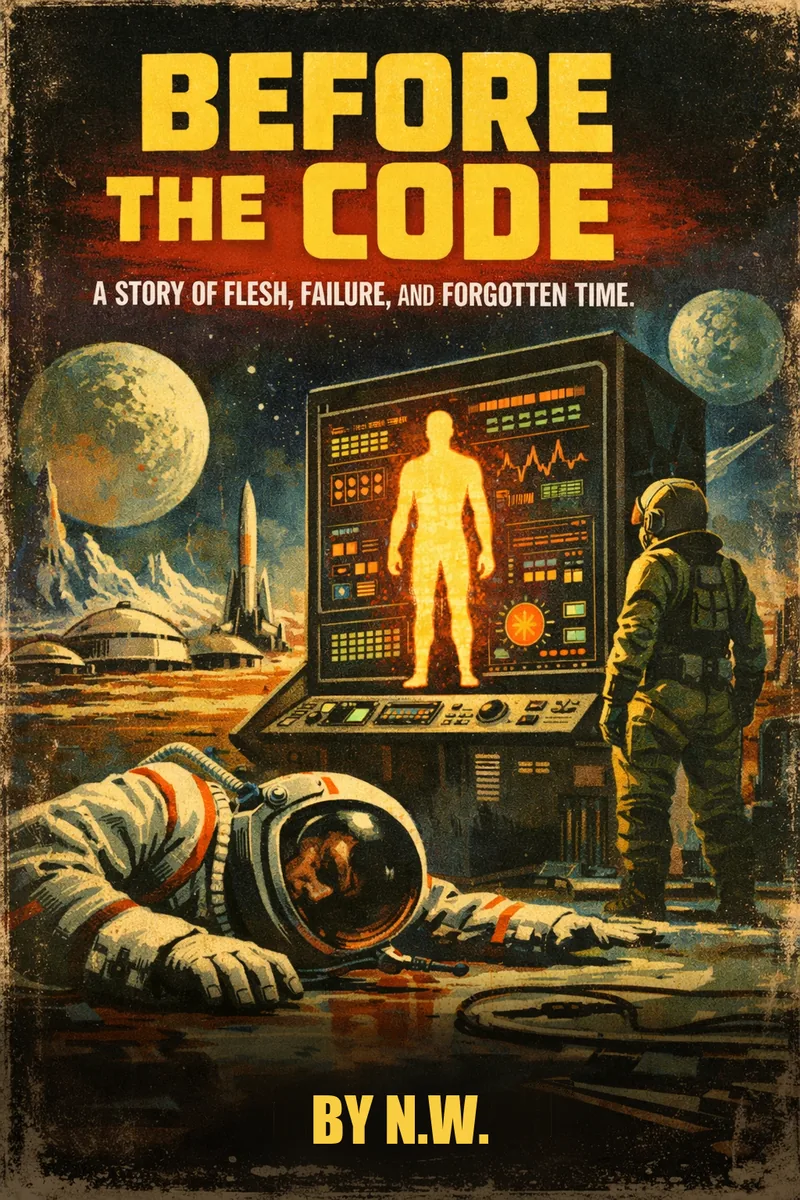
The fiction is not decoration. Life Atlas is a biological digital twin — a model of a person, kept current, used to rehearse a decision before it is lived with. Nobody has run one for a lifetime yet, so the only honest way to examine what that does to a family, a ward or a crew is to write it out and look at it. Before the Code opens on the case that started it: an infection that killed faster than the diagnosis could arrive.
Company Memory
Company memory — institutional knowledge as a living twin.
Read it →Extreme Collaboration
Extreme collaboration across agents and humans.
Read it →Healthcare Roadmap
A digital-twin roadmap for healthcare.
Read it →Lpi Protocol
The Life Programmable Interface — an open protocol for human digital twins.
Read it →Nri Tokyo
Network reality intelligence for Open RAN, applied to Tokyo.
Read it →Reconstruction Gap
The reconstruction gap — from reality capture to decisions.
Read it →Smile Digital Twins
The SMILE methodology for digital-twin readiness.
Read it →44 shorter pieces — the reading behind the stories.
The thinking, as it happens.
Daily signals on digital twins, physical AI and where the world is heading — on LinkedIn.
One call is enough to know if we're a fit.
Nobody brings the full stack of digital twin competence — organizational, global, change management, technology strategy, and a NASA JPL-derived method — the way we do. We bring the best people together for a company faster than anyone else, and we implement it with them.
An answer that takes nine months to verify gets verified against a reality that has moved on.
Scoping workshop from €4,500, credited in full against the project. See how scoping works